Rome and Jerusalem (1862)
Page 99 • Click to zoom
Page 99 of 264
79
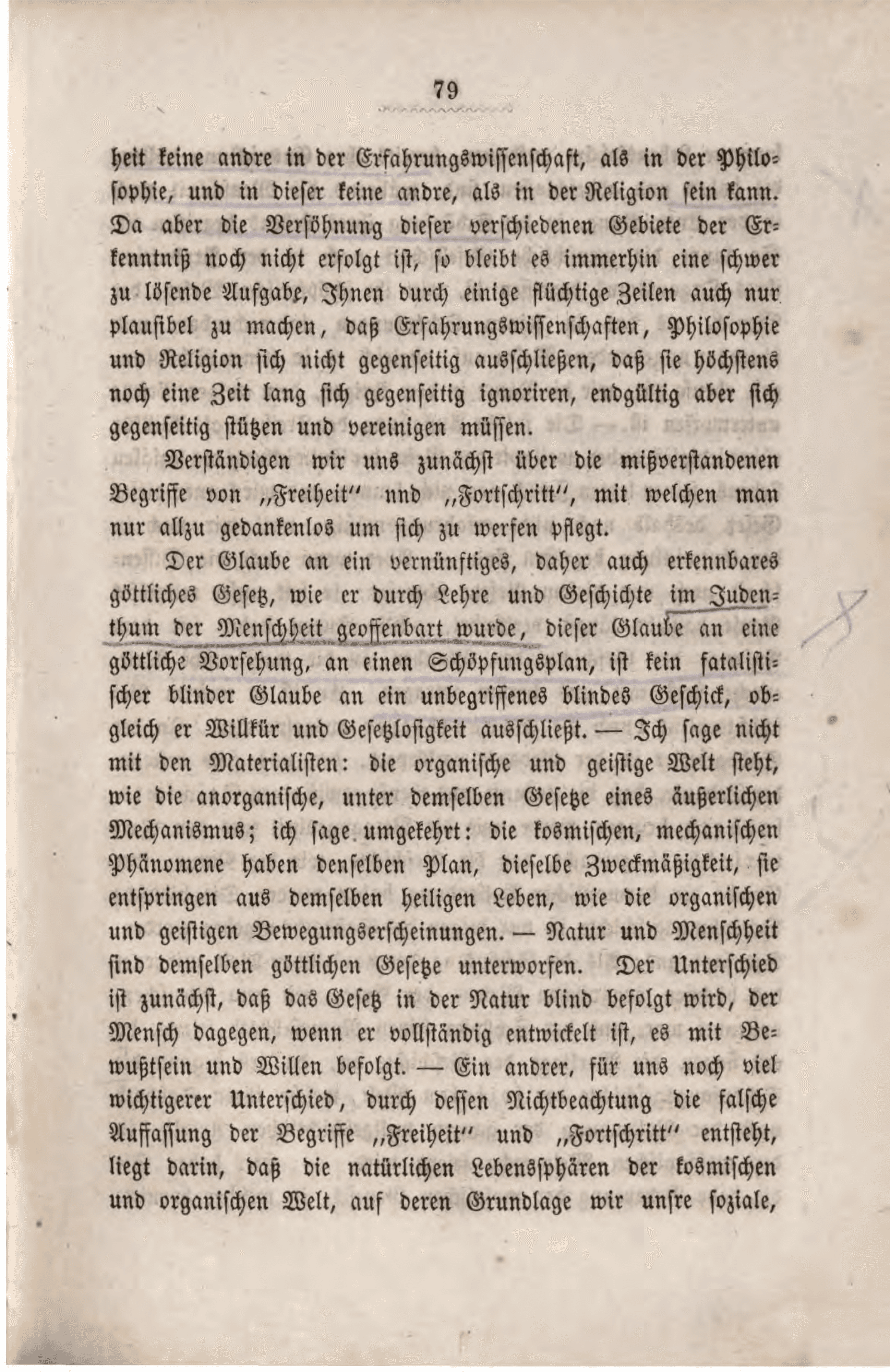
...ty none other in empirical science than in philosophy, and in this none other than in religion.
But since the reconciliation of these different fields of knowledge has not yet occurred, it remains a difficult task to make it plausible to you, even in just a few fleeting lines, that empirical sciences, philosophy, and religion do not mutually exclude one another; that they may at most ignore each other for a time, but must ultimately support and unite with one another.
Let us first come to an understanding of the misunderstood concepts of "Freedom" and "Progress," which are all too often bandied about thoughtlessly.
The belief in a rational, and therefore also knowable, divine law, as it was revealed to humanity through teaching and history in Judaism, this belief in a divine providence, in a plan of creation, is not a fatalistic blind faith in an incomprehensible blind destiny, although it does exclude arbitrariness and lawlessness. — I do not say, with the materialists: the organic and spiritual world stands, like the inorganic, under the same law of an external mechanism; I say, on the contrary: the cosmic, mechanical phenomena have the same plan, the same purposefulness, they spring from the same holy life as the organic and spiritual manifestations of movement. — Nature and humanity are subject to the same divine law. The difference, first, is that the law in nature is followed blindly, whereas man, when he is fully developed, follows it with consciousness and will. — Another difference, much more important for us, through the disregard of which the false conception of the terms "Freedom" and "Progress" arises, lies in the fact that the natural spheres of life of the cosmic and organic world, on whose foundation our social,
Show Original German Text
79 heit keine andre in der Erfahrungsmiſſenschaft, als in der Philoſophie, und in dieſer keine andre, als in der Religion ſeyn kann. Da aber die Verſöhnung dieſer verschiedenen Gebiete der Erkenntniß noch nicht erfolgt ist, ſo bleibt es immerhin eine schwer zu löſende Aufgabe, Ihnen durch einige flüchtige Zeilen auch nur plauſibel zu machen, daß Erfahrungsmiſſenschaften, Philoſophie und Religion ſich nicht gegenſeitig ausschließen, daß ſie höchstens noch eine Zeit lang ſich gegenſeitig ignonren, endgültig aber ſich gegenſeitig stützen und vereinigen müſſen. Verständigen wir uns zunächst über die mißverstandenen Begnffe von „Freiheit“ und „Fortschntt“, mit welchen man nur allzu gedankenloſ um ſich zu werfen pflegt. Der Glaube an ein vemünftiges, daher auch erkennbares göttliches Geſetz, wie er durch Lehre und Geschichte im Judenthum der Menschheit geoffenbart wurde, dieſer Glaube an eine göttliche Vorſehung, an einen Schöpfungsplan, ist kein fatalistischer blinder Glaube an ein unbegnffenes blindes Geschick, obgleich er Willkür und Geſetzloſigkeit ausschließt. — Ich ſage nicht mit den Matenalisten: die organische und geistige Welt steht, wie die anorganische, unter demſelben Geſetze eines äußerlichen Mechanismus; ich ſage umgekehrt: die koſmischen, mechanischen Phänomene haben denſelben Plan, dieſelbe Zweckmäßigſkeit, ſie entspnngen aus demſelben heiligen Leben, wie die organischen und geistigen Bewegungsscheinungen. — Natur und Menschheit ſind demſelben göttlichen Geſetze unterworfen. Der Unterschied ist zunächst, daß das Geſetz in der Natur blind befolgt wird, der Mensch dagegen, wenn er vollständig entwickelt ist, es mit Bewußtſein und Willen befolgt. — Ein andrer, für uns noch viel wichtigerer Unterschied, durch deſſen Nichtbeachtung die falsche Auffaſſung der Begnffe „Freiheit“ und „Fortschntt“ entsteht, liegt dann, daß die natürlichen Lebenssphären der koſmischen und organischen Welt, auf deren Grundlage wir unſre ſoziale,