Rome and Jerusalem (1862)
Page 96 • Click to zoom
Page 96 of 264
Tenth Letter.
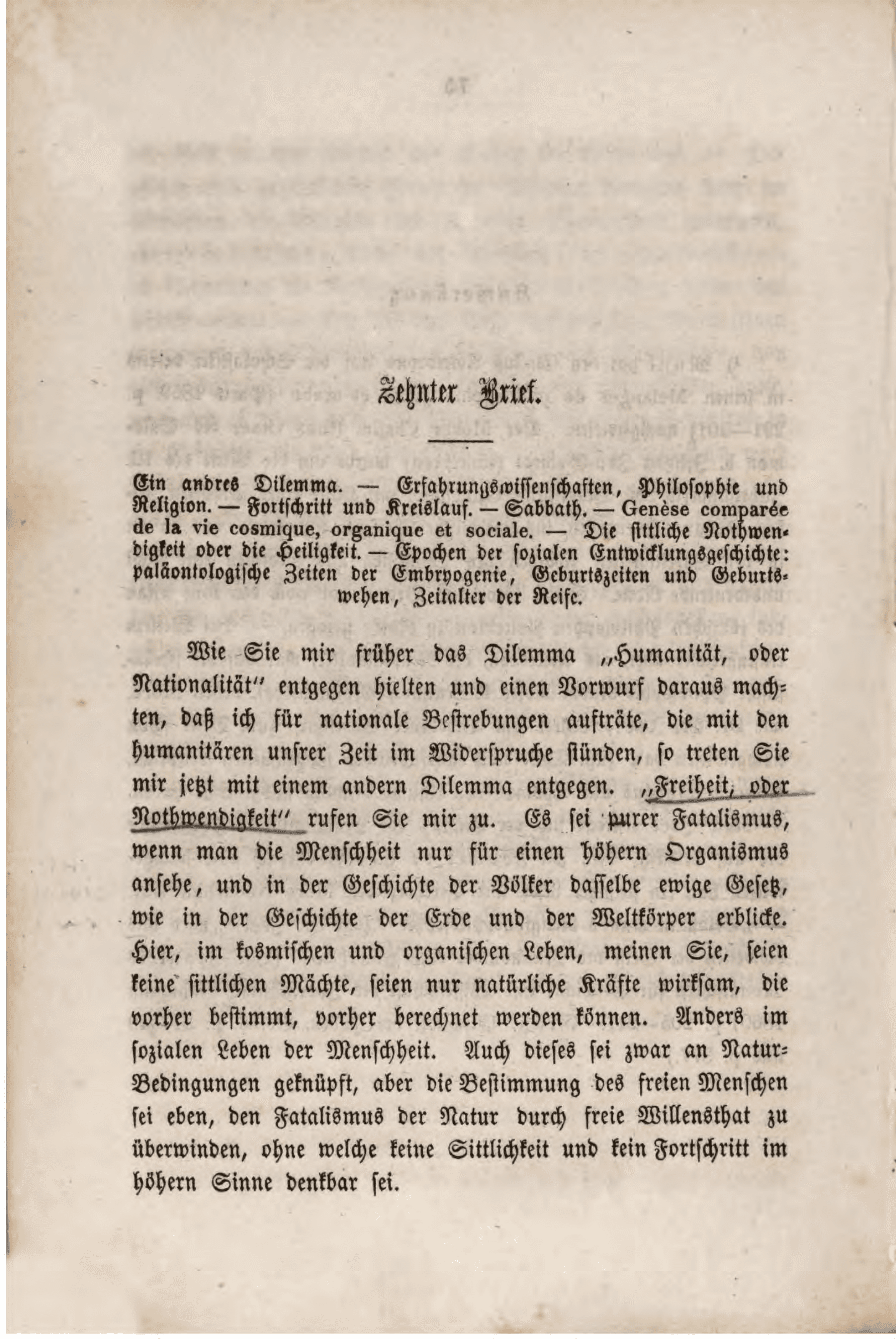
Another Dilemma. — Empirical sciences, philosophy and religion. — Progress and cycle. — Sabbath. — Genèse comparée de la vie cosmique, organique et sociale. — The moral necessity or holiness. — Epochs of social developmental history: paleontological times of embryogeny, times of birth and birth pangs, age of the journey.
Just as you previously confronted me with the dilemma "Humanity" or "Nationality" and reproached me for advocating national aspirations that were in contradiction with the humanitarian ones of our time, so you now confront me with another dilemma. "Freedom, or Necessity" you call out to me. It is pure fatalism, you say, if one regards humanity merely as a higher organism, and perceives in the history of peoples the same eternal law as in the history of the Earth and the celestial bodies. Here, in cosmic and organic life, you believe, there are no moral powers, only natural forces at work, which can be predetermined, pre-calculated. It is different in the social life of humanity. This too, is indeed tied to natural conditions, but the destiny of free man is precisely to overcome the fatalism of nature through free acts of will, without which no morality and no progress in the higher sense would be conceivable.
Show Original German Text
GV Zehnter Bnef. Ein andres Dilemma. — Erfahrungswiſſenschaften, Philoſophie und Religion. — Fortschntt und Kreislauf. — Sabbath. — Genèſe comparée de la vie cosmique, organique et ſociale. — Die ſittliche Nothwendigkeit oder die Heiligkeit. — Epochen der ſozialen Entwicklungsgeschichte: paläontologische Zeiten der Embryogenie, Geburtszeiten und Geburtswehen, Zeitalter der Reiſe. Wie Sie mir früher das Dilemma „Humanität“, oder „Nationalität“ entgegen hielten und einen Vorwurf daraus machten, daß ich für nationale Bestrebungen aufträte, die mit den humanitären unsrer Zeit im Widerspruche stünden, ſo treten Sie mir jetzt mit einem andem Dilemma entgegen. „Freiheit, oder **„Nothwendigkeit“** rufen Sie mir zu. Es ſei purer Fatalismus, wenn man die Menschheit nur für einen höhem Organismus anſehe, und in der Geschichte der Völker daſſelbe ewige Geſetz, wie in der Geschichte der Erde und der Weltkörper erblicke. Hier, im koſmischen und organischen Leben, meinen Sie, ſeien keine ſittlichen Mächte, ſeien nur natürliche Kräfte wirkſam, die vorher bestimmt, vorher berechnet werden können. Anders im ſozialen Leben der Menschheit. Auch dieſes ſei zwar an NaturBedingungen geknüpft, aber die Bestimung des freien Menschen ſei eben, den Fatalismus der Natur durch freie Willensthat zu überwinden, ohne welche keine Sittlichkeit und kein Fortschntt im höhem Sinne denkbar ſei.