Rome and Jerusalem (1862)
Page 89 • Click to zoom
Page 89 of 264
69
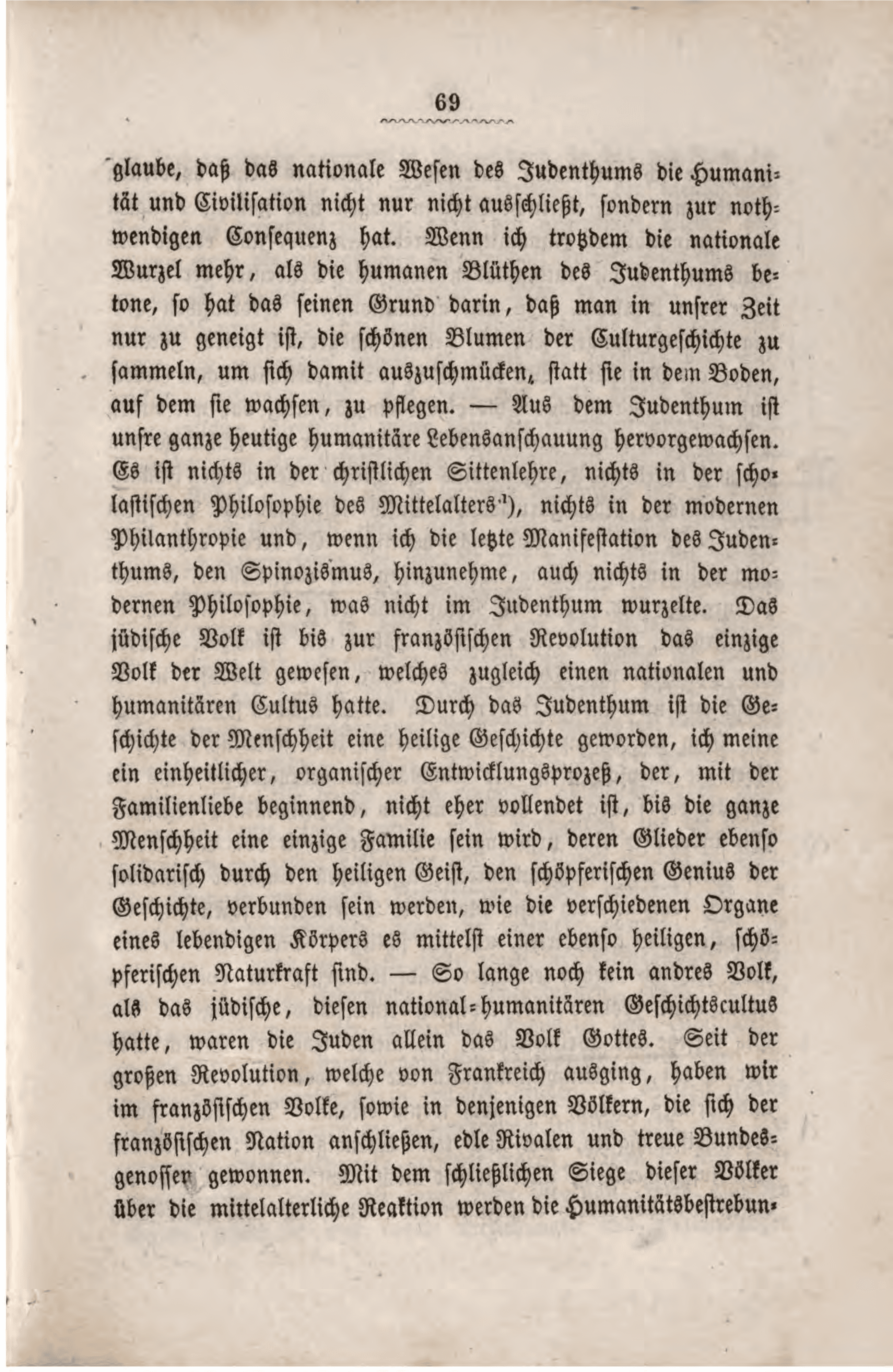
believe that the national essence of Judaism not only does not exclude humanity and civilization, but has them as a necessary consequence. If I nevertheless emphasize the national root more than the humane blossoms of Judaism, it is because in our time people are all too inclined to collect the beautiful flowers of cultural history to adorn themselves with them, instead of cultivating them in the soil in which they grow.
— Our entire modern humanitarian worldview has grown out of Judaism.
There is nothing in Christian moral teaching, nothing in the scholastic philosophy of the Middle Ages¹), nothing in modern philanthropy, and, if I add the last manifestation of Judaism, Spinozism, also nothing in modern philosophy that was not rooted in Judaism.
Until the French Revolution, the Jewish people were the only people in the world who had at the same time a national and a humanitarian cult.
Through Judaism, the history of humanity has become a sacred history, I mean a unified, organic process of development which, beginning with family love, will not be complete until all of humanity becomes a single family, whose members will be just as solidly united by the holy spirit, the creative genius of history, as the different organs of a living body are by means of an equally sacred, creative force of nature.
— As long as no other people than the Jewish people had this national-humanitarian cult of history, the Jews alone were the people of God.
Since the great Revolution that originated in France, we have gained noble rivals and loyal allies in the French people, as well as in those peoples who align themselves with the French nation. With the final victory of these peoples over the medieval reaction, the humanitarian strivings-
Show Original German Text
69 glaube, daß das nationale Wesen des Judenthums die Humanität und Civilisation nicht nur nicht ausschließt, sondem zur nothwendigen Consequenz hat. Wenn ich trotzdem die nationale Wurzel mehr, als die humanen Blüten des Judenthums betone, so hat das seinen Grund dann, daß man in unsrer Zeit nur zu geneigt ist, die schönen Blumen der Culturgeschichte zu sammeln, um sich damit auszuschmücken, statt sie in dem Boden, auf dem sie wachsen, zu pflegen. — Aus dem Judenthum ist unsre ganze heutige humanitäre Lebensanschauung hervorgewachsen. Es ist nichts in der chnstlichen Sittenlehre, nichts in der scholaftischen Philosophie des Mittelalters¹), nichts in der modemen Philanthropie und, wenn ich die letzte Manifestation des Judenthums, den Spinozismus, hinzunehme, auch nichts in der modemen Philosophie, was nicht im Judenthum wurzelte. Das jüdische Volk ist bis zur französischen Revolution das einzige Volk der Welt gewesen, welches zugleich einen nationalen und humanitären Cultus hatte. Durch das Judenthum ist die Geschichte der Menschheit eine heilige Geschichte geworden, ich meine ein einheitlicher, organischer Entwicklungsprozeß, der, mit der Familienliebe beginnend, nicht eher vollendet ist, bis die ganze Menschheit eine einzige Familie sein wird, deren Glieder ebenso solidansch durch den heiligen Geist, den schöpfenschen Genius der Geschichte, verbunden sein werden, wie die verschiedenen Organe eines lebendigen Körpers es mittelst einer ebenso heiligen, schöpfenschen Naturkraft sind. — So lange noch kein andres Volk, als das jüdische, diesen national-humanitären Geschichtscultus hatte, waren die Juden allein das Volk Gottes. Seit der großen Revolution, welche von Frankreich ausging, haben wir im französischen Volke, sowie in denjenigen Völkem, die sich der französischen Nation anschließen, edle Rivalen und treue Bundesgenossen gewonnen. Mit dem schließlichen Siege dieser Völker über die mittelalterliche Reaktion werden die Humanitätsbestrebun-