Rome and Jerusalem (1862)
Page 88 • Click to zoom
Page 88 of 264
Ninth Letter.
A Dilemma. — Sacred History of Humanity — Our Allies. — Unity of the Human Race. — Races and National Types. — Organism of Humanity. — Organ of Love.
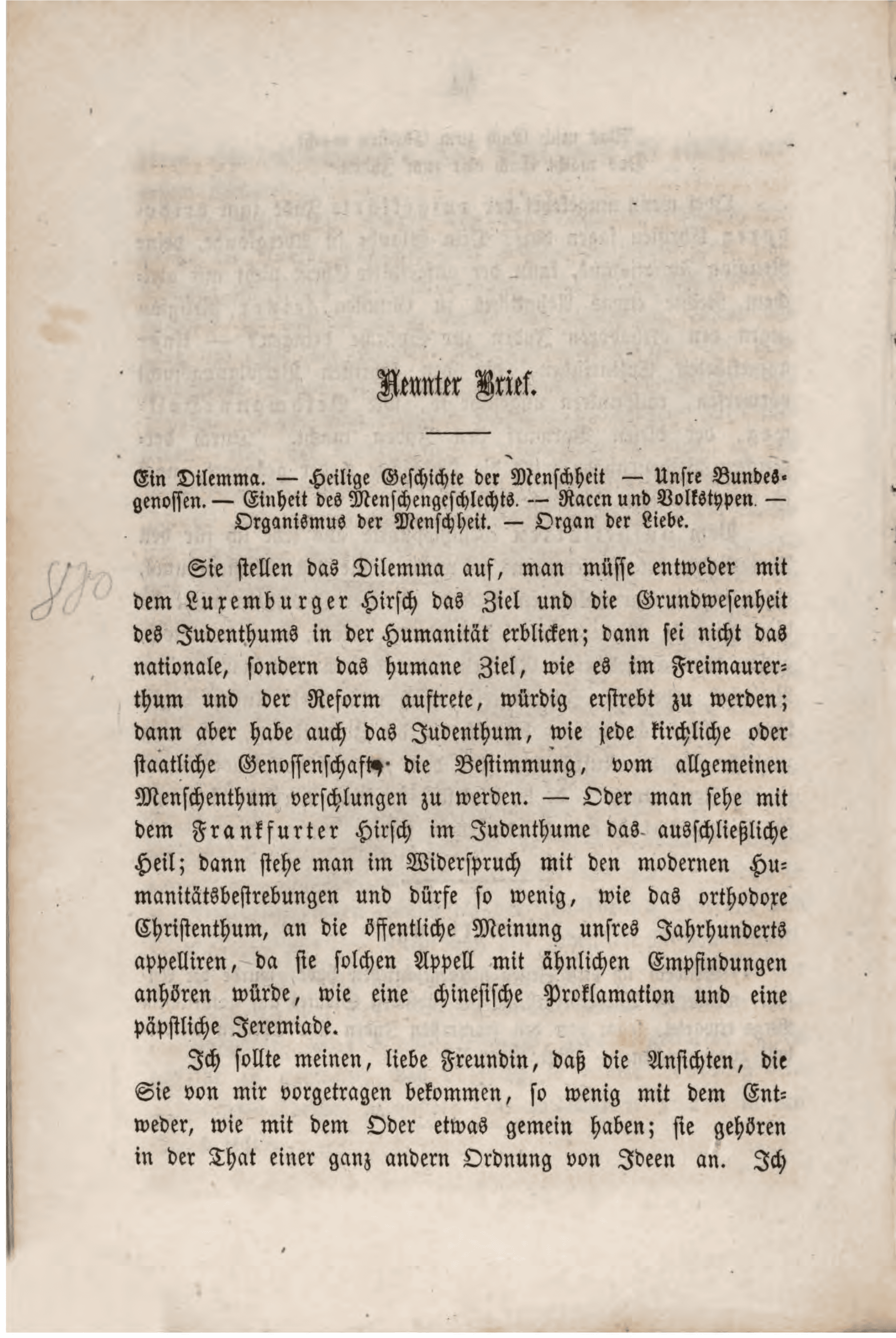
You propose the dilemma that one must either, with the Luxembourger Hirsch, see the goal and the fundamental essence of Judaism in humanity; then it is not the national, but the humane goal, as it appears in Freemasonry and the Reform movement, that is worthy of being pursued; but then Judaism, like every ecclesiastical or state association, would also be destined to be swallowed up by humanity in general. — Or one sees, with the Frankfurter Hirsch, the exclusive salvation in Judaism; then one stands in contradiction to modern humanitarian aspirations and could appeal to the public opinion of our century as little as orthodox Christianity, since it would listen to such an appeal with feelings similar to those for a Chinese proclamation and a papal jeremiad.
I should think, dear friend, that the views you have heard presented by me have as little in common with the 'Either' as with the 'Or'; they belong, in fact, to a completely different order of ideas.
Show Original German Text
# Neunter Bnef. — Ein Dilemma. — Heilige Geschichte der Menschheit — Unsre Bundesgenoſſen. — Einheit des Menschengeschlechts. — Racen und Volkstypen. — Organismus der Menschheit. — Organ der Liebe. Sie stellen das Dilemma auf, man müſſe entweder mit dem Luxemburger Hirsch das Ziel und die Grundweſenheit des Judenthums in der Humanität erblicken; dann ſei nicht das nationale, ſondem das humane Ziel, wie es im Freimaurerthum und der Reform auftrete, würdig erstrebt zu werden; dann aber habe auch das Judenthum, wie jede kirchliche oder staatliche Genoſſenschaft, die Bestimmung, vom allgemeinen Menschenthum verschlungen zu werden. — Oder man ſehe mit dem Frankfurter Hirsch im Judenthume das ausschließliche Heil; dann stehe man im Widerspruch mit den modemen Humanitätsbestrebungen und dürfe ſo wenig, wie das orthodoxe Chnstenthum, an die öffentliche Meinung unfres Jahrhunderts appelliren, da ſie ſolchen Appell mit ähnlichen Empfindungen anhören würde, wie eine chineſische Proklamation und eine päpstliche Jeremiade. Ich ſollte meinen, liebe Freundin, daß die Anſichten, die Sie von mir vorgetragen bekommen, ſo wenig mit dem Entweder, wie mit dem Oder etwas gemein haben; ſie gehören in der That einer ganz andem Ordnung von Ideen an. Ich