Rome and Jerusalem (1862)
Page 81 • Click to zoom
Page 81 of 264
61
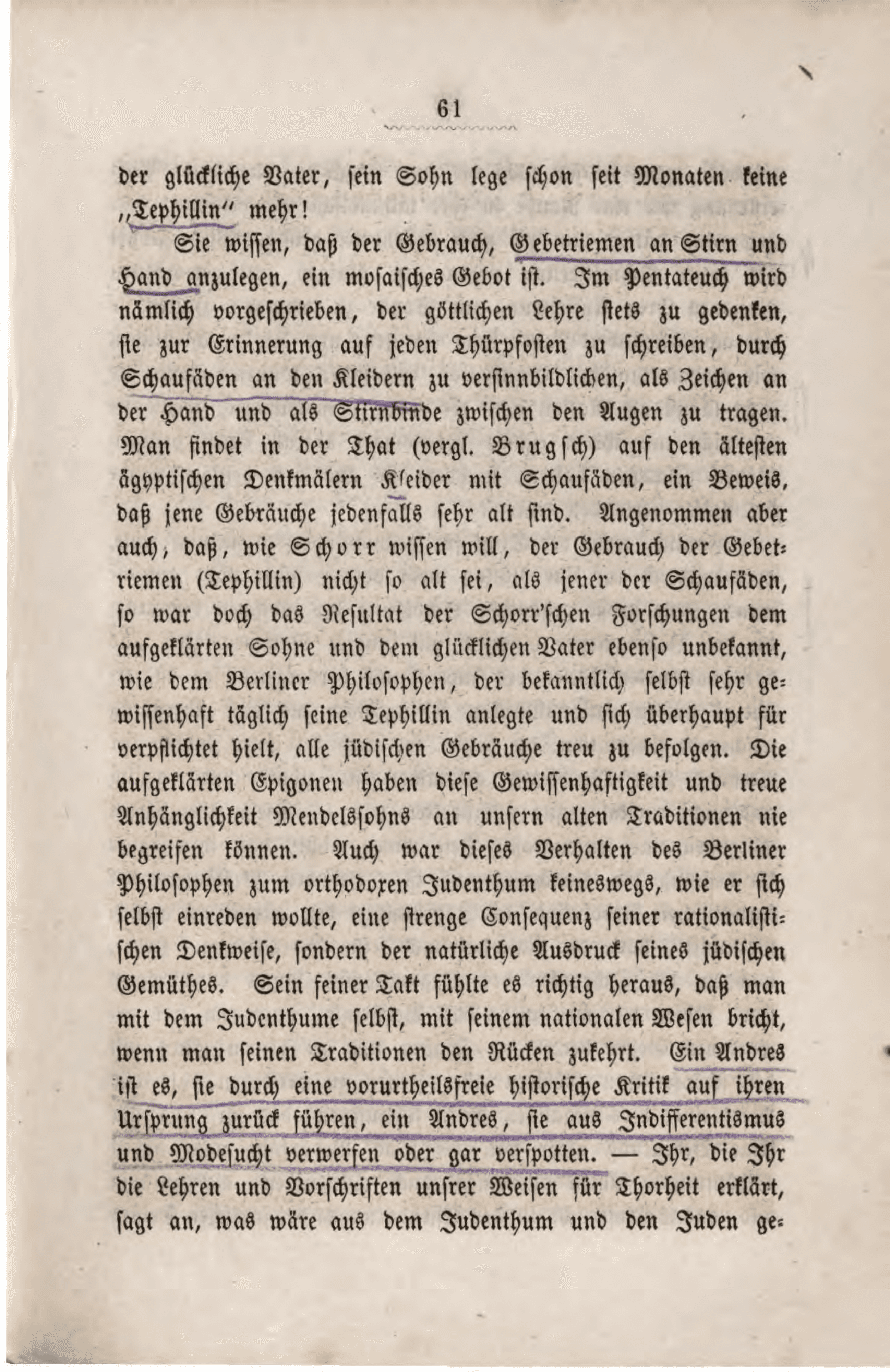
the happy father, that his son has not put on "Tephillin" for months!
You know that the custom of putting on prayer straps on the forehead and hand is a Mosaic commandment. For in the Pentateuch it is prescribed to always remember the divine teaching, to write it on every doorpost as a reminder, to symbolize it by show-threads on the clothes, to wear it as a sign on the hand and as a frontlet between the eyes. One does indeed find (cf. Brugsch) clothes with show-threads on the oldest Egyptian monuments, a proof that those customs are in any case very old.
But even assuming that, as Schorr would have it, the use of prayer straps (Tephillin) is not as old as that of the show-threads, the result of Schorr's research was just as unknown to the enlightened son and the happy father as it was to the Berlin philosopher, who, as is well known, very conscientiously put on his Tephillin daily himself and considered himself obligated to faithfully follow all Jewish customs.
The enlightened epigones have never been able to comprehend this conscientiousness and faithful adherence of Mendelssohn to our old traditions.
Nor was this behavior of the Berlin philosopher towards orthodox Judaism by any means, as he wanted to persuade himself, a strict consequence of his rationalistic way of thinking, but rather the natural expression of his Jewish spirit. His fine tact correctly sensed that one breaks with Judaism itself, with its national essence, when one turns one's back on its traditions.
It is one thing to trace them back to their origin through unprejudiced historical criticism; it is another to reject or even mock them out of indifference and a craving for fashion. — You who declare the teachings and precepts of our Sages to be foolishness, tell us, what would have become of Judaism and the Jews—
Show Original German Text
61 der glückliche Vater, ſein Sohn lege schon ſeit Monaten keine „Tephillin“ mehr! Sie wiſſen, daß der Gebrauch, Gebetnemen an Stim und Hand anzulegen, ein mosaisches Gebot ist. Im Pentateuch wird nämlich vorgeschneben, der göttlichen Lehre stets zu gedenken, ſie zur Ennnerung auf jeden Thürpfosten zu schreiben, durch Schauſäden an den Kleidem zu verſinnbildlichen, als Zeichen an der Hand und als Stimbinde zwischen den Augen zu tragen. Man findet in der That (vergl. Brugsch) auf den ältesten ägyptischen Denkmälem Kleider mit Schauſäden, ein Beweis, daß jene Gebräuche jedenfalls ſehr alt ſind. Angenommen aber auch, daß, wie Schorr wiſſen will, der Gebrauch der Gebet- nemen (Tephillin) nicht ſo alt ſei, als jener der Schauſäden, ſo war doch das Reſultat der Schorr'schen Forschungen dem aufgeklärten Sohne und dem glücklichen Vater ebenſo unbekannt, wie dem Berliner Philoſophen, der bekanntlich ſelbst ſehr gewiſſenhaft täglich ſeine Tephillin anlegte und ſich überhaupt für verpflichtet hielt, alle jüdischen Gebräuche treu zu befolgen. Die aufgeklärten Epigonen haben dieſe Gewiſſenhaftigkeit und treue Anhänglichkeit Mendelsſohns an unſem alten Traditionen nie begreifen können. Auch war dieſes Verhalten des Berliner Philoſophen zum orthodoren Judenthum keineswegs, wie er ſich ſelbst einreden wollte, eine strenge Conſequenz ſeiner rationalistischen Denkweiſe, ſondem der natürliche Ausdruck ſeines jüdischen Gemüthes. Sein ſeiner Takt fühlte es nchtig heraus, daß man mit dem Judenthume ſelbst, mit ſeinem nationalen Weſen bncht, wenn man ſeinen Traditionen den Rücken zukehrt. Ein Andres ist es, ſie durch eine vorurtheilsfreie histonsche Kntik auf ihren Ursprung zurück zu führen, ein Andres, ſie aus Indifferentismus und Modeſucht verwerfen oder gar verspotten. — Ihr, die Ihr die Lehren und Vorschnften unſrer Weiſen für Thorheit erklärt, ſagt an, was wäre aus dem Judenthum und den Juden ge-