Rome and Jerusalem (1862)
Page 29 • Click to zoom
Page 29 of 264
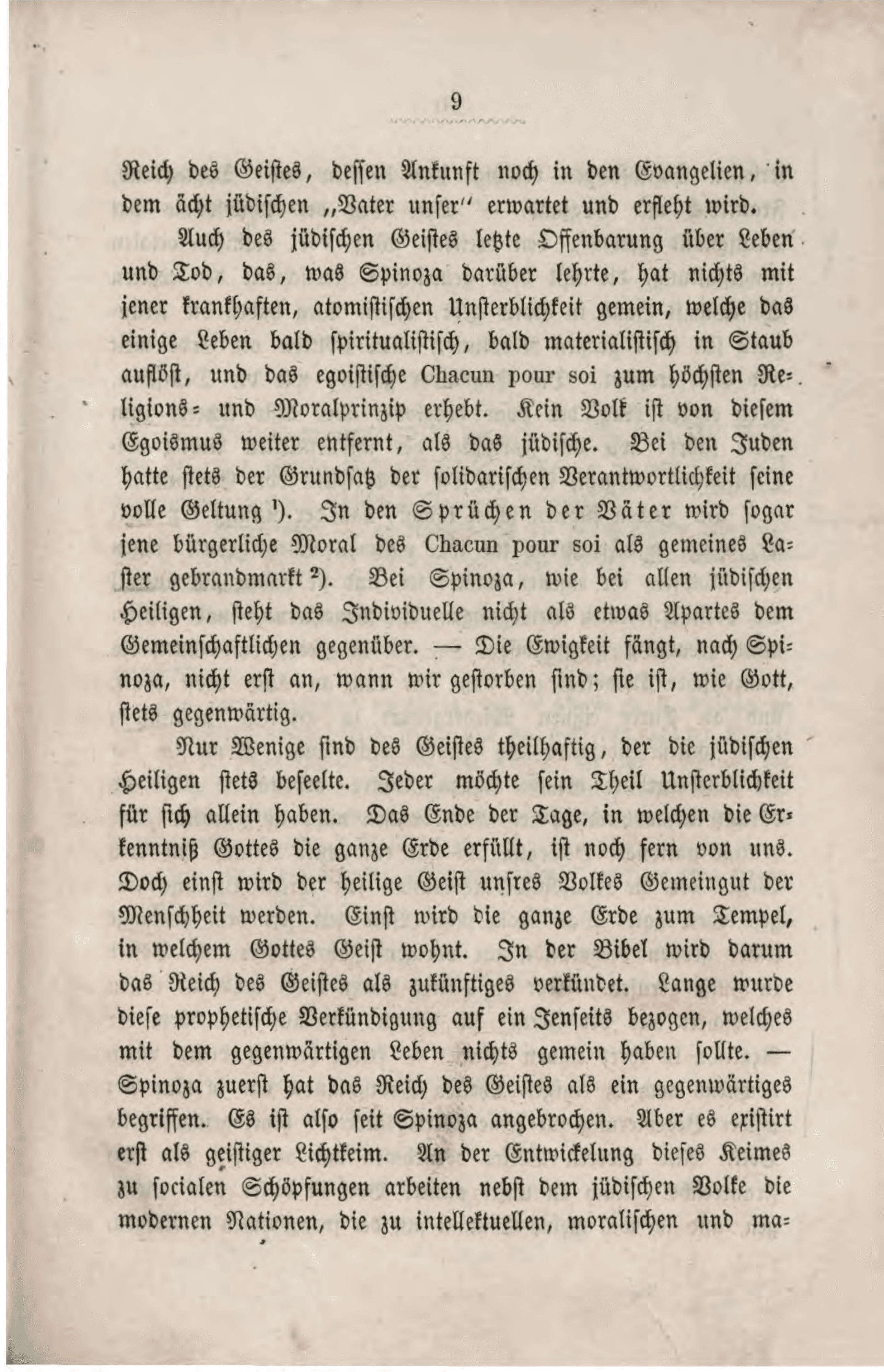
Kingdom of the Spirit, whose arrival is still awaited and longed for in the Gospels, in the truly Jewish "Our Father."
Also the final revelation of the Jewish spirit concerning life and death, that which Spinoza taught about it, has nothing in common with that morbid, atomistic immortality, which dissolves the one life, sometimes spiritualistically, sometimes materialistically, into dust, and elevates the egoistic Chacun pour soi to the highest principle of religion and morality. No people is further removed from this egoism than the Jewish people. Among the Jews, the principle of solidary responsibility always held its full validity ¹). In the Sayings of the Fathers, that bourgeois morality of Chacun pour soi is even branded as a common vice ²). With Spinoza, as with all Jewish saints, the individual does not stand opposite the communal as something separate. — Eternity, according to Spinoza, does not first begin when we have died; it is, like God, always present.
Only a few partake of the spirit that always animated the Jewish saints. Everyone would like to have their share of immortality for themselves alone. The end of days, in which the knowledge of God fills the whole earth, is still far from us. But one day the holy spirit of our people will become the common property of humanity. One day the whole earth will become a temple in which God's spirit dwells. In the Bible, the kingdom of the spirit is therefore proclaimed as a future one. For a long time, this prophetic proclamation was related to a hereafter, which was to have nothing in common with the present life. — Spinoza was the first to conceive of the kingdom of the spirit as a present one. It has therefore dawned since Spinoza. But it exists at first only as a spiritual seed of light. Working on the development of this seed into social creations are, besides the Jewish people, the modern nations, which are becoming intellectual, moral, and ma-
Show Original German Text
9 Reich des Geistes, dessen Ankunft noch in den Evangelien, in dem ächt jüdischen „Vater unſer“ erwartet und erſeht wird. Auch des jüdischen Geistes lehte Offenbarung über Leben und Tod, das, was Spinoza darüber lehrte, hat nichts mit jener krankhaften, atomistischen Unsterblichkeit gemein, welche das einige Leben bald spintualistisch, bald matenalistisch in Staub auflöst, und das egoistische Chacun pour soi zum höchsten Re- ligions- und Moralpnnzip erhebt. Kein Volk ist von diesem Egoismus weiter entfemt, als das jüdische. Bei den Juden hatte stets der Grundsaß der solidanschen Verantwortlichkeit seine volle Geltung ¹). In den Sprüchen der Väter wird sogar jene bürgerliche Moral des Chacun pour soi als gemeines La- ster gebrandmarkt ²). Bei Spinoza, wie bei allen jüdischen Heiligen, steht das Individuelle nicht als etwas Apartes dem Gemeinschaftlichen gegenüber. — Die Ewigkeit fängt, nach Spi- noza, nicht erst an, wann wir gestorben sind; sie ist, wie Gott, stets gegenwärtig. Nur Wenige sind des Geistes theilhaftig, der die jüdischen Heiligen stets beseelte. Jeder möchte sein Theil Unsterblichkeit für sich allein haben. Das Ende der Tage, in welchen die Er- kenntniß Gottes die ganze Erde erfüllt, ist noch fem von uns. Doch einst wird der heilige Geist unſres Volkes Gemeingut der Menschheit werden. Einst wird die ganze Erde zum Tempel, in welchem Gottes Geist wohnt. In der Bibel wird darum das Reich des Geistes als zukünftiges verkündet. Lange wurde diese prophetische Verkündigung auf ein Jenseits bezogen, welches mit dem gegenwärtigen Leben nichts gemein haben sollte. — Spinoza zuerst hat das Reich des Geistes als ein gegenwärtiges begnffen. Es ist also seit Spinoza angebrochen. Aber es existirt erst als geistiger Lichtkeim. An der Entwicklung dieses Keimes zu socialen Schöpfungen arbeiten nebst dem jüdischen Volke die modemen Nationen, die zu intellektuellen, moralischen und ma-