Rome and Jerusalem (1862)
Page 249 • Click to zoom
Page 249 of 264
229
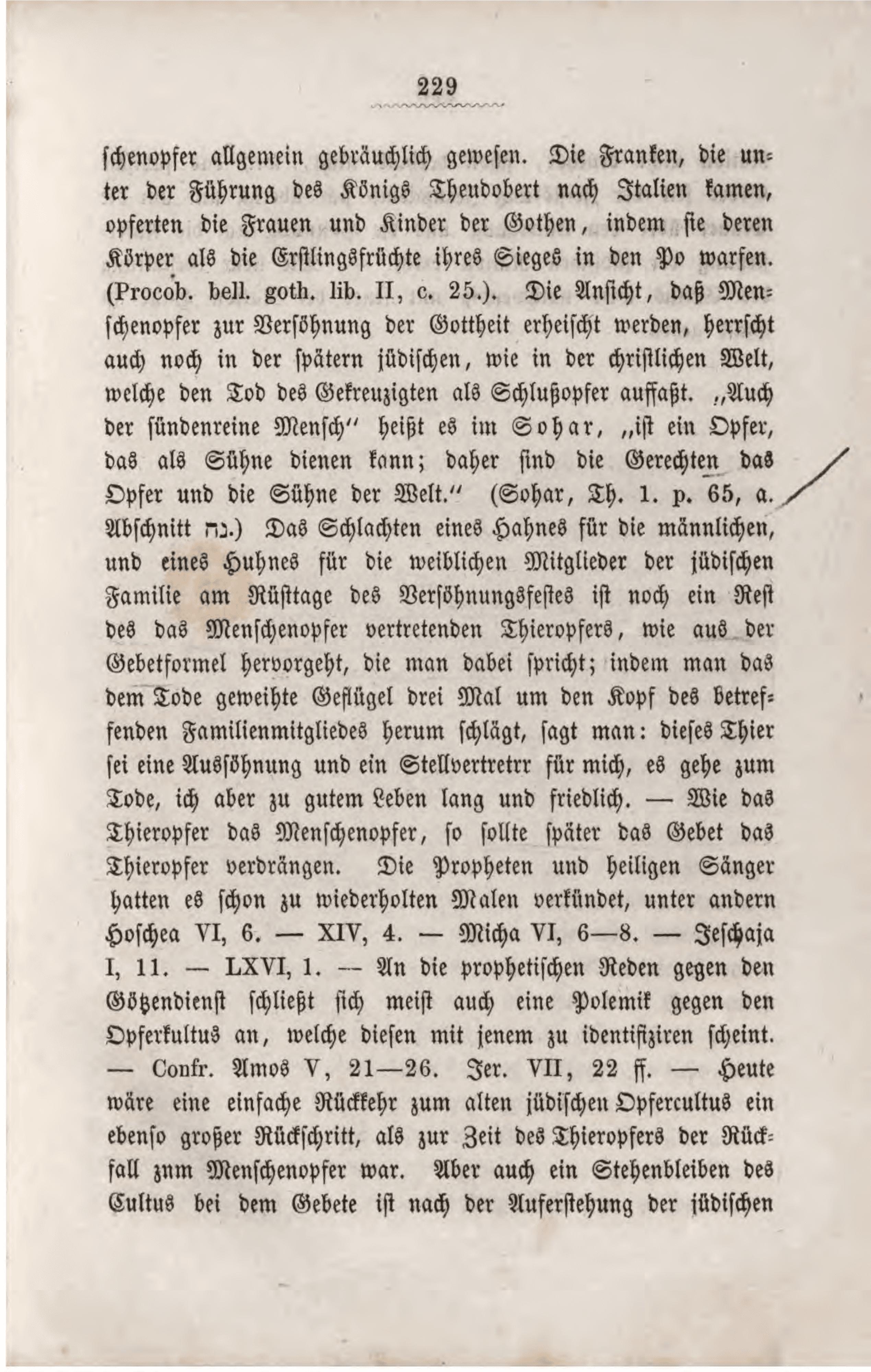
human sacrifices were common practice. The Franks, who came to Italy under the leadership of King Theudobert, sacrificed the women and children of the Goths by throwing their bodies into the Po as the first fruits of their victory. (Procop. bell. goth. lib. II, c. 25.) The view that human sacrifices are required for atonement with the deity still prevails in the later Jewish, as well as in the Christian world, which regards the death of the Crucified as a final sacrifice. "Even the sinless man," it says in the Zohar, "is a sacrifice that can serve as atonement; therefore the righteous are the sacrifice and the atonement of the world." (Zohar, Part 1. p. 65, a. Section 72.) The slaughter of a rooster for the male, and a hen for the female members of the Jewish family on the eve of the Day of Atonement is still a remnant of the animal sacrifice that replaced human sacrifice, as is evident from the prayer formula spoken during it; while striking the fowl destined for death three times around the head of the respective family member, one says: this animal is an atonement and a substitute for me, it goes to death, but I to a good, long, and peaceful life.
— Just as animal sacrifice replaced human sacrifice, so later prayer was to supplant animal sacrifice. The prophets and holy singers had already proclaimed it on repeated occasions, among others Hosea VI, 6. — XIV, 4. — Micah VI, 6–8. — Isaiah I, 11. — LXVI, 1.
— The prophetic speeches against idolatry are usually also followed by a polemic against the sacrificial cult, which seems to identify the latter with the former.
— C.f. Amos V, 21–26. Jer. VII, 22 ff.
— Today, a simple return to the old Jewish sacrificial cult would be just as great a regression as the relapse into human sacrifice was at the time of animal sacrifice. But for the cult to remain at prayer is also, after the resurrection of the Jewish...
Show Original German Text
229 schenopfer allgemein gebräuchlich geweſen. Die Franken, die unter der Führung des Königs Theudobert nach Italien kamen, opferten die Frauen und Kinder der Gothen, indem ſie deren Körper als die Erstlingsfrüchte ihres Sieges in den Po warfen. (Procob. bell. goth. lib. II, c. 25.) Die Anſicht, daß Menschenopfer zur Verſöhnung der Gottheit erheischt werden, herrscht auch noch in der spätem jüdischen, wie in der chnstlichen Welt, welche den Tod des Gekreuzigten als Schlußopfer auffaßt. „Auch der ſündenreine Mensch“ heißt es im Sohar, „ist ein Opfer, das als Sühne dienen kann; daher ſind die Gerechten das Opfer und die Sühne der Welt.“ (Sohar, Th. 1. p. 65, a. Abschnitt 72.) Das Schlachten eines Hahnes für die männlichen, und eines Huhnes für die weiblichen Mitglieder der jüdischen Familie am Rüsttage des Verſöhnungsfestes ist noch ein Rest des das Menschenopfer vertretenden Thieropfers, wie aus der Gebetsformel hervorgeht, die man dabei spncht; indem man das dem Tode geweihte Geflügel drei Mal um den Kopf des betreffenden Familienmitgliedes herum schlägt, ſagt man: dieſes Thier ſei eine Ausſöhnung und ein Stellvertretrr für mich, es gehe zum Tode, ich aber zu gutem Leben lang und fnedlich. — Wie das Thieropfer das Menschenopfer, ſo ſollte später das Gebet das Thieropfer verdrängen. Die Propheten und heiligen Sänger hatten es schon zu wiederholten Malen verkündet, unter andem Hoschea VI, 6. — XIV, 4. — Micha VI, 6—8. — Jeschaja I, 11. — LXVI, 1. — An die prophetischen Reden gegen den Götzendienst schließt ſich meist auch eine Polemik gegen den Opferkultus an, welche dieſen mit jenem zu identifiziren scheint. — Confr. Amos V, 21—26. Jer. VII, 22 ff. — Heute wäre eine einfache Rückkehr zum alten jüdischen Opfercultus ein ebenſo großer Rückschntt, als zur Zeit des Thieropfers der Rückfall zum Menschenopfer war. Aber auch ein Stehenbleiben des Cultus bei dem Gebete ist nach der Auferstehung der jüdischen