Rome and Jerusalem (1862)
Page 230 • Click to zoom
Page 230 of 264
210
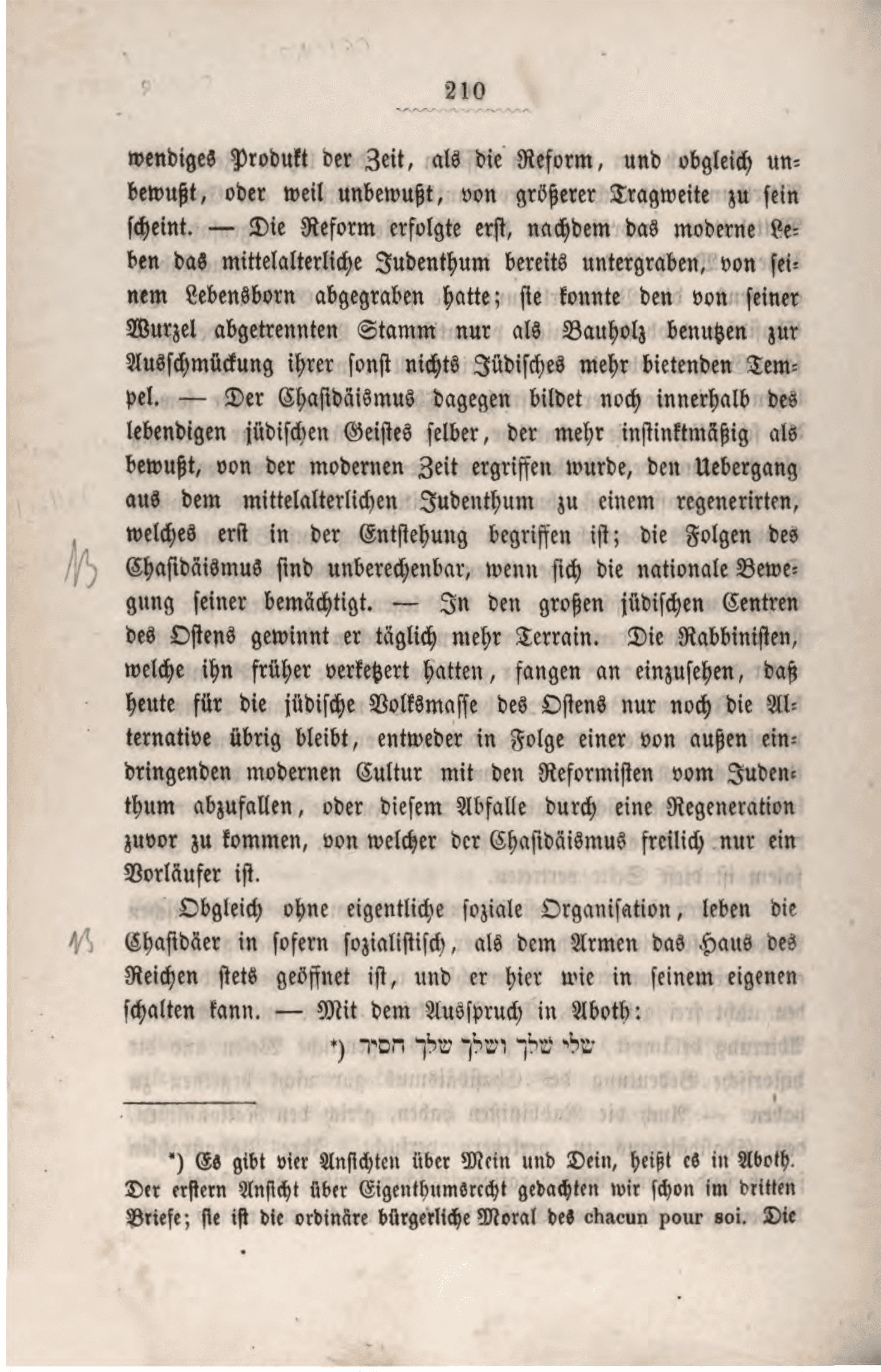
necessary product of the times than the Reform, and although unconscious, or because it is unconscious, appears to be of greater consequence. — The Reform only occurred after modern life had already undermined medieval Judaism, had dug it away from its fount of life; it could only use the trunk, severed from its root, as timber for the embellishment of its temples, which otherwise offered nothing Jewish anymore. — Hasidism, on the other hand, still forms, within the living Jewish spirit itself—which was seized by the modern age more instinctively than consciously—the transition from medieval Judaism to a regenerated one, which is only just in the process of coming into being; the consequences of Hasidism are incalculable if the national movement takes hold of it. — In the great Jewish centers of the East, it gains more ground daily. The Rabbinists, who had previously declared it heretical, are beginning to see that today, for the Jewish masses of the East, only the alternative remains: either to fall away from Judaism with the Reformists as a result of a modern culture penetrating from the outside, or to preempt this apostasy through a regeneration, of which Hasidism is, of course, only a forerunner.
Although without any real social organization, the Hasidim live socialistically, insofar as the house of the rich is always open to the poor, and he can act there as if in his own. — With the saying in Avot: (שלך שלך ושלי שלי) *)
*) There are four views concerning 'mine and thine,' it says in Avot. The first view on property rights we have already mentioned in the third letter; it is the ordinary bourgeois morality of chacun pour soi. The
Show Original German Text
210 wendiges Produkt der Zeit, als die Reform, und obgleich unbewußt, oder weil unbewußt, von größerer Tragweite zu ſein scheint. — Die Reform erfolgte erst, nachdem das modeme Leben das mittelalterliche Judenthum bereits untergraben, von ſeinem Lebensbom abgegraben hatte; ſie konnte den von ſeiner Wurzel abgetrennten Stamm nur als Bauholz benußen zur Ausschmückung ihrer ſonst nichts Jüdisches mehr bietenden Tempel. — Der Chaſidäismus dagegen bildet noch innerhalb des lebendigen jüdischen Geistes selber, der mehr instinktmäßig als bewußt, von der modemen Zeit ergnffen wurde, den Uebergang aus dem mittelalterlichen Judenthum zu einem regenenrten, welches erst in der Entstehung begnffen ist; die Folgen des Chaſidäismus sind unberechenbar, wenn ſich die nationale Bewegung ſeiner bemächtigt. — In den großen jüdischen Centren des Ostens gewinnt er täglich mehr Terrain. Die Rabbinisten, welche ihn früher verketzert hatten, fangen an einzuſehen, daß heute für die jüdische Volksmaſſe des Ostens nur noch die Altemative übng bleibt, entweder in Folge einer von außen eindnngenden modemen Cultur mit den Reformisten vom Judenthum abzufallen, oder dieſem Abfalle durch eine Regeneration zuvor zu kommen, von welcher der Chaſidäismus freilich nur ein Vorläufer ist. Obgleich ohne eigentliche ſoziale Organiſation, leben die Chaſidäer in ſofem ſozialistisch, als dem Armen das Haus des Reichen stets geöffnet ist, und er hier wie in ſeinem eigenen schalten kann. — Mit dem Ausspruch in Aboth: (שלשלשלח הסירה ) *) *) Es gibt vier Ansichten über Mein und Dein, heißt es in Aboth. Der erstem Anſicht über Eigenthumsrecht gedachten wir schon im dntten Bnefe; ſie ist die ordinäre bürgerliche Moral des chacun pour soi. Die