Rome and Jerusalem (1862)
Page 220 • Click to zoom
Page 220 of 264
200
...could, without denying the humane creator in history, bring a more comforting view of life into the ruins of a self-annihilating world through the hope of its eventual rebirth.
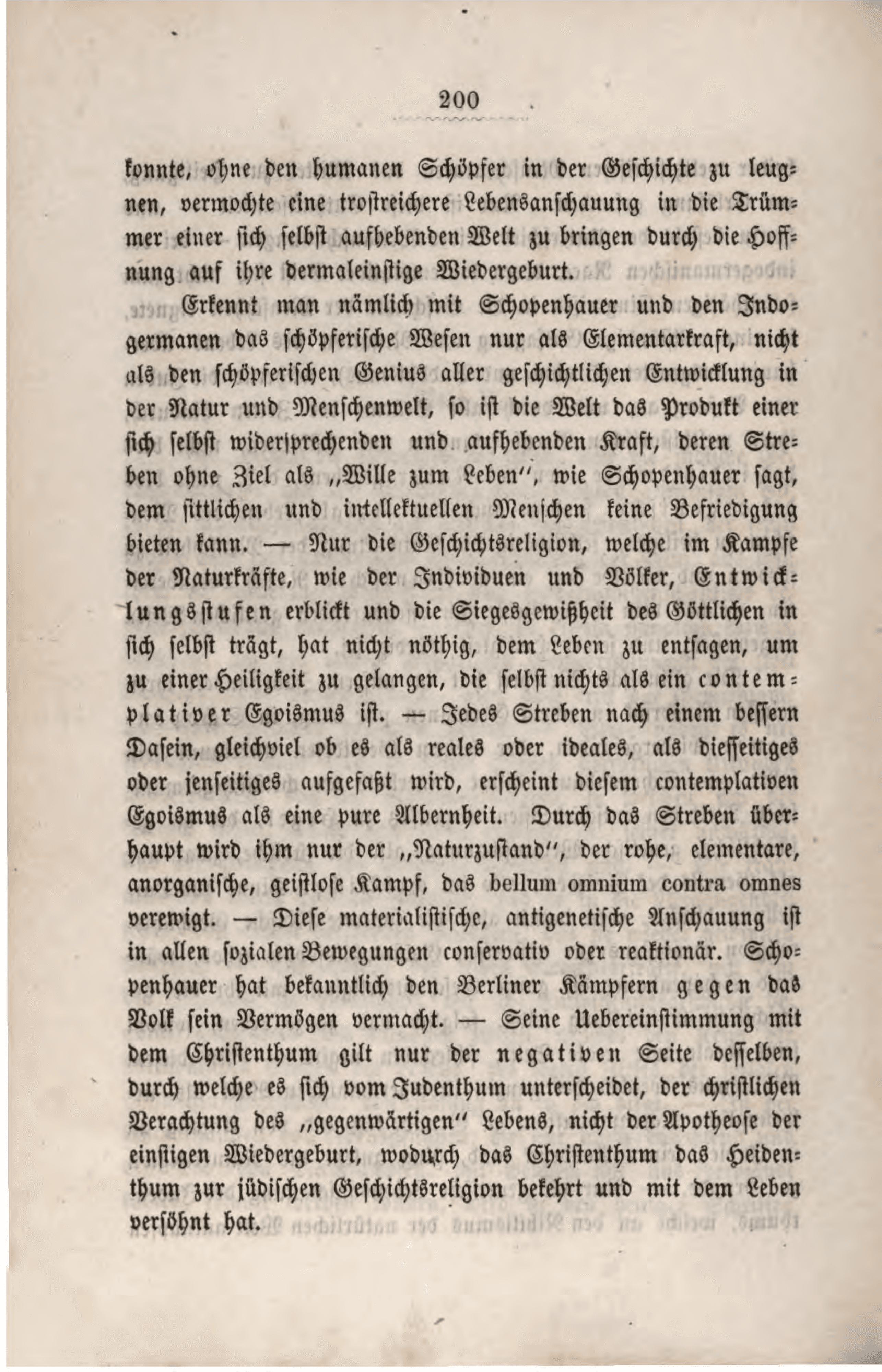
For if one, with Schopenhauer and the Indo-Germans, recognizes the creative essence merely as an elemental force, not as the creative genius of all historical development in the world of nature and man, then the world is the product of a self-contradicting and self-annihilating force, whose striving without a goal as the “Will to Live,” as Schopenhauer says, can offer no satisfaction to the moral and intellectual man. — Only the religion of history, which perceives stages of development in the struggle of natural forces, as of individuals and peoples, and which carries within itself the certainty of the victory of the divine, does not need to renounce life in order to attain a sanctity that is itself nothing but a contemplative egoism. — Every striving for a better existence, regardless of whether it is conceived as real or ideal, as of this world or the next, appears to this contemplative egoism as pure foolishness. Through striving in general, only the “state of nature”—the raw, elemental, anorganic, spiritless struggle, the bellum omnium contra omnes—is perpetuated for it. — This materialistic, anti-genetic view is conservative or reactionary in all social movements. Schopenhauer, as is well known, bequeathed his fortune to the Berlin fighters against the people. — His agreement with Christianity applies only to its negative side, by which it distinguishes itself from Judaism—the Christian contempt for “present” life—not to the apotheosis of the future rebirth, through which Christianity converted paganism to the Jewish religion of history and reconciled it with life.
Show Original German Text
200 konnte **ohne** den humanen Schöpfer in der Geschichte zu leugnen, vermochte eine trostreichere Lebensanschauung in die Trümmer einer ſich ſelbst aufhebenden Welt zu bnngen durch die Hoffnung auf ihre dermaleinstige Wiedergeburt. Erkennt man nämlich mit Schopenhauer und den Indogermanen das schöpfensche Weſen nur als Elementarkraft, nicht als den schöpfenschen Genius aller geschichtlichen Entwicklung in der Natur und Menschenwelt, ſo ist die Welt das Produkt einer ſich ſelbst widersprechenden und aufhebenden Kraft, deren Streben ohne Ziel als „Wille zum Leben“, wie Schopenhauer ſagt, dem ſittlichen und intellektuellen Menschen keine Befnedigung bieten kann. — Nur die Geschichtsreligion, welche im Kampfe der Naturkräfte, wie der Individuen und Völker, Entwicklungsstufen erblickt und die Siegesgewißheit des Göttlichen in ſich ſelbst trägt, hat nicht nöthig, dem Leben zu entſagen, um zu einer Heiligkeit zu gelangen, die ſelbst nichts als ein contemplativer Egoismus ist. — Jedes Streben nach einem beſſem Daſein, gleichviel ob es als reales oder ideales, als diesſeitiges oder jenſeitiges aufgefaßt wird, erscheint dieſem contemplativen Egoismus als eine pure Albemheit. Durch das Streben überhaupt wird ihm nur der „Naturzustand“, der rohe, elementare, anorganische, geistloſe Kampf, das bellum omnium contra omnes verewigt. — Dieſe matenalistische, antigeneſſische Anschauung ist in allen ſozialen Bewegungen conſervativ oder reaktionär. Schopenhauer hat bekanntlich den Berliner Kämpfem gegen das Volk ſein Vermögen vermacht. — Seine Uebereinstimmung mit dem Chnstenthum gilt nur der negativen Seite desſelben, durch welche es ſich vom Judenthum unterscheidet, der chnstlichen Verachtung des „gegenwärtigen“ Lebens, nicht der Apotheoſe der einstigen Wiedergeburt, wodurch das Chnstenthum das Heidenthum zur jüdischen Geschichtsreligion bekehrt und mit dem Leben verſöhnt hat.