Rome and Jerusalem (1862)
Page 196 • Click to zoom
Page 196 of 264
176
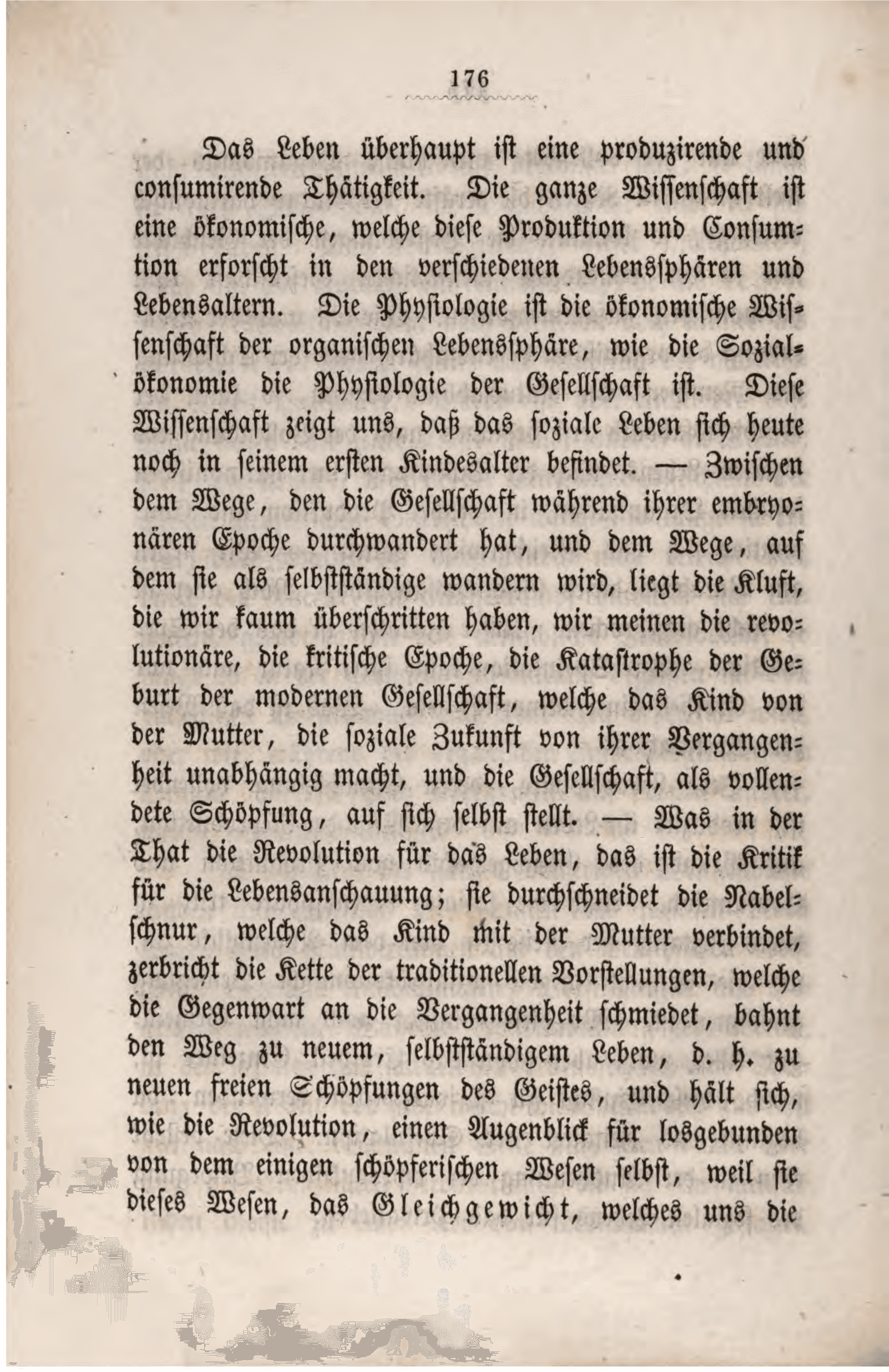
Life in general is a producing and consuming activity. The whole of science is an economic one, which researches this production and consumption in the various spheres and ages of life. Physiology is the economic science of the organic sphere of life, just as social economy is the physiology of society. This science shows us that social life today is still in its earliest infancy. — Between the path that society has traversed during its embryonic epoch, and the path on which it will wander as an independent being, lies the chasm that we have barely crossed; we mean the revolutionary, the critical epoch, the catastrophe of the birth of modern society, which makes the child independent of the mother, the social future of its past, and establishes society, as a perfected creation, upon itself.
— What revolution is in fact for life, criticism is for the worldview; it cuts the umbilical cord that connects the child with the mother, breaks the chain of traditional ideas which forges the present to the past, paves the way to new, independent life, i.e., to new free creations of the spirit, and considers itself, like the revolution, for a moment to be unbound from the sole creative being itself, because this being, the equilibrium, which to us the
Show Original German Text
176 Das Leben überhaupt ist eine produzirende und consumirende Thätigkeit. Die ganze Wissenschaft ist eine ökonomische, welche diese Produktion und Consum- tion erforscht in den verschiedenen Lebenssphären und Lebensaltem. Die Physiologie ist die ökonomische Wis- senschaft der organischen Lebenssphäre, wie die Sozial- ökonomie die Physiologie der Gesellschaft ist. Diese Wissenschaft zeigt uns, daß das soziale Leben sich heute noch in seinem ersten Kindesalter befindet. — Zwischen dem Wege, den die Gesellschaft während ihrer embryio- nären Epoche durchwandert hat, und dem Wege, auf dem sie als selbstständige wandem wird, liegt die Kluft, die wir kaum überschntten haben, wir meinen die revo- lutionäre, die kntische Epoche, die Katastrophe der Ge- burt der modemen Gesellschaft, welche das Kind von der Mutter, die soziale Zukunft von ihrer Vergangen- heit unabhängig macht, und die Gesellschaft, als vollen- dete Schöpfung, auf sich selbst stellt. — Was in der That die Revolution für das Leben, das ist die Kntik für die Lebensanschauung; sie durchschneidet die Nabel- schnur, welche das Kind mit der Mutter verbindet, zerbncht die Kette der traditionellen Vorstellungen, welche die Gegenwart an die Vergangenheit schmiedet, bahnt den Weg zu neuem, selbstständigem Leben, d. h. zu neuen freien Schöpfungen des Geistes, und hält sich, wie die Revolution, einen Augenblick für losgebunden von dem einigen schöpfenschen Wesen selbst, weil sie dieses Wesen, das Gleichgewicht, welches uns die