Rome and Jerusalem (1862)
Page 174 • Click to zoom
Page 174 of 264
154
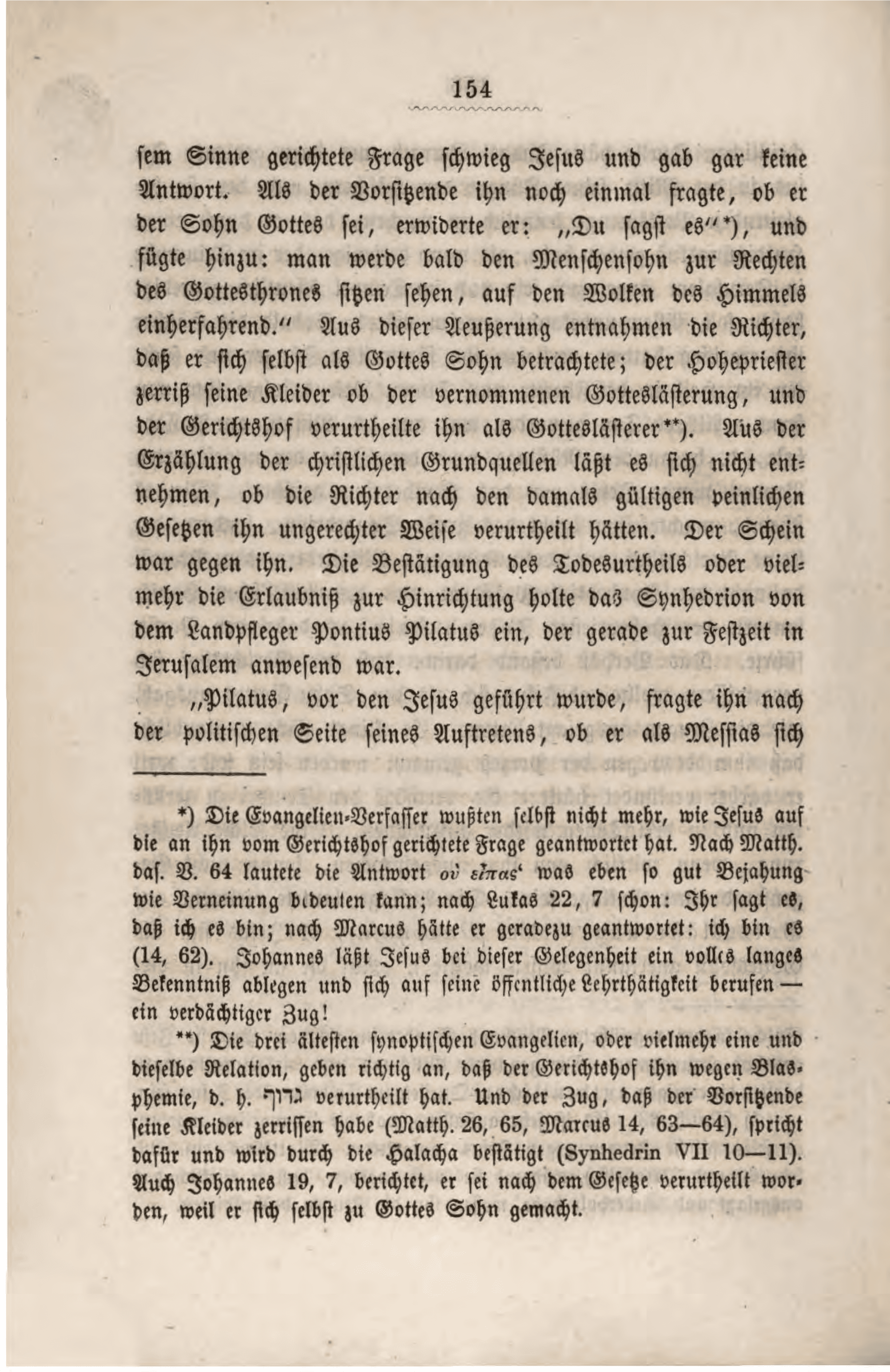
To the question posed in this sense, Jesus remained silent and gave no answer at all. When the presiding officer asked him once more if he was the Son of God, he replied: "You say it"*), and added: one would soon see the Son of Man sitting at the right hand of God's throne, coming on the clouds of heaven." From this statement the judges inferred that he considered himself the Son of God; the high priest tore his clothes over the perceived blasphemy, and the court condemned him as a blasphemer**). From the narrative of the original Christian sources, it cannot be determined whether the judges had unjustly condemned him according to the penal laws valid at that time. Appearances were against him. The confirmation of the death sentence, or rather the permission for the execution, was obtained by the Sanhedrin from the governor Pontius Pilate, who was present in Jerusalem at that time for the festival.
"Pilate, before whom Jesus was brought, asked him about the political side of his appearance, whether he as Messiah...
*) The Gospel writers themselves no longer knew how Jesus answered the question put to him by the court. According to Matth. 26, v. 64, the answer was σὺ εἶπας (you said it), which can mean affirmation just as well as denial; according to Luke 22, 70: You say that I am; according to Mark he would have answered directly: I am (14, 62). John has Jesus make a full, long confession on this occasion and refer to his public teaching activity — a suspicious feature!
**) The three oldest synoptic Gospels, or rather one and the same account, correctly state that the court condemned him for blasphemy, i.e., גדּוּף. And the feature that the presiding officer tore his clothes (Matth. 26, 65, Mark 14, 63–64), speaks for this and is confirmed by the Halakha (Sanhedrin VII 10–11). John 19, 7, also reports that he was condemned according to the law because he had made himself the Son of God.
Show Original German Text
154 ſem Sinne genchtete Frage schwieg Jeſus und gab gar keine Antwort. Als der Vorſitzende ihn noch einmal fragte, ob er der Sohn Gottes ſei, erwiderte er: „Du ſagst es“*), und fügte hinzu: man werde bald den Menschenſohn zur Rechten des Gottesthrones ſitzen ſehen, auf den Wolken des Himmels einherfahrend.“ Aus dieſer Äußerung entnahmen die Richter, daß er ſich ſelbst als Gottes Sohn betrachte; der Hohepnester zernß ſeine Kleider ob der vemommenen Gotteslästerung, und der Genchtshof verurteilte ihn als Gotteslästerer**). Aus der Erzählung der chnstlichen Grundquellen läßt es ſich nicht entnehmen, ob die Richter nach den damals gültigen peinlichen Geſetzen ihn ungerechter Weiſe verurteilt hätten. Der Schein war gegen ihn. Die Bestätigung des Todesurteils oder vielmehr die Erlaubniß zur Hinnchtung holte das Synhednon von dem Landpfleger Pontius Pilatus ein, der gerade zur Festzeit in Jeruſalem anweſend war. „Pilatus, vor den Jeſus geführt wurde, fragte ihn nach der politischen Seite ſeines Auftretens, ob er als Meſſias ſich \ \ \ *) Die Evangelien-Verfaſſer wußten ſelbst nicht mehr, wie Jeſus auf die an ihn vom Genchtshof genchtete Frage geantwortet hat. Nach Matth. daß. V. 64 lautete die Antwort ov ειπας΄ was eben ſo gut Bejahung wie Vemeinung bedeuten kann; nach Lukas 22, 7 schon: Ihr ſagt es, daß ich es bin; nach Marcus hätte er geradezu geantwortet: ich bin es (14, 62). Johannes läßt Jeſus bei dieſer Gelegenheit ein volles langes Bekenntniß ablegen und ſich auf ſeine öffentliche Lehrthätigkeit berufen — ein verdächtiger Zug! **) Die drei ältesten ſynoptischen Evangelien, oder vielmehr eine und dieſelbe Relation, geben nchtig an, daß der Genchtshof ihn wegen Blasphemie, d. h. רחצ verurteilt hat. Und der Zug, daß der Vorſitzende ſeine Kleider zernſſen habe (Matth. 26, 65, Marcus 14, 63—64), spncht dafür und wird durch die Halacha bestätigt (Synhednn VII 10—11). Auch Johannes 19, 7, benchtet, er ſei nach dem Geſetze verurteilt worden, weil er ſich ſelbst zu Gottes Sohn gemacht.