Rome and Jerusalem (1862)
Page 169 • Click to zoom
Page 169 of 264
149
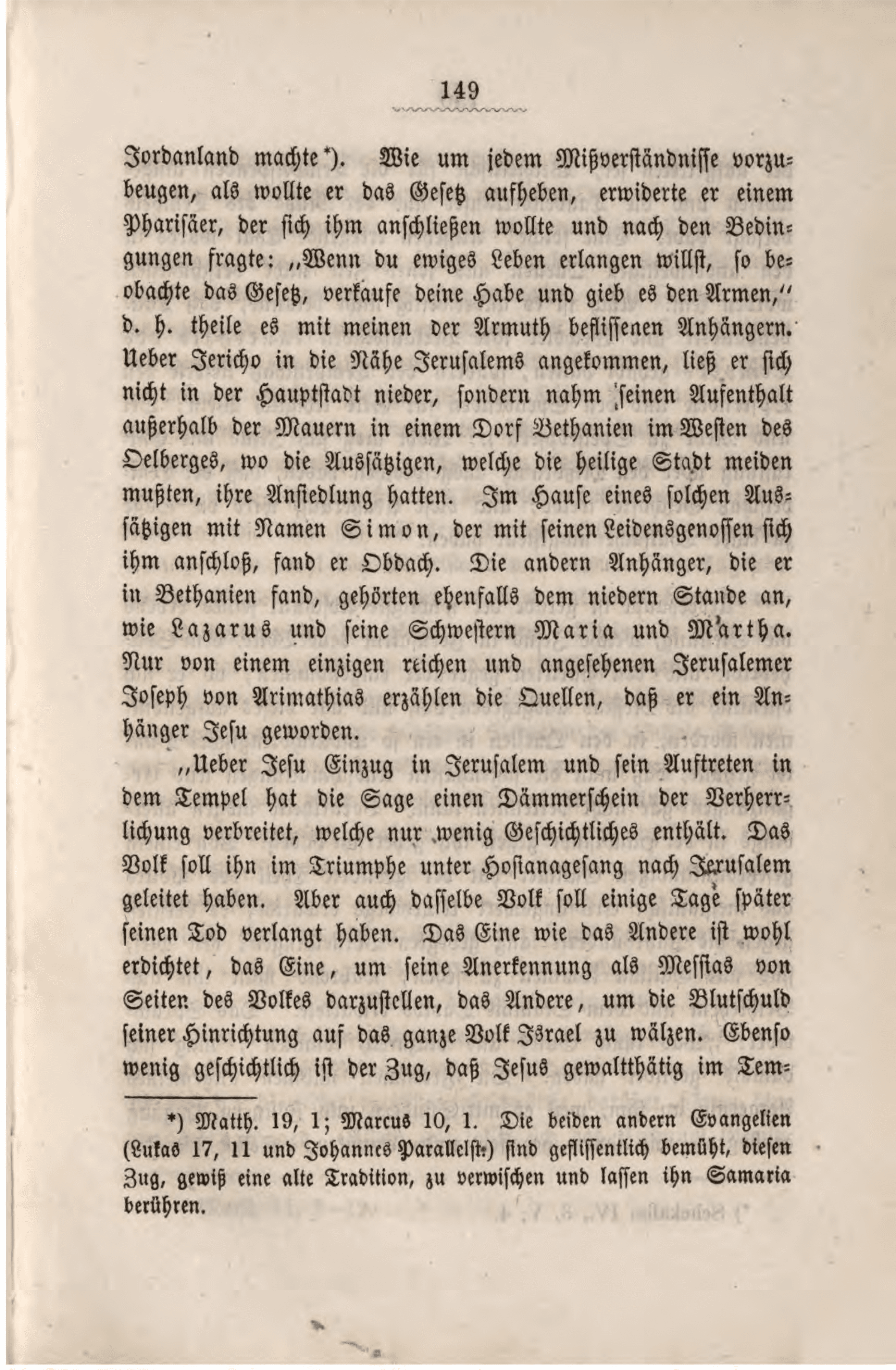
...made for the land of Jordan*). As if to prevent any misunderstanding that he wanted to abolish the Law, he replied to a Pharisee who wanted to join him and asked about the conditions: "If you want to attain eternal life, then observe the Law, sell your possessions and give it to the poor," i.e., share it with my followers who are devoted to poverty.
Having arrived near Jerusalem via Jericho, he did not settle in the capital, but took up his residence outside the walls in a village, Bethany, on the west of the Mount of Olives, where the lepers, who had to avoid the holy city, had their settlement. He found shelter in the house of such a leper by the name of Simon, who, with his fellow sufferers, joined him. The other followers he found in Bethany also belonged to the lower class, like Lazarus and his sisters Mary and Martha.
The sources tell of only a single rich and respected man from Jerusalem, Joseph of Arimathea, who became a follower of Jesus.
"Legend has spread a twilight glow of glorification over Jesus' entry into Jerusalem and his appearance in the temple, which contains little of historical substance. The people are said to have led him in triumph to Jerusalem with songs of Hosanna. But the same people are also said to have demanded his death a few days later. The one, as well as the other, is likely fabricated; the one to portray his recognition as Messiah by the people, the other to cast the blood guilt of his execution upon the entire people of Israel. Just as unhistorical is the feature that Jesus acted violently in the temple...
*) Matth. 19, 1; Mark 10, 1. The other two Gospels (Luke 17, 11 and John's parallel passage) are studiously concerned with obscuring this journey, certainly an old tradition, and have him pass through Samaria.
Show Original German Text
149 Jordaniaud machte *). Wie um jedem Mißverständniſſe vorzubeugen, als wollte er das Geſetz aufheben, erwiederte er einem Phanſäer, der ſich ihm anschließen wollte und nach den Bedingungen fragte: „Wenn du ewiges Leben erlangen willst, ſo beobachte das Geſetz, verkaufe deine Habe und gieb es den Armen,“ d. h. theile es mit meinen der Armuth beflissenen Anhängem. Ueber Jencho in die Nähe Jeruſalems angekommen, ließ er ſich nicht in der Hauptstadt nieder, ſondem nahm ſeinen Aufenthalt außerhalb der Mauem in einem Dorf Bethanien im Westen des Oelberges, wo die Ausſäßigen, welche die heilige Stadt meiden mußten, ihre Anſiedlung hatten. Im Hauſe eines ſolchen Ausſäßigen mit Namen Simon, der mit ſeinen Leidensgenoſſen ſich ihm anschloß, fand er Obdach. Die andem Anhänger, die er in Bethanien fand, gehörten ebenfalls dem niedem Stande an, wie Lazarus und ſeine Schwestem Mana und Martha. Nur von einem einzigen reichen und angeſehenen Jeruſalemer Joſeph von Anmathias erzählen die Quellen, daß er ein Anhänger Jeſu geworden. „Ueber Jeſu Einzug in Jeruſalem und ſein Auftreten in dem Tempel hat die Sage einen Dämmerschein der Verherrlichung verbreitet, welche nur wenig Geschichtliches enthält. Das Volk ſoll ihn im Tnumphe unter Hoſianageſang nach Jeruſalem geleitet haben. Aber auch daſſelbe Volk ſoll einige Tage später ſeinen Tod verlangt haben. Das Eine wie das Andere ist wohl erdichtet, das Eine, um ſeine Anerkennung als Meſſias von Seiten des Volkes darzustellen, das Andere, um die Blutschuld ſeiner Hinnchtung auf das ganze Volk Iſrael zu wälzen. Ebenſo wenig geschichtlich ist der Zug, daß Jeſus gewaltthätig im Tem *) Matth. 19, 1; Marcus 10, 1. Die beiden andem Evangelien (Lucas 17, 11 und Johannes Parallelst.) ſind gefliffentlich bemüht, dieſen Zug, gewiß eine alte Tradition, zu verwischen und laſſen ihn Samana berühren.