Rome and Jerusalem (1862)
Page 164 • Click to zoom
Page 164 of 264
144
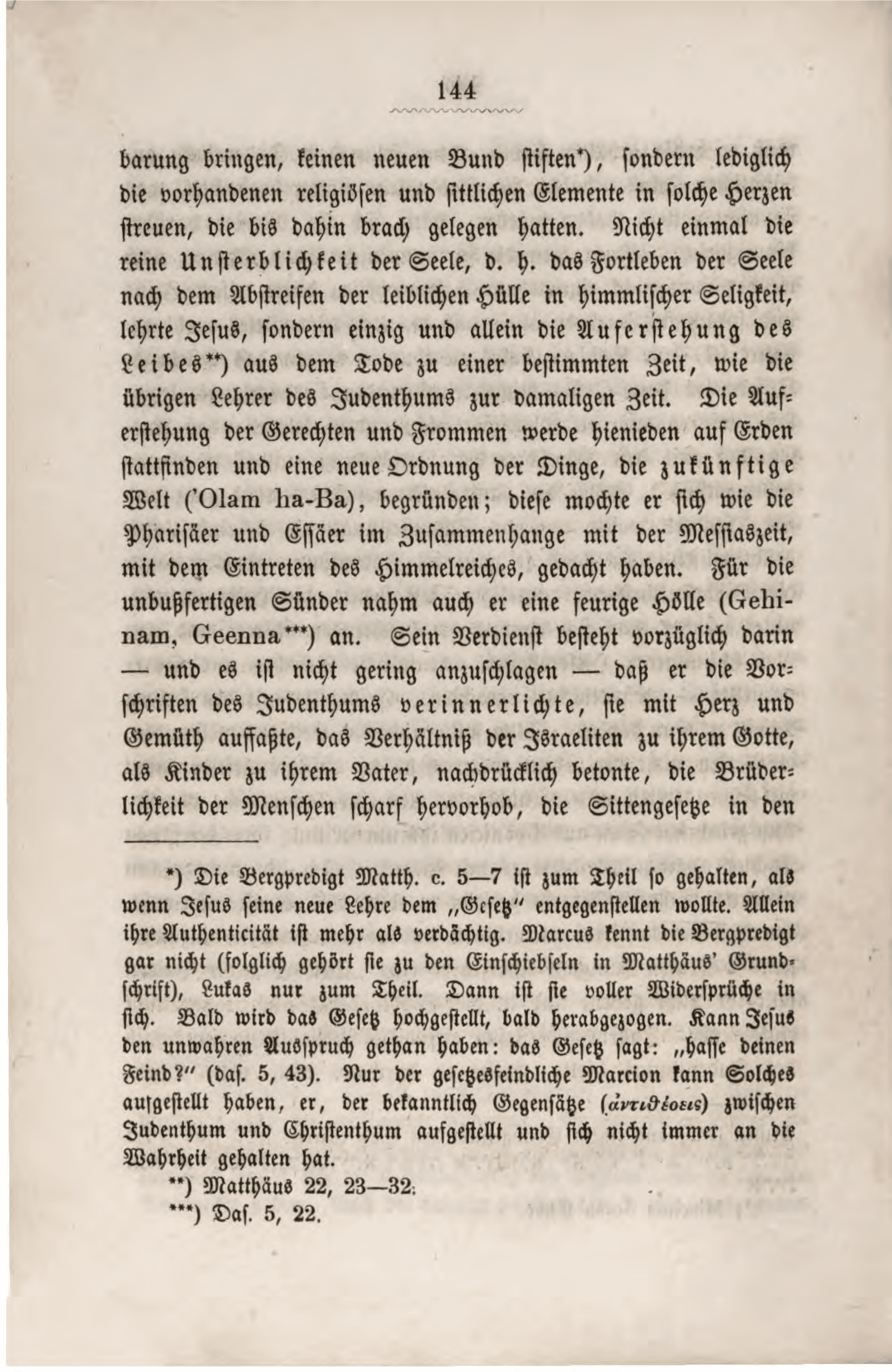
...bring revelation, to found no new covenant*), but merely to sow the existing religious and moral elements into such hearts that had hitherto lain fallow.
Jesus did not even teach the pure immortality of the soul, i.e., the soul's continued existence in heavenly bliss after shedding the bodily shell, but solely and exclusively the resurrection of the body**) from death at a specific time, like the other teachers of Judaism at that time. The resurrection of the righteous and the pious would take place here on earth and establish a new order of things, the world to come ('Olam ha-Ba); he may have conceived of this, like the Pharisees and Essenes, in connection with the Messianic era, with the advent of the Kingdom of Heaven. For unrepentant sinners, he too assumed a fiery hell (Gehinnam, Geenna***).
His merit consists preeminently—and it is not to be underestimated—in the fact that he internalized the precepts of Judaism, conceived of them with heart and soul, emphatically stressed the relationship of the Israelites to their God as that of children to their father, sharply highlighted the brotherhood of man, [and brought] the moral laws into the...
*) The Sermon on the Mount in Matt. ch. 5–7 is partly delivered as if Jesus wanted to oppose his new teaching to the "Law." However, its authenticity is more than suspect. Mark does not know the Sermon on the Mount at all (consequently, it belongs to the interpolations in Matthew's source text), Luke only in part. Furthermore, it is full of internal contradictions. At one moment the Law is exalted, at another it is denigrated. Could Jesus have made the untrue statement: the Law says, "hate your enemy?" (ibid. 5, 43). Only the anti-Law Marcion could have asserted such a thing, he who, as is well known, set up oppositions (ἀντιθέσεις) between Judaism and Christianity and did not always adhere to the truth.
**) Matthew 22, 23–32.
***) Ibid. 5, 22.
Show Original German Text
144 barung bnngen, keinen neuen Bund stiften\*), ſondem lediglich die vorhandenen religiöſen und ſittlichen Elemente in ſolche Herzen streuen, die bis dahin brach gelegen hatten. Nicht einmal die reine Unsterblichkeit der Seele, d. h. das Fortleben der Seele nach dem Abstreifen der leiblichen Hülle in himmlischer Seligkeit, lehrte Jeſus, ſondem einzig und allein die Auferstehung des Leibes\*\*) aus dem Tode zu einer bestimmten Zeit, wie die übngen Lehrer des Judenthums zur damaligen Zeit. Die Auferstehung der Gerechten und Frommen werde hienieden auf Erden stattfinden und eine neue Ordnung der Dinge, die zukünftige Welt ('Olam ha-Ba), begründen; dieſe mochte er ſich wie die Phanſäer und Esſäer im Zuſammenhange mit der Mesſiaszeit, mit dem Eintreten des Himmelreiches, gedacht haben. Für die unbußfertigen Sünder nahm auch er eine feunge Hölle (Gehinnam, Geenna\*\*\*) an. Sein Verdienst besteht vorzüglich dann — und es ist nicht genng anzuschlagen — daß er die Vorschnften des Judenthums vennnerlichte, ſie mit Herz und Gemüth auffaßte, das Verhältniß der Iſraeliten zu ihrem Gotte, als Kinder zu ihrem Vater, nachdrücklich betonte, die Brüderlichkeit der Menschen scharf hervorhob, die Sittengeſetze in den \* ) Die Bergpredigt Matth. c. 5–7 ist zum Theil ſo gehalten, als wenn Jeſus ſeine neue Lehre dem „Geſetz“ entgegenstellen wollte. Allein ihre Authenticität ist mehr als verdächtig. Marcus kennt die Bergpredigt gar nicht (folglich gehört ſie zu den Einschiebseln in Matthäus' Grundschnft), Lukas nur zum Theil. Dann ist ſie voller Widersprüche in ſich. Bald wird das Geſetz hochgestellt, bald herabgezogen. Kann Jeſus den unwahren Ausspruch gethan haben: das Geſetz ſagt: „haſſe deinen Feind?“ (daſ. 5, 43). Nur der geſeßfeindliche Marcion kann Solches aufgestellt haben, er, der bekanntlich Gegenſäße (ἀντιθέσεις) zwischen Judenthum und Chnstenthum aufgestellt und ſich nicht immer an die Wahrheit gehalten hat. \*\* ) Matthäus 22, 23–32. \*\*\* ) Daſ. 5, 22.