Rome and Jerusalem (1862)
Page 163 • Click to zoom
Page 163 of 264
143
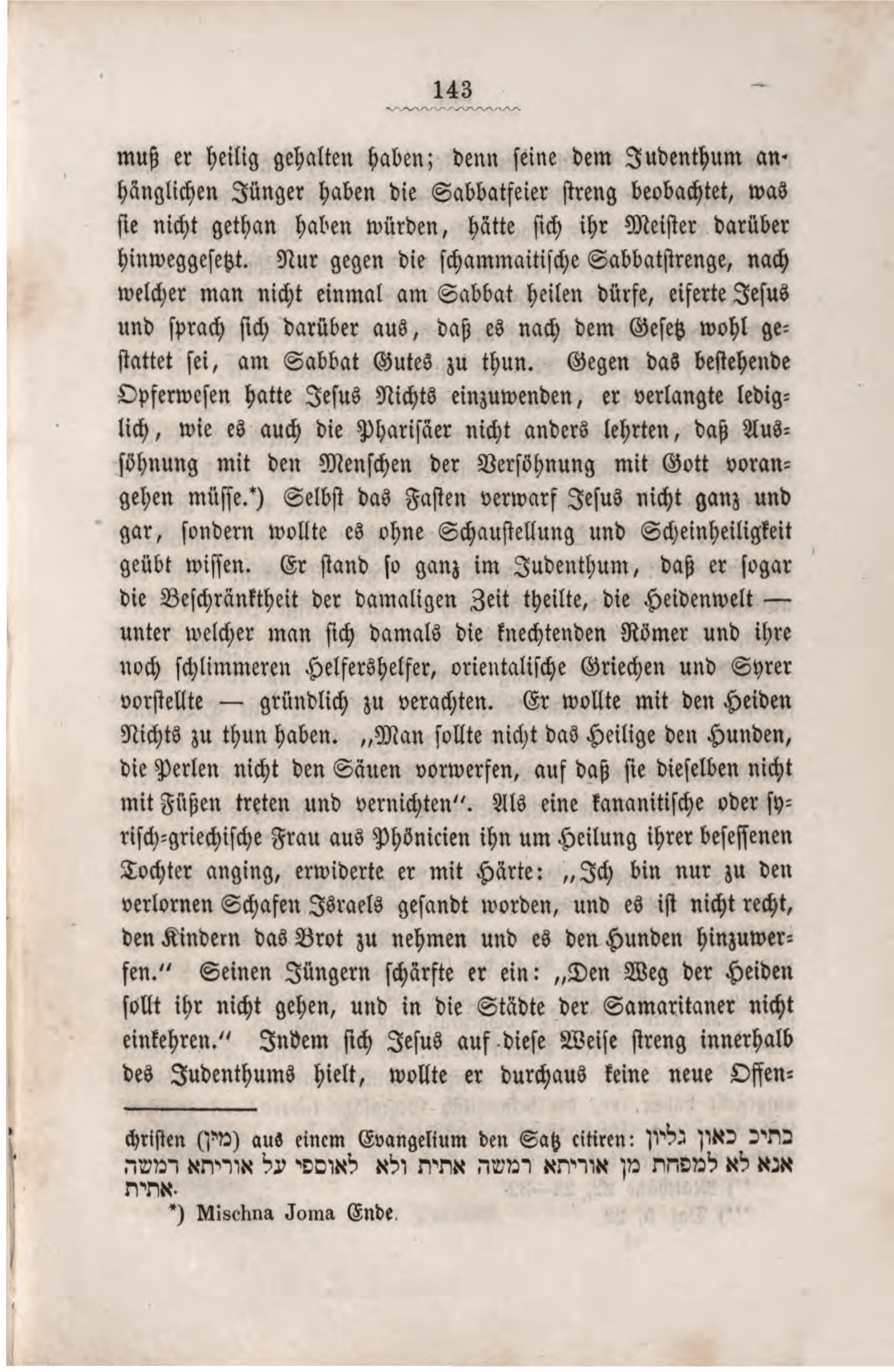
he must have held it sacred; for his disciples, who adhered to Judaism, observed the Sabbath celebration strictly, which they would not have done had their master disregarded it. Only against the Shammaite Sabbath strictness, according to which one was not even allowed to heal on the Sabbath, did Jesus inveigh and express that according to the law it was indeed permitted to do good on the Sabbath.
Jesus had no objection to the existing system of sacrifice; he merely demanded, as the Pharisees also taught, that reconciliation with men must precede reconciliation with God.*)
Even fasting Jesus did not reject entirely, but wanted it to be practiced without ostentation and hypocrisy. He stood so completely within Judaism that he even shared the narrow-mindedness of that time, to thoroughly despise the Gentile world — which at that time was imagined as the enslaving Romans and their even worse henchmen, oriental Greeks and Syrians. He wanted to have nothing to do with the Gentiles. "One should not give that which is holy to the dogs, nor cast pearls before swine, lest they trample them under their feet and destroy them." When a Canaanite or Syro-Grecian woman from Phoenicia approached him for the healing of her possessed daughter, he replied with harshness: "I was sent only to the lost sheep of Israel, and it is not right to take the children's bread and throw it to the dogs." He impressed upon his disciples: "Do not go in the way of the Gentiles, and do not enter the cities of the Samaritans."
By thus keeping strictly within Judaism, Jesus by no means wanted to found a new reve-
Christians (מין) cite from a Gospel the sentence: בתיב כאן גליון אנא לא למפחת מן אוריא דמשה אתית ולא לאוספי על אוריא דמשה אתית.
*) Mishna Yoma, end.
Show Original German Text
143 muß er heilig gehalten haben; denn seine dem Judenthum an- hänglichen Jünger haben die Sabbatsfeier streng beobachtet, was sie nicht gethan haben würden, hätte sich ihr Meister darüber hinweggesetzt. Nur gegen die schammaitische Sabbatsstrenge, nach welcher man nicht einmal am Sabbat heilen dürfe, eiferte Jesus und sprach sich darüber aus, daß es nach dem Gesez wohl ge- stattet sei, am Sabbat Gutes zu thun. Gegen das bestehende Opferwesen hatte Jesus Nichts einzuwenden, er verlangte ledig- lich, wie es auch die Phansäer nicht anders lehrten, daß Aus- söhnung mit den Menschen der Versöhnung mit Gott voran- gehen müsse.*) Selbst das Fasten verwarf Jesus nicht ganz und gar, sondem wollte es ohne Schaustellung und Scheinheiligkeit geübt wissen. Er stand so ganz im Judenthum, daß er sogar die Beschränktheit der damaligen Zeit theilte, die Heidenwelt — unter welcher man sich damals die knechtenden Römer und ihre noch schlimmeren Helfershelfer, onentalische Gnechen und Syrer vorstellte — gründlich zu verachten. Er wollte mit den Heiden Nichts zu thun haben. „Man sollte nicht das Heilige den Hunden, die Perlen nicht den Säuen vorwerfen, auf daß sie dieselben nicht mit Füßen treten und vemichten.“ Als eine kananitische oder sy- nsch-gnechische Frau aus Phönicien ihn um Heilung ihrer besessenen Tochter anging, erwiderte er mit Härte: „Ich bin nur zu den verlomen Schafen Israels gesandt worden, und es ist nicht recht, den Kindem das Brot zu nehmen und es den Hunden hinzuwer- fen.“ Seinen Jüngem schärfte er ein: „Den Weg der Heiden sollt ihr nicht gehen, und in die Städte der Samantaner nicht einkehren.“ Indem sich Jesus auf diese Weise streng innerhalb des Judenthums hielt, wollte er durchaus keine neue Offen chnsten (מין) aus einem Evangelium den Satz citiren: בתיב כאן גליון אנא לא למפחת מן אוריא דמשה אתית ולא לאוספי על אוריא דמשה אתית. *) Mischna Joma Ende.