Rome and Jerusalem (1862)
Page 162 • Click to zoom
Page 162 of 264
142
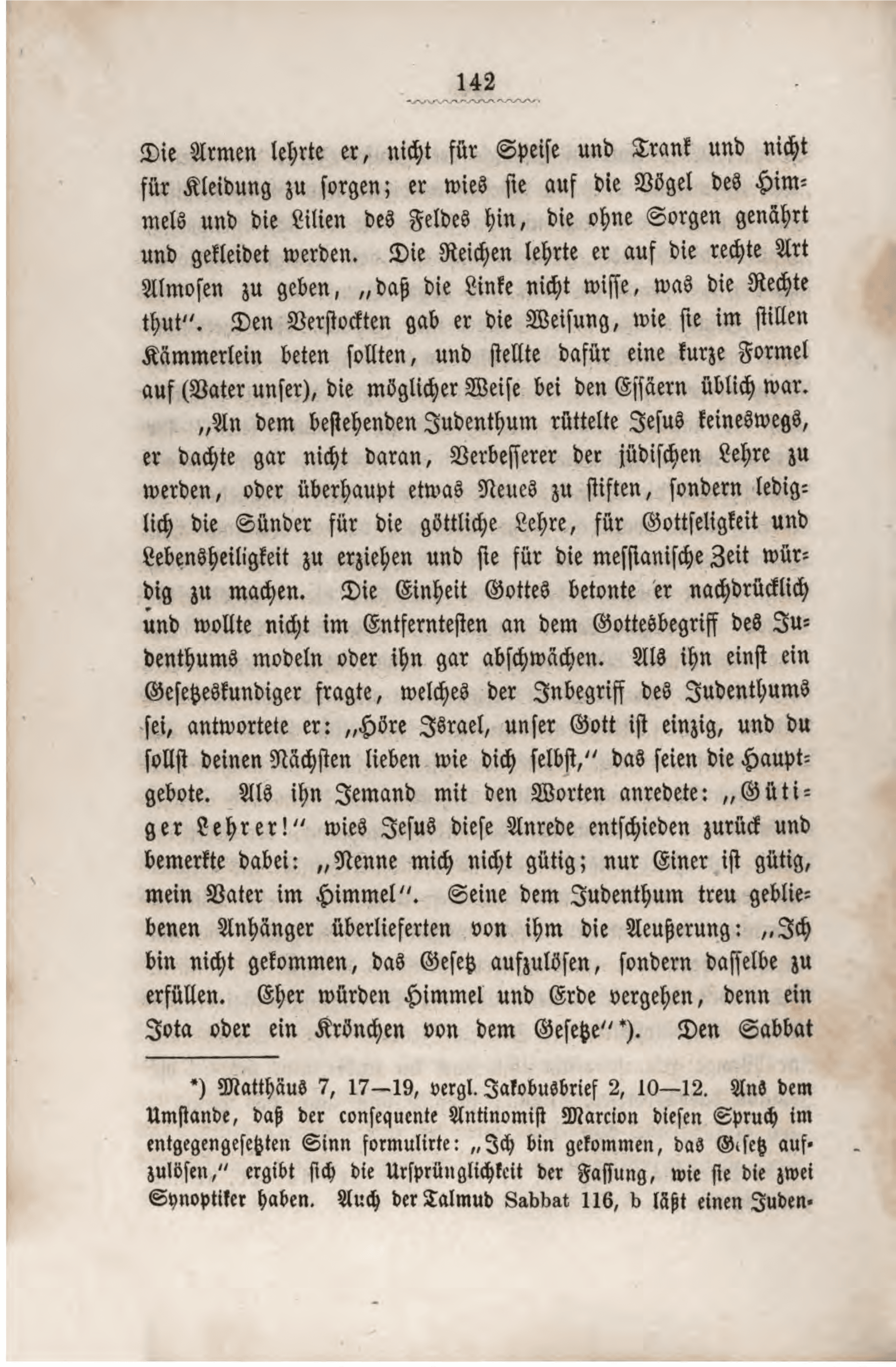
He taught the poor not to worry about food and drink and not about clothing; he pointed them to the birds of the sky and the lilies of the field, which are fed and clothed without worry. He taught the rich the right way to give alms, "that the left hand may not know what the right hand is doing." To the hard-hearted he gave the instruction how they should pray in their quiet chambers, and for this he set up a short formula (Our Father), which was possibly common among the Essenes.
"Jesus in no way shook the existing Judaism, he did not think at all of becoming a reformer of the Jewish doctrine, or of founding anything new at all, but merely to educate sinners for the divine doctrine, for godliness and sanctity of life, and to make them worthy of the messianic age. He emphatically stressed the unity of God and did not in the least want to alter the concept of God in Judaism or even to weaken it. When a man learned in the law once asked him what the epitome of Judaism was, he answered: "hear, O Israel, our God is one, and you shall love your neighbor as yourself," that these were the main commandments. When someone addressed him with the words: "Good Teacher!" Jesus firmly rejected this address, remarking: "Do not call me good; only One is good, my Father in heaven." His followers who remained faithful to Judaism handed down from him the utterance: "I have not come to abolish the law, but to fulfill it. Heaven and earth would sooner pass away than one jot or one tittle of the law." The Sabbath
*) Matthew 7, 17–19, cf. Epistle of James 2, 10–12. From the circumstance that the consistent antinomian Marcion formulated this saying in the opposite sense: "I have come to abolish the law," the originality of the version as the two Synoptics have it becomes clear. Also the Talmud Shabbat 116b has a Judeo-
Show Original German Text
142 Die Armen lehrte er, nicht für Speise und Trank und nicht für Kleidung zu sorgen; er wies sie auf die Vögel des Himmels und die Lilien des Feldes hin, die ohne Sorgen genährt und gekleidet werden. Die Reichen lehrte er auf die rechte Art Almosen zu geben, „daß die Linke nicht wisse, was die Rechte thut“. Den Verstockten gab er die Weisung, wie sie im stillen Kämmerlein beten sollten, und stellte dafür eine kurze Formel auf (Vater unser), die möglicher Weise bei den Essäem üblich war. „An dem bestehenden Judenthum rüttelte Jesus keineswegs, er dachte gar nicht daran, Verbesserer der jüdischen Lehre zu werden, oder überhaupt etwas Neues zu stiften, sondem lediglich die Sünder für die göttliche Lehre, für Gottseligkeit und Lebensheiligkeit zu erziehen und sie für die messianische Zeit würdig zu machen. Die Einheit Gottes betonte er nachdrücklich und wollte nicht im Entfemtesten an dem Gottesbegnff des Judenthums modeln oder ihn gar abschwächen. Als ihn einst ein Gesetzeskundiger fragte, welches der Inbegnff des Judenthums sei, antwortete er: „höre Israel, unser Gott ist einzig, und du sollst deinen Nächsten lieben wie dich selbst,“ das seien die Hauptgebote. Als ihn Jemand mit den Worten anredete: „Gütiger Lehrer!“ wies Jesus diese Anrede entschieden zurück und bemerkte dabei: „Nenne mich nicht gütig; nur Einer ist gütig, mein Vater im Himmel“. Seine dem Judenthum treu gebliebenen Anhänger überlieferten von ihm die Aeußerung: „Ich bin nicht gekommen, das Gesetz aufzulösen, sondem dasselbe zu erfüllen. Eher würden Himmel und Erde vergehen, denn ein Jota oder ein Krönchen von dem Gesetze.“ Den Sabbat \* ) Matthäus 7, 17–19, vergl. Jakobusbnef 2, 10–12. Aus dem Umstande, daß der consequente Antinomist Marcion diesen Spruch im entgegengesetzten Sinn formulirte: „Ich bin gekommen, das Gesetz aufzulösen,“ ergibt sich die Ursprünglichkeit der Fassung, wie sie die zwei Synoptiker haben. Auch der Talmud Sabbat 116, b läßt einen Juden-