The Victory of Judaism over Germanism
Page 25 • Click to zoom
Page 25 of 53
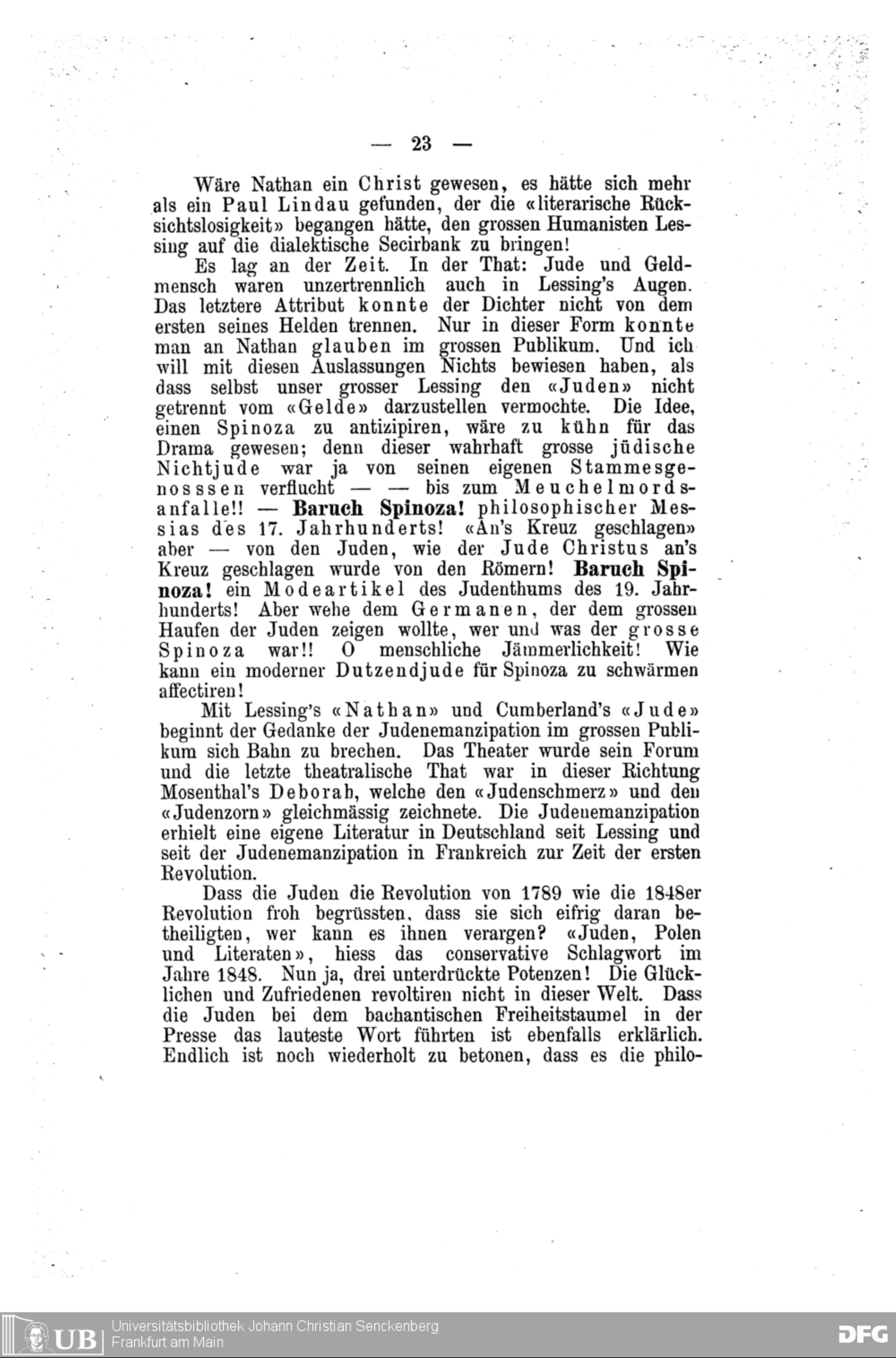
— 23 —
Had Nathan been a Christian, more than one Paul Lindau would have been found who would have committed the "literary recklessness" of bringing the great humanist Lessing to the dialectical dissection table!
It was due to the times. In fact: Jew and money- man were inseparable even in Lessing's eyes. The poet could not separate the latter attribute from the former of his hero. Only in this form could the general public believe in Nathan. And with these remarks, I want to have proven nothing other than that even our great Lessing was unable to portray the "Jew" separately from "money." The idea of anticipating a Spinoza would have been too bold for the drama; for this truly great Jewish non-Jew was indeed cursed by his own tribes- men—to the point of murderous attacks!!—Baruch Spinoza! philosophical Mes- siah of the 17th century! "Crucified" but—by the Jews, just as the Jew Christ was crucified by the Romans! Baruch Spi- noza! an article of murder for 19th-century Judaism! But woe to the Teuton who wanted to show the great mass of Jews who and what the great Spinoza was!! O human wretchedness! How can a modern dime-a-dozen Jew affect to be enthusiastic about Spinoza!
With Lessing's "Nathan" and Cumberland's "The Jew," the idea of Jewish emancipation begins to make its way among the general public. The theater became its forum and the last theatrical deed in this direction was Mosenthal's Deborah, which portrayed the "Jewish sorrow" and the "Jewish wrath" equally. Jewish emancipation received its own literature in Germany since Lessing and since the emancipation of the Jews in France at the time of the first Revolution.
That the Jews gladly welcomed the Revolution of 1789 as well as the 1848 Revolution, that they eagerly participated in it, who can blame them for it? "Jews, Poles, and men of letters," was the conservative slogan in the year 1848. Well yes, three oppressed powers! The happy and the content do not revolt in this world. That the Jews had the loudest voice in the press during the Bacchantic frenzy of freedom is also understandable. Finally, it must be repeatedly emphasized that it is the philo-
Show Original German Text
— 23 — Wäre Nathan ein Chnst geweſen, es hätte ſich mehr als ein Paul Lindau gefunden, der die «literansche Rück- ſichtsloſigkeit» begangen hätte, den groſſen Humanisten Les- ſing auf die dialektische Secirbank zu bnngen! Es lag an der Zeit. In der That: Jude und Geld- mensch waren unzertrennlich auch in Lessings Augen. Das letztere Attnbut konnte der Dichter nicht von dem ersten seines Helden trennen. Nur in dieser Form konnte man an Nathan glauben im groſſen Publikum. Und ich will mit diesen Auslaſſungen Nichts bewiesen haben, als dass ſelbst unser groſſer Lessing den «Juden» nicht getrennt vom «Gelde» darzustellen vermochte. Die Idee, einen Spinoza zu antizipiren, wäre zu kühn für das Drama geweſen; denn dieſer wahrhaft groſſe jüdische Nichtjude war ja von seinen eigenen Stammgesge- noſſen verflucht — bis zum Meuchemord- anfalle!! — **Baruch Spinoza!** philosophischer Mes- ſias des 17. Jahrhunderts! «An’s Kreuz geschlagen» aber — von den Juden, wie der Jude Chnstus an’s Kreuz geschlagen wurde von den Römem! **Baruch Spi-** **noza!** ein Mordartikel des Judenthums des 19. Jahr- hunderts! Aber wehe dem Germanen, der dem groſſen Haufen der Juden zeigen wollte, wer und was der grosse Spinoza war!! O menschliche Jämmerlichkeit! Wie kann ein modemer Dutzendjude für Spinoza zu schwärmen affectiren! Mit Lessing’s «Nathan» und Cumberland’s «Jude» beginnt der Gedanke der Judenemanzipation im groſſen Publi- kum ſich Bahn zu brechen. Das Theater wurde ſein Forum und die letzte theatrasche That war in dieſer Richtung Mosenthal’s Deborah, welche den «Judenschmerz» und den «Judenzom» gleichmässig zeichnete. Die Judenemanzipation erhielt eine eigene Literatur in Deutschland ſeit Lessing und ſcít der Judenemanzipation in Frankreich zur Zeit der ersten Revolution. Dass die Juden die Revolution von 1789 wie die 1848er Revolution froh begrüssten, dass ſie ſich eifng daran be- theiligten, wer kann es ihnen verargen? «Juden, Polen und Literaten», hiess das conservative Schlagwort im Jahre 1848. Nun ja, drei unterdrückte Potenzen! Die Glück- lichen und Zufnedenen revoltiren nicht in dieſer Welt. Dass die Juden bei dem bachannschen Freiheitstaumel in der Presse das lauteste Wort führten ist ebenfalls erklärlich. Endlich ist noch wiederholt zu betonen, dass es die philo-