The Victory of Judaism over Germanism
Page 24 • Click to zoom
Page 24 of 53
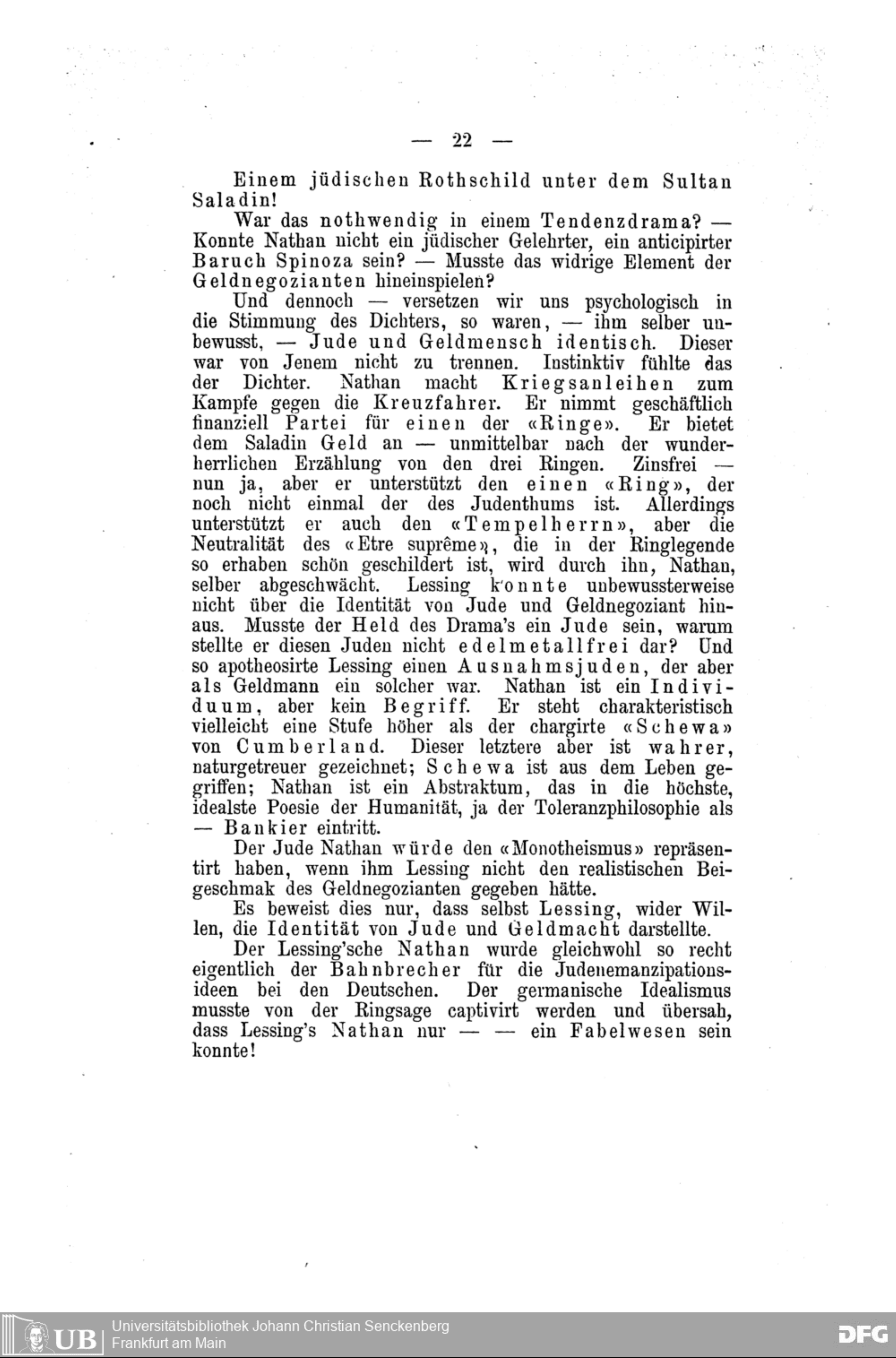
— 22 —
A Jewish Rothschild under the Sultan Saladin!
Was that necessary in a tendentious drama?— Could Nathan not have been a Jewish scholar, an anticipated Baruch Spinoza?—Did the odious element of the money negotiator have to play a part?
And yet—if we put ourselves psychologically into the poet's mood, then—unbeknownst to himself—Jew and money-man were identical. This latter could not be separated from the former. The poet felt this instinctively. Nathan makes war loans for the fight against the Crusaders. He takes sides financially in a business-like way for one of the "rings."—He offers Saladin money—immediately after the wonderfully magnificent tale of the three rings. Interest-free— well yes, but he supports the one "ring," which is not even that of Judaism. Admittedly, he also supports the "Knight Templar," but the neutrality of the "Etre suprême," which is so sublimely and beautifully depicted in the ring legend, is weakened by him, Nathan, himself. Lessing was unconsciously unable to get beyond the identity of Jew and money negotiator. If the hero of the drama had to be a Jew, why did he not portray this Jew free of precious metals? And so Lessing apotheosized an exceptional Jew, who was, however, such as a money-man. Nathan is an individ- ual, but not a concept. He stands characteristically perhaps one step higher than the caricatured "Sheva" of Cumberland. This latter, however, is drawn more truly, more true to life; Sheva is cast from life; Nathan is an abstract, which enters into the highest, most ideal poetry of humanity, indeed of the philosophy of tolerance, as — a banker.
The Jew Nathan would have represented "monotheism" if Lessing had not given him the realistic after- taste of the money negotiator.
This only proves that even Lessing, against his will, portrayed the identity of Jew and money-man. Lessing's Nathan nevertheless became so very much the trailblazer for the ideas of Jewish emancipation among the Germans. Germanic idealism was bound to be captivated by the ring legend and overlooked that Lessing's Nathan could only be—a mythical creature!
Show Original German Text
— 22 — Einem jüdischen Rothschild unter dem Sultan Saladin! Was das nothwendig in einem Tendenzdrama? — Konnte Nathan nicht ein jüdischer Gelehrter, ein anticipirter Baruch Spinoza ſein? — Musste das widnge Element der Geldnegozianten hineinspielen? Und dennoch — verſetzen wir uns psychologisch in die Stimmung des Dichters, ſo waren, — ihm ſelber un- bewusst, — Jude und Geldmensch identisch. Dieſer war von Jenem nicht zu trennen. Instinktiv fühlte das der Dichter. Nathan macht Knegsanleihen zum Kampfe gegen die Kreuzfahrer. Er nimmt geschäftlich finanziell Partei für einen der „Ringe“, — Er bietet dem Saladin Geld an — unmittelbar nach der wunder- herrlichen Erzählung von den drei Ringen. Zinsfrei — nun ja, aber er unterstützt den einen „Ring“, der noch nicht einmal der des Judenthums ist. Allerdings unterstützt er auch den «Tempelherm», aber die Neutralität des «Etre suprême», die in der Ringlegende ſo erhaben schön geschildert ist, wird durch ihn, Nathan, ſelber abgeschwächt. Leſſing konnte unbewussterweiſe nicht über die Identität von Jude und Geldnegoziant hin- aus. Musste der Held des Drama’s ein Jude ſein, warum stellte er dieſen Juden nicht Edelmetallſrei dar? Und ſo apotheoſirte Leſſing einen Ausnahmsjuden, der aber als Geldmann ein ſolcher war. Nathan ist ein Indivi- duum, aber kein Begnff. Er steht charaktenstisch vielleicht eine Stufe höher als der chargirte «Schewa» von Cumberland. Dieſer letztere aber ist wahrer, naturgetreuer gezeichnet; Schewa ist aus dem Leben ge- gnffen; Nathan ist ein Abstraktum, das in die höchste idealste Poeſie der Humanität, ja der Toleranzphiloſophie als — Bankier eintntt. Der Jude Nathan würde den «Monotheismus» repräſen- tirt haben, wenn ihm Leſſing nicht den realistischen Bei- geschmack des Geldnegozianten gegeben hätte. Es beweist dies nur, dass ſelbst Leſſing wider Wil- len, die Identität von Jude und Geldmensch darstellte. Der Leſſing’sche Nathan wurde gleichwohl ſo recht eigentlich der Bahnbrecher für die Judenemanzipations- ideen bei den Deutschen. Der germanische Idealismus musste von der Ringsage captivirt werden und überſah, dass Leſſing’s Nathan nur — ein Fabelweſen ſein konnte!