The Victory of Judaism over Germanism
Page 18 • Click to zoom
Page 18 of 53
— 16 —
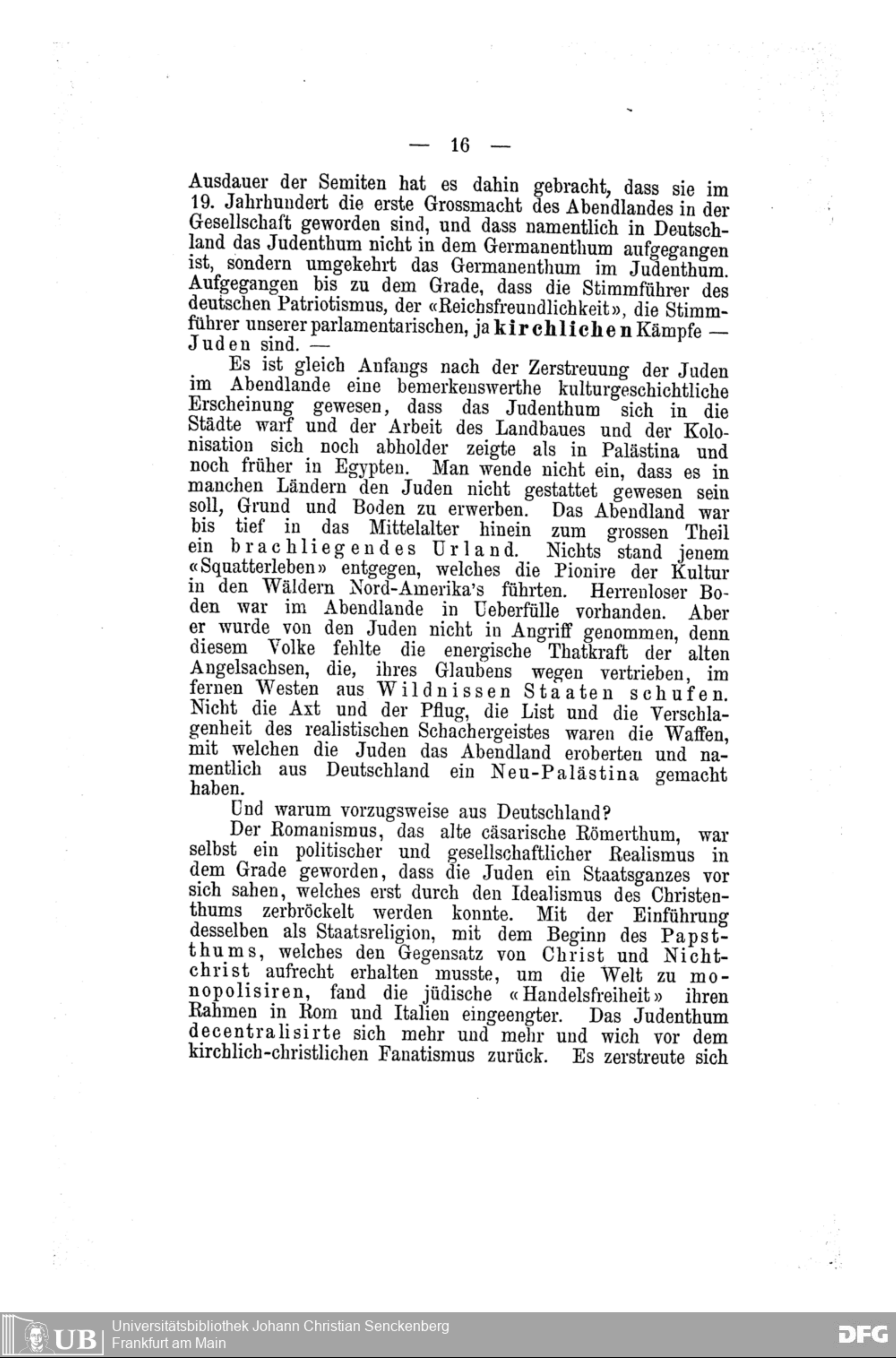
endurance of the Semites has brought it to the point that in the 19th century they have become the first great power of the Occident in society, and that, particularly in Germany, Jewry has not been absorbed into Germandom, but rather, conversely, Germandom into Jewry. Absorbed to the degree that the spokesmen of German patriotism, of "friendliness to the Reich," the spokes- men of our parliamentary, indeed ecclesiastical struggles — are Jews. Right from the beginning after the dispersion of the Jews in the Occident, it was a remarkable phenomenon of cultural history that Jewry threw itself into the cities and showed itself to be even more averse to the work of agriculture and colo- nization than in Palestine and even earlier in Egypt. One should not object that in some countries the Jews were supposedly not permitted to acquire land and property. The Occident was, deep into the Middle Ages, for the most part a fallow, primeval land. Nothing stood in the way of that "squatter life" which the pioneers of culture led in the forests of North America. Ownerless land was available in abundance in the Occident. But it was not taken up by the Jews, for this people lacked the energetic drive of the old Anglo-Saxons, who, driven out for their faith, in the far West created states out of wildernesses. Not the axe and the plow, but the cunning and the craft- iness of the realistic haggling spirit were the weapons with which the Jews conquered the Occident and, in particular, made a New Palestine out of Germany. And why preferably out of Germany? Romanism, the old Caesarean Romanism, had itself become a political and social realism to such a degree that the Jews saw before them a state entity which could only be dismembered by the idealism of Chris- tianity. With its introduction as the state religion, with the beginning of the Pap- acy, which had to maintain the opposition between Christian and non- Christian in order to monopolize the world, Jewish "freedom of trade" found its scope more confined in Rome and Italy. Jewry decentralized more and more and retreated before the ecclesiastical-Christian fanaticism. It dispersed
Show Original German Text
— 16 — Ausdauer der Semiten hat es dahin gebracht, dass sie im 19. Jahrhundert die erste Grossmacht des Abendlandes in der Gesellschaft geworden sind, und dass namentlich in Deutsch- land das Judenthum nicht in dem Germanenthum aufgegangen ist, sondem umgekehrt das Germanenthum im Judenthum. Aufgegangen bis zu dem Grade, dass die Stimmführer des deutschen Patnotismus, der «Reichsfreundlichkeit», die Stimm- führer unserer parlamentanschen, ja **kirchlichen Kämpfe** — Juden sind. Es ist gleich Anfangs nach der Zerstreuung der Juden im Abendlande eine bemerkenswerthe kulturgeschichtliche Erscheinung gewesen, dass das Judenthum sich in die Städte warf und der Arbeit des Landbaues und der Kolo- nisation sich noch abholder zeigte als in Palästina und noch früher in Egypten. Man wende nicht ein, dass es in manchen Ländem den Juden nicht gestattet gewesen sein soll, Grund und Boden zu erwerben. Das Abendland war bis tief in das Mittelalter hinein zum grossen Theil ein brachliegendes Urland. Nichts stand jenem «Squatterleben» entgegen, welches die Pioniere der Kultur in den Wäldem Nord-Amenka’s führten. Herrenloser Bo- den war im Abendlande in Ueberfülle vorhanden. Aber er wurde von den Juden nicht in Angnff genommen, denn diesem Volke fehlte die energische Thatkraft der alten Angelsachsen, die, ihres Glaubens wegen vertneben, im femen Westen aus Wildnissen Staaten schufen. Nicht die Axt und der Pflug, die List und die Verschla- genheit des realistischen Schachergeistes waren die Waffen, mit welchen die Juden das Abendland eroberten und na- mentlich aus Deutschland ein Neu-Palästina gemacht haben. Und warum vorzugsweise aus Deutschland? Der Romanismus, das alte cäsansche Römerthum, war selbst ein politischer und gesellschaftlicher Realismus in dem Grade geworden, dass die Juden ein Staatsganzes vor sich sahen, welches erst durch den Idealismus des Chnsten- thums zerröckelt werden konnte. Mit der Einführung desselben als Staatsreligion, mit dem Beginn des Papst- thums, welches den Gegensatz von Chnst und Nicht- chnst aufrecht erhalten musste, um die Welt zu mo- nopolisiren, fand die jüdische «Handelsfreiheit» ihren Rahmen in Rom und Italien eingeengter. Das Judenthum decentralisirte sich mehr und mehr und wich vor dem kirchlich-chnstlichen Fanatismus zurück. Es zerstreute sich