The Racial Problem (1912)
Page 508 • Click to zoom
Page 508 of 568
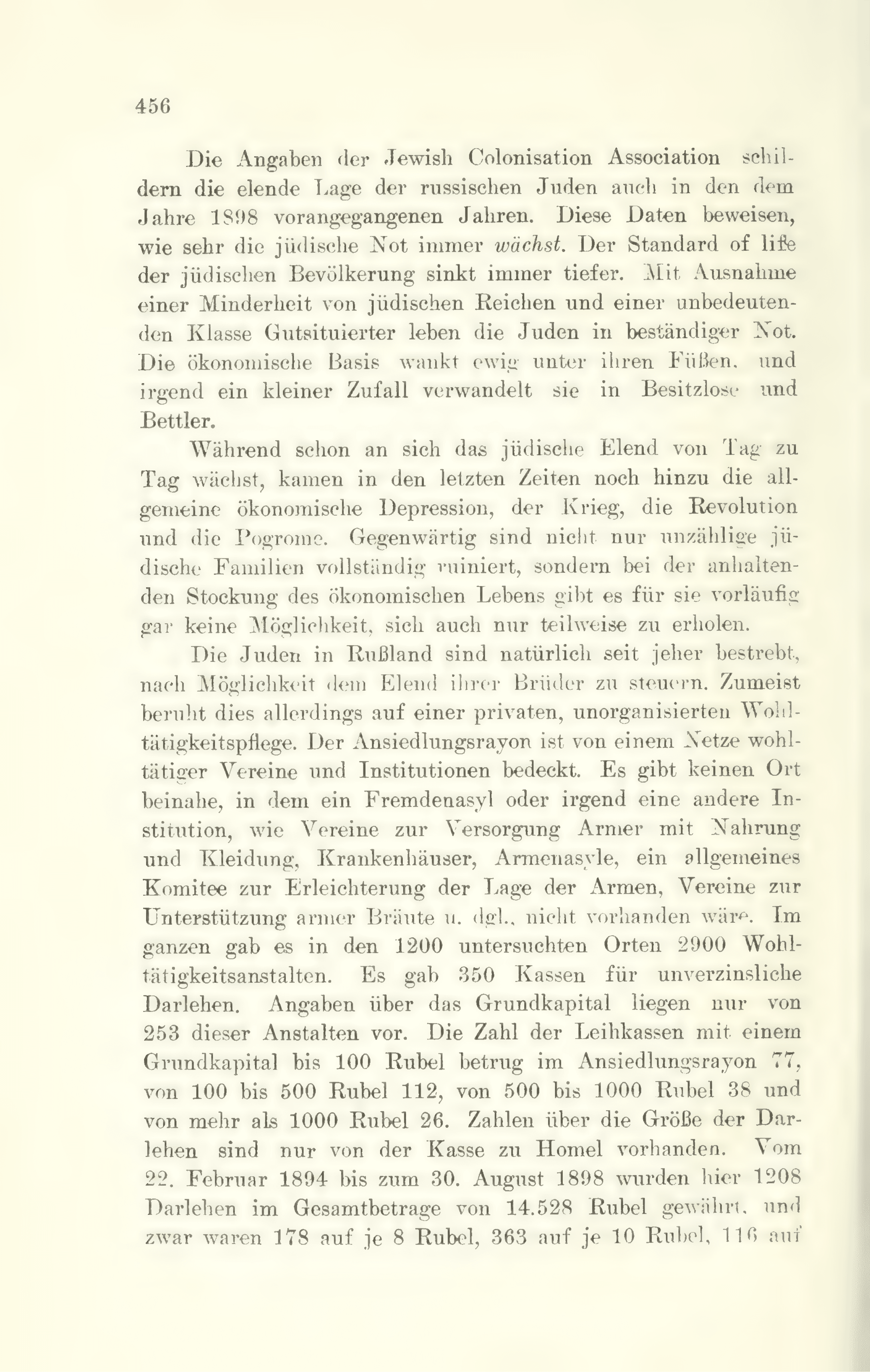
456 The data from the Jewish Colonisation Association also depict the miserable situation of the Russian Jews in the years preceding 1898. This data proves how much Jewish hardship is constantly growing. The standard of life of the Jewish population is sinking ever lower. With the exception of a minority of rich Jews and an insignificant class of the well-to-do, the Jews live in constant distress. The economic basis is forever shaking beneath their feet, and any small accident turns them into the dispossessed and beggars. While Jewish misery was already growing day by day, in recent times the general economic depression, the war, the revolution, and the pogroms have been added. Currently, not only are countless Jewish families completely ruined, but with the persistent stagnation of economic life, there is for them for the time being no possibility at all to even partially recover. The Jews in Russia have, of course, always striven, as much as possible, to counter the misery of their brethren. For the most part, however, this is based on private, unorganized charity work. The Pale of Settlement is covered by a network of charitable societies and institutions. There is hardly a place where a shelter for strangers or some other institution, such as societies for supplying the poor with food and clothing, hospitals, poor asylums, a general committee for alleviating the situation of the poor, societies for supporting poor brides, and the like, would not be present. In total, there were 2,900 charitable institutions in the 1,200 localities surveyed. There were 350 funds for interest-free loans. Data on the capital stock is only available for 253 of these institutions. The number of lending funds with a capital stock of up to 100 rubles in the Pale of Settlement was 77, from 100 to 500 rubles 112, from 500 to 1000 rubles 38, and of more than 1000 rubles 26. Figures on the size of the loans are only available from the fund in Gomel. From February 22, 1894, to August 30, 1898, 1,208 loans totaling 14,528 rubles were granted here, of which 178 were for 8 rubles each, 363 for 10 rubles each, 116 for
Show Original German Text
456 Die Angaben der Jewish Colonisation Association schil- dem die elende Lage der russischen Juden auch in den dem Jahre 1898 vorangegangenen Jahren. Diese Daten beweisen, wie sehr die jüdische Not immer wächst. Der Standard of life der jüdischen Bevölkerung sinkt immer tiefer. Mit Ausnahme einer Minderheit von jüdischen Reichen und einer unbedeuten- den Klasse Gutſituierter leben die Juden in beständiger Not. Die ökonomische Baſis wankt ewig unter ihren Füßen. und irgend ein kleiner Zufall verwandelt sie in Beſitzloſe und Bettler. Während schon an ſich das jüdische Elend von Tag zu Tag wächst, kamen in den letzten Zeiten noch hinzu die all- gemeine ökonomische Depreſſion, der Kneg, die Revolution und die Pogrome. Gegenwärtig ſind nicht nur unzählige jü- dische Familien vollständig ruiniert, ſondem bei der anhalten- den Stockung des ökonomischen Lebens gibt es für ſie vorläufig gar keine Möglichkeit, ſich auch nur teilweiſe zu erholen. Die Juden in Rußland ſind natürlich ſeit jeher bestrebt, nach Möglichkeit dem Elend ihrer Brüder zu steuem. Zumeist beruht dies allerdings auf einer pnvaten, unorganiſierten Wohl- tätigkeitspflege. Der Anſiedlungsrayon ist von einem Netze wohl- tätiger Vereine und Institutionen bedeckt. Es gibt keinen Ort beinahe, in dem ein Fremdenaſyl oder irgend eine andere In- stitution, wie Vereine zur Verſorgung Armer mit Nahrung und Kleidung, Krankenhäuſer, Armenaſyle, ein allgemeines Komitee zur Erleichterung der Lage der Armen, Vereine zur Unterstützung armer Bräute u. dgl., nicht vorhanden wäre. Im ganzen gab es in den 1200 unterſuchten Orten 2900 Wohl- tätigkeitsanstalten. Es gab 350 Kaſſen für unverzinsliche Darlehen. Angaben über das Grundkapital liegen nur von 253 dieſer Anstalten vor. Die Zahl der Leihkaſſen mit einem Grundkapital bis 100 Rubel betrug im Anſiedlungsrayon 77, von 100 bis 500 Rubel 112, von 500 bis 1000 Rubel 38 und von mehr als 1000 Rubel 26. Zahlen über die Größe der Dar- lehen ſind nur von der Kaſſe zu Homel vorhanden. Vom 22. Februar 1894 bis zum 30. August 1898 wurden hier 1208 Darlehen im Geſamtbetrage von 14.528 Rubel gewährt. und zwar waren 178 auf je 8 Rubel, 363 auf je 10 Rubel, 116 auf