The Racial Problem (1912)
Page 406 • Click to zoom
Page 406 of 568
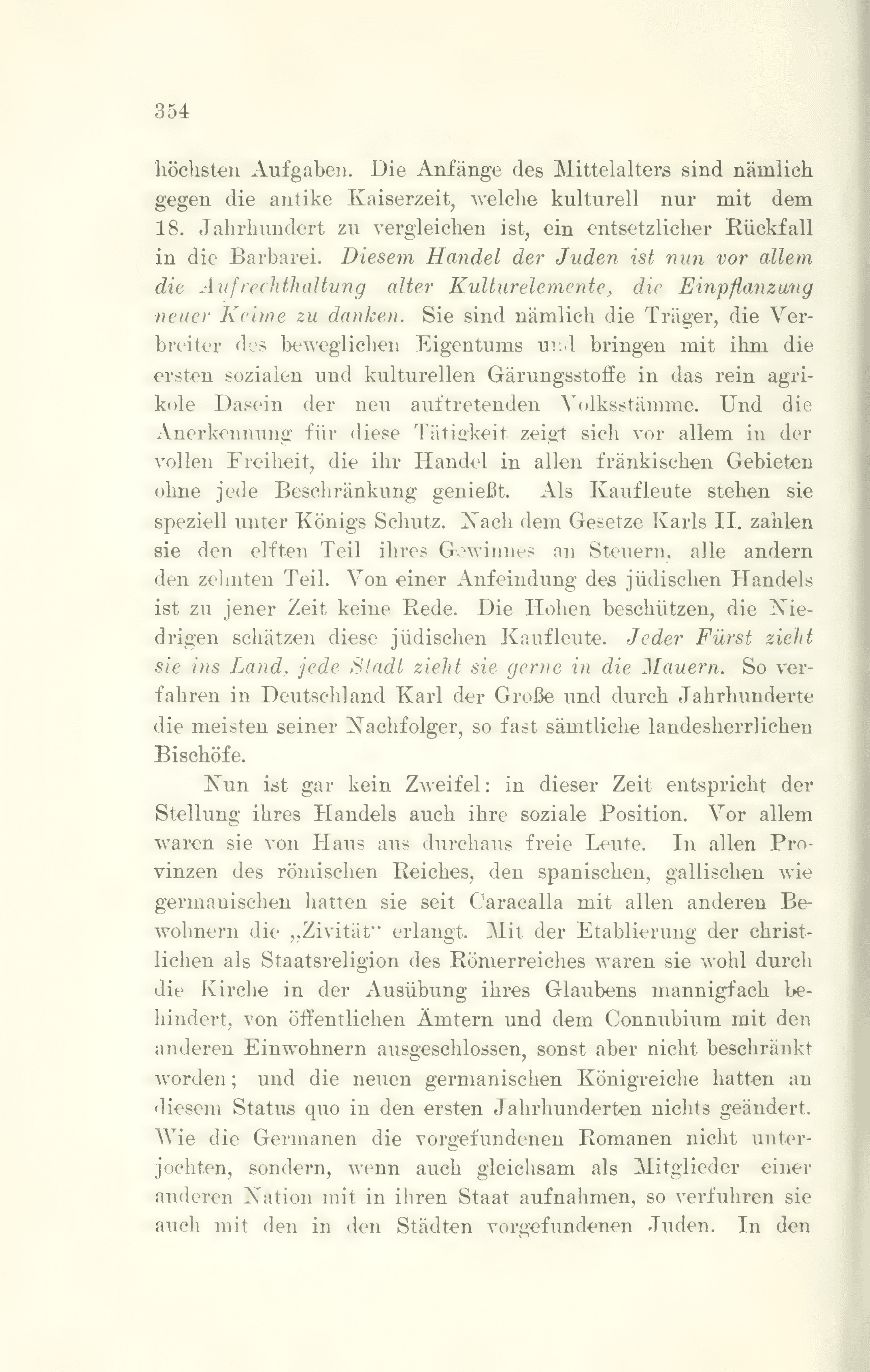
354 highest tasks. The beginning of the Middle Ages is, in comparison to the ancient imperial era, which is culturally comparable only with the 18th century, a dreadful relapse into barbarism. To this trade of the Jews, we owe above all the preservation of old cultural elements, the planting of new seeds. For they are the carriers, the dis- seminators of movable property and with it brought the first social and cultural fermenting agents into the purely agricul- tural existence of the newly emerging tribes. And the recognition for this activity is shown above all in the full freedom that their trade enjoys in all Frankish territories without any restriction. As merchants, they are specially under the king's protection. According to the law of Charles II, they pay the eleventh part of their profit in taxes, all others the tenth part. Of any hostility to Jewish trade, there is no mention at that time. The high-ranking protect them, the low- ranking value these Jewish merchants. Every prince draws them into the country, every city gladly draws them into its walls. Thus acted in Germany Charlemagne and for centuries most of his successors, as did almost all the territorial bishops.
Now there is no doubt: in this period, their social position corresponded to the position of their trade. Above all, they were from the outset completely free people. In all pro- vinces of the Roman Empire, the Spanish, Gallic as well as Germanic, they had, since Caracalla, attained “civity” along with all other inhabitants. With the establishment of the Christian religion as the state religion of the Roman Empire, they were indeed hindered by the Church in various ways in the practice of their faith, excluded from public offices and from connubium with the other inhabitants, but were not otherwise restricted; and the new Germanic kingdoms had changed nothing about this status quo in the first centuries. Just as the Germans did not subjugate the Romans they found, but rather, albeit as members of another nation, accepted them into their state, so they also proceeded with the Jews found in the cities. In the
Show Original German Text
354 höchsten Aufgaben. Die Anfänge des Mittelalters sind nämlich gegen die antike Kaiserzeit, welche kulturell nur mit dem 18. Jahrhundert zu vergleichen ist, ein entſetzlicher Rückfall in die Barbarei. Dieſem Handel der Juden ist nun vor allem die Aufrechterhaltung alter Kulturelemente, die Einpflanzung neuer Keime zu danken. Sie ſind nämlich die Träger, die Ver- breiter des beweglichen Eigentums und bnngen mit ihm die ersten ſozialen und kulturellen Gärungsstoffe in das rein agn- kole Daſein der neu auftretenden Volksstämme. Und die Anerkennung für dieſe Tätigkeit zeigt ſich vor allem in der vollen Freiheit, die ihr Handel in allen fränkischen Gebieten ohne jede Beschränkung genießt. Als Kaufleute stehen ſie speziell unter Königs Schutz. Nach dem Geseze Karls II. zahlen ſie den elften Teil ihres Gewinnes an Steuem, alle andem den zehnten Teil. Von einer Anfeindung des jüdischen Handels ist zu jener Zeit keine Rede. Die Hohen beschützen, die Nie- dngen schätzen dieſe jüdischen Kaufleute. Jeder Fürst zieht ſie ins Land, jede Stadt zieht ſie geme in die Mauem. So ver- fahren in Deutschland Karl der Große und durch Jahrhunderte die meisten ſeiner Nachfolger, ſo fast ſämtliche landesherrlichen Bischöfe. Nun ist gar kein Zweifel: in dieſer Zeit entspncht der Stellung ihres Handels auch ihre soziale Poſition. Vor allem waren ſie von Haus aus durchaus freie Leute. In allen Pro- vinzen des römischen Reiches, den spanischen, gallischen wie germanischen hatten ſie ſeit Caracalla mit allen anderen Be- wohnem die „Zivität“ erlangt. Mit der Etablierung der chnst- lichen als Staatsreligion des Römerreiches waren ſie wohl durch die Kirche in der Ausübung ihres Glaubens mannigfach be- hindert, von öffentlichen Ämtem und dem Connubium mit den anderen Einwohnem ausgeschloſſen, ſonst aber nicht beschränkt worden; und die neuen germanischen Königreiche hatten an dieſem Status quo in den ersten Jahrhunderten nichts geändert. Wie die Germanen die vorgefundenen Romanen nicht unter- jochten, ſondem, wenn auch gleichſam als Mitglieder einer anderen Nation mit in ihren Staat aufnahmen, ſo verfuhren ſie auch mit den in den Städten vorgefundenen Juden. In den