The Racial Problem (1912)
Page 373 • Click to zoom
Page 373 of 568
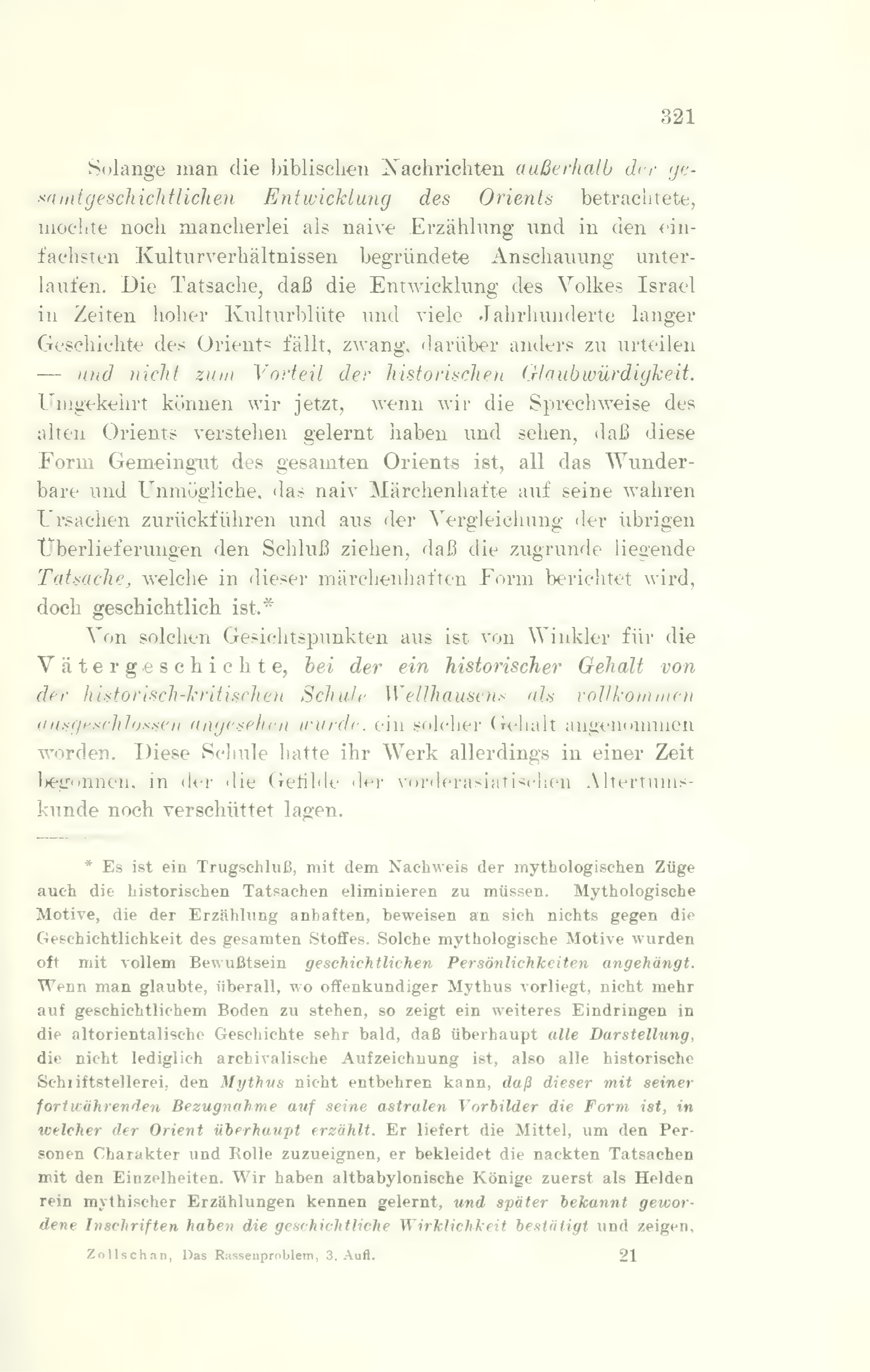
321 As long as one considered the biblical accounts outside the overall historical development of the Orient, much could still pass as naive narration and as a view founded in the simplest cultural conditions. The fact that the development of the people of Israel falls into times of high cultural flourishing and many centuries of Oriental history forced a different judgment on the matter — and not to the advantage of historical credibility.
Conversely, now that we have learned to understand the manner of speech of the ancient Orient and see that this form is the common property of the entire Orient, we can trace all the wonderful and impossible, the naively fairytale-like, back to its true causes and, from comparing the other traditions, draw the conclusion that the underlying fact, which is reported in this fairytale-like form, is nevertheless historical.*
From such points of view, a historical content has been assumed by Winkler for the patriarchal history, for which a historical content was regarded as completely excluded by the historical-critical school of Wellhausen. This school had, to be sure, begun its work at a time when the fields of Near Eastern archaeology were still buried.
- It is a fallacy to think that with the proof of the mythological features the historical facts must also be eliminated. Mythological motifs attached to the narrative do not in themselves prove against the historicity of the entire material. Such mythological motifs were often attached to historical personalities with full consciousness. If one believed that wherever obvious myth is present, one is no longer on historical ground, a deeper penetration into ancient Oriental history very soon shows that all representation that is not merely archival recording, thus all historical writing, cannot do without myth, that myth, with its constant reference to its astral archetypes, is the form in which the Orient narrates at all. It provides the means to assign character and role to the persons, it clothes the naked facts with details. We first came to know old Babylonian kings as heroes of purely mythical tales, and inscriptions that became known later have confirmed the historical reality and show, Zollschan, The Race Problem, 3rd ed. 21
Show Original German Text
321 Solange man die biblischen Nachnchten außerhalb der ge- ſamtgeschichtlichen Entwicklung des Onents betrachtete, mochte noch mancherlei als naive Erzählung und in den ein- fachsten Kulturverhältniſſen begründete Anschauung unter- laufen. Die Tatsache, daß die Entwicklung des Volkes Israel in Zeiten hoher Kulturblüte und viele Jahrhunderte langer Geschichte des Onents fällt, zwang, darüber anders zu urteilen — und nicht zum Vorteil der histonschen Glaubwürdigkeit. Umgekehrt können wir jetzt, wenn wir die Sprechweiſe des alten Onents verstehen gelemt haben und ſehen, daß dieſe Form Gemeingut des geſamten Onents ist, all das Wunder- bare und Unmögliche, das naiv Märchenhafte auf ſeine wahren Urſachen zurückführen und aus der Vergleichung der übngen Überlieferungen den Schluß ziehen, daß die zugrunde liegende Tatsache, welche in dieſer märchenhaften Form benchtet wird, doch geschichtlich ist.* Von ſolchen Geſichtspunkten aus ist von Winkler für die Vätergeschichte, bei der ein histonscher Gehalt von der histonsch-kntischen Schule Wellhauſens als vollkommen ausgeschloſſen angeſehen wurde, ein ſolcher Gehalt angenommen worden. Dieſe Schule hatte ihr Werk allerdings in einer Zeit begonnen, in der die Gefilde der vorderaſiatischen Altertums- kunde noch verschüttet lagen. * Es ist ein Trugschluß, mit dem Nachweis der mythologischen Züge auch die histonschen Tatsachen eliminieren zu müſſen. Mythologische Motive, die der Erzählung anhaften, beweiſen an ſich nicht gegen die Geschichtlichkeit des geſamten Stoffes. Solche mythologische Motive wurden oft mit vollem Bewußtſein geschichtlichen Perſönlichkeiten angehängt. Wenn man glaubte, überall, wo offenkundiger Mythus vorliegt, nicht mehr auf geschichtlichem Boden zu stehen, ſo zeigt ein weiteres Eindnngen in die altonentalische Geschichte ſehr bald, daß überhaupt alle Darstellung, die nicht lediglich archivalische Aufzeichnung ist, alſo alle histonsche Schnftstellerei, den Mythus nicht entbehren kann, daß dieſer mit ſeiner fortwährenden Bezugnahme auf ſeine astralen Vorbilder die Form ist, in welcher der Onent überhaupt erzählt. Er liefert die Mittel, um den Per- ſonen Charakter und Rolle zuzueignen, er bekleidet die nackten Tatsachen mit den Einzelheiten. Wir haben altbabylonische Könige zuerst als Helden rein mythischer Erzählungen kennen gelemt, und später bekannt gewor- dene Inschnften haben die geschichtliche Wirklichkeit bestätigt und zeigen, Zollschan, Das Raſſenproblem, 3. Aufl. 21