The Racial Problem (1912)
Page 291 • Click to zoom
Page 291 of 568
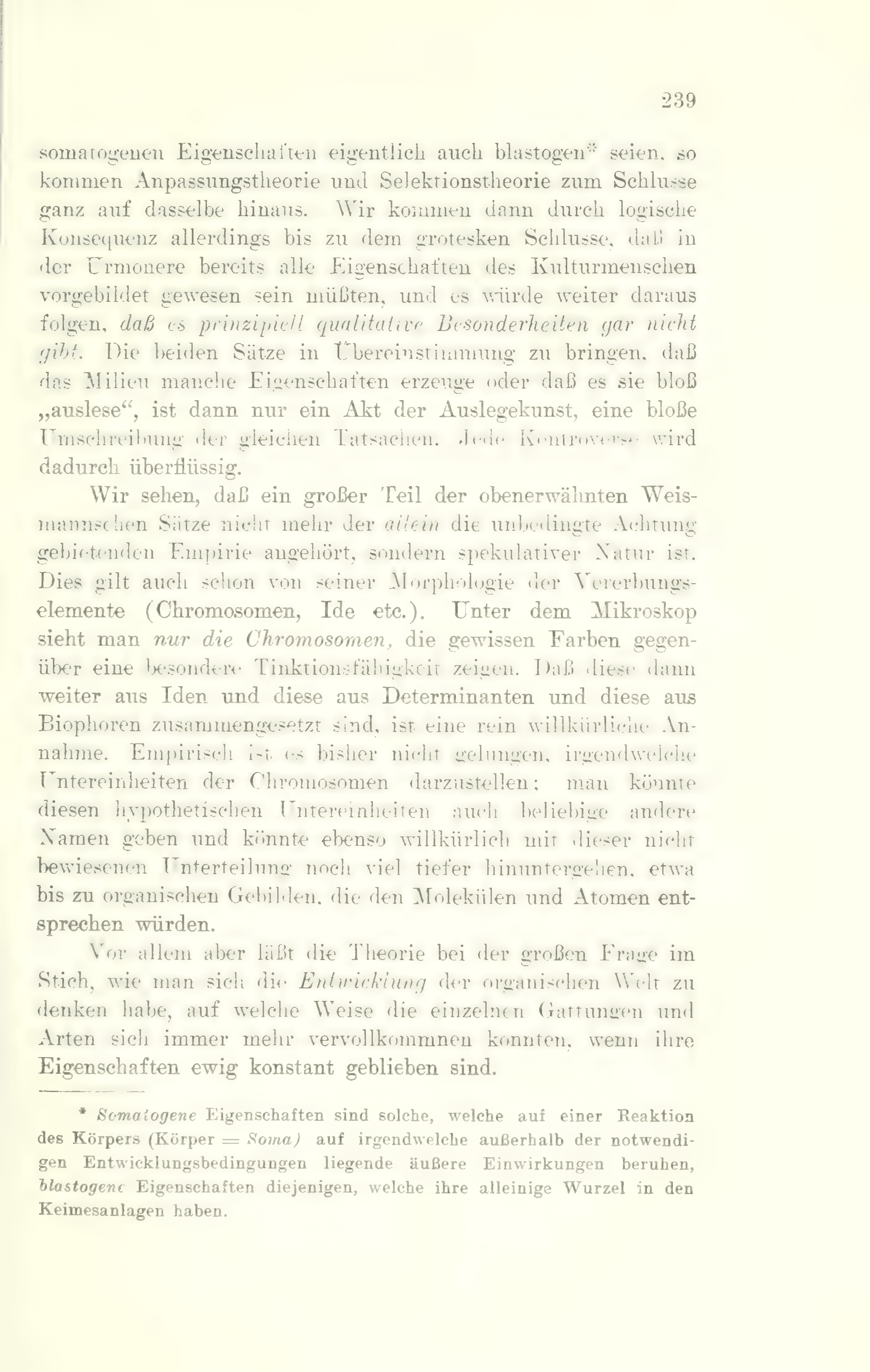
239 somatogenic properties were actually also blastogenic*, then adaptation theory and selection theory would ultimately come to the very same conclusion. By logical consequence, we would then arrive at the grotesque conclusion that in the primordial moneron all the properties of civilized man must have already been preformed, and it would further follow that, in principle, qualitative peculiarities do not exist at all. To bring the two propositions into agreement—that the milieu creates some properties or that it merely "selects" them—is then only an act of interpretive artistry, a mere rewording of the same facts. Any controversy is thereby rendered superfluous. We see that a large part of the above-mentioned Weismannian theses no longer belongs to the empiricism that alone commands unconditional respect, but is of a speculative nature. This is also true of his morphology of the elements of heredity (chromosomes, ids, etc.). Under the microscope, one sees only the chromosomes, which show a particular stainability towards certain dyes. That these are then further composed of ids, and these of determinants, and these of biophores, is a purely arbitrary assumption. Empirically, it has not yet been possible to demonstrate any subunits of the chromosomes; one could also give these hypothetical subunits any other names and could just as arbitrarily go much deeper with this unproven subdivision, perhaps down to organic structures that would correspond to molecules and atoms. Above all, however, the theory fails us on the great question of how one is to conceive of the development of the organic world, in what way the individual genera and species could become more and more perfect if their properties have remained eternally constant.
- Somatogenic properties are those based on a reaction of the body (body - soma) to any external influences lying outside the necessary conditions for development; blastogenic properties are those which have their sole root in the germinal predispositions.
Show Original German Text
239 somatogenen Eigenschaften eigentlich auch blastogen* seien, so kommen Anpassungstheone und Selektionstheone zum Schlusse ganz auf dasselbe hinaus. Wir kommen dann durch logische Konsequenz allerdings bis zu dem grotesken Schlusse, daß in der Urmonere bereits alle Eigenschaften des Kulturmenschen vorgebildet gewesen sein müßten, und es würde weiter daraus folgen, daß es pnnzipiell qualitative Besonderheiten gar nicht gibt. Die beiden Sätze in Übereinstimmung zu bnngen, daß das Milieu manche Eigenschaften erzeuge oder daß es sie bloß „auslese“, ist dann nur ein Akt der Auslegekunst, eine bloße Umschreibung der gleichen Tatsachen. Jede Kontroverse wird dadurch überflüssig. Wir sehen, daß ein großer Teil der obenerwähnten Weis- mannschen Sätze nicht mehr der allein die unbedingte Achtung gebietenden Empine angehört, sondem spekulativer Natur ist. Dies gilt auch schon von seiner Morphologie der Vererbungs- elemente (Chromosomen, Ide etc.). Unter dem Mikroskop sieht man nur die Chromosomen, die gewissen Farben gegen- über eine besondere Tintionsfähigkeit zeigen. Daß diese dann weiter aus Iden und diese aus Determinanten und diese aus Biophoren zusammengesetzt sind, ist eine rein willkürliche An- nahme. Empinsch ist es bisher nicht gelungen, irgendwelche Untereinheiten der Chromosomen darzustellen; man könnte diesen hypothetischen Untereinheiten auch beliebige andere Namen geben und könnte ebenso willkürlich mit dieser nicht bewiesenen Unterteilung noch viel tiefer hinuntergehen, etwa bis zu organischen Gebilden, die den Molekülen und Atomen ent- sprechen würden. Vor allem aber läßt die Theone bei der großen Frage im Stich, wie man sich die Entwicklung der organischen Welt zu denken habe, auf welche Weise die einzelnen Gattungen und Arten sich immer mehr vervollkommnen konnten, wenn ihre Eigenschaften ewig konstant geblieben sind. * Somatogene Eigenschaften sind solche, welche auf einer Reaktion des Körpers (Körper - Soma) auf irgendwelche außerhalb der notwendi- gen Entwicklungsbedingungen liegende äußere Einwirkungen beruhen, blastogene Eigenschaften diejenigen, welche ihre alleinige Wurzel in den Keimesanlagen haben.