The Racial Nobility of the Jews
Page 40 • Click to zoom
Page 40 of 76
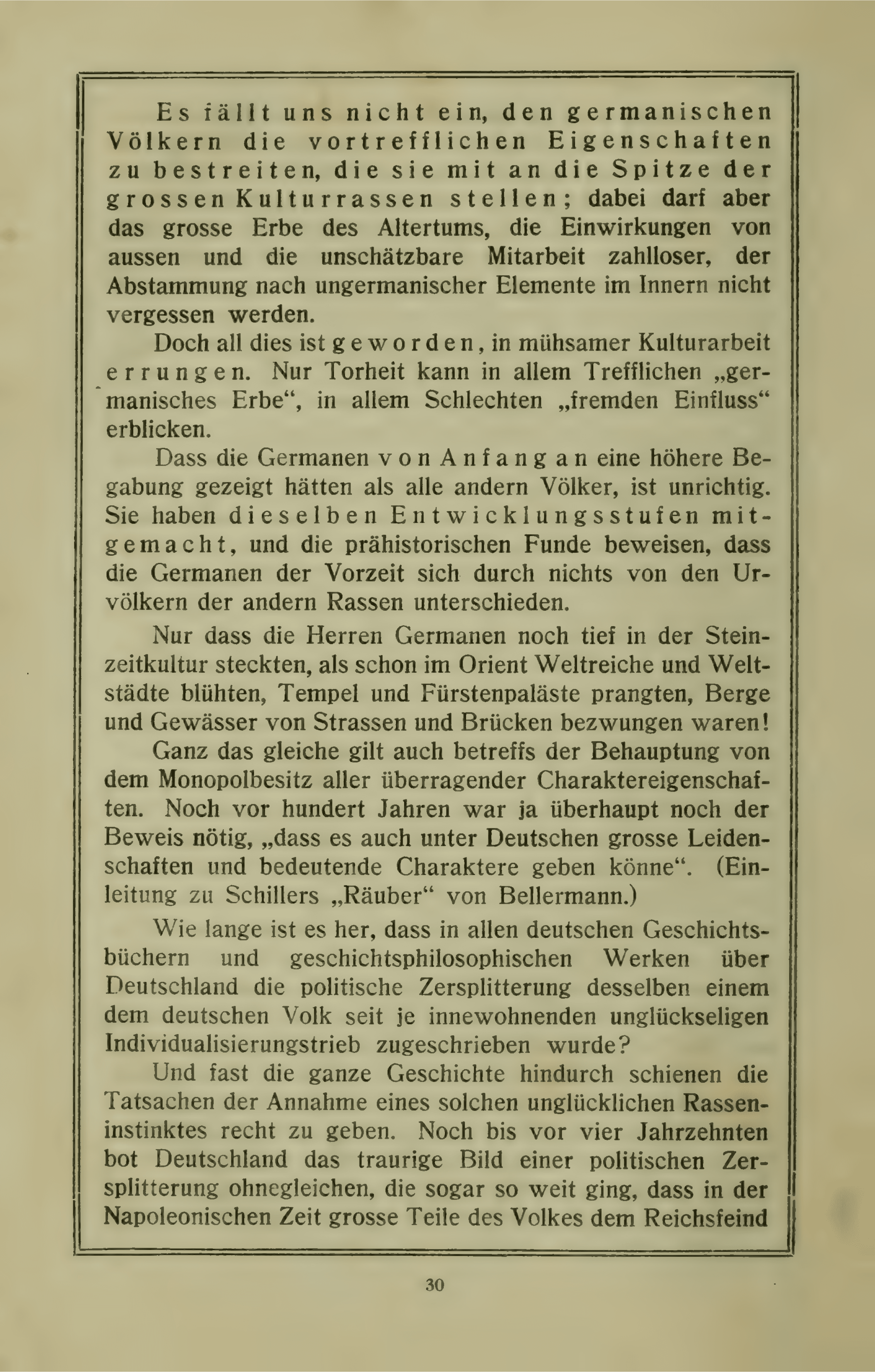
It would not occur to us to deny the Germanic peoples the excellent qualities that place them at the forefront of the great culture-races; yet in doing so, the great heritage of antiquity, the influences from outside, and the invaluable collaboration of countless elements of non-Germanic descent within must not be forgotten.
But all this has come to be, achieved through arduous cultural work. Only foolishness can see "Germanic heritage" in everything excellent, and "foreign influence" in everything bad.
That the Germanic peoples showed a higher talent than all other peoples from the beginning is incorrect.
They have gone through the same stages of development, and prehistoric finds prove that the Germanic peoples of prehistoric times were in no way different from the primordial peoples of the other races.
Only that the "master" Germans were still stuck deep in Stone Age culture when in the Orient world empires and world cities were already flourishing, temples and princely palaces stood resplendent, mountains and waters had been conquered by roads and bridges!
Exactly the same is also true concerning the claim of a monopoly on all superior character traits. Just a hundred years ago, proof was still necessary "that great passions and significant characters could also exist among Germans." (Introduction to Schiller's "The Robbers" by Bellermann.)
How long ago was it that in all German history books and works on the philosophy of history concerning Germany, its political fragmentation was attributed to a calamitous drive for individualization inherent in the German people since time immemorial?
And throughout almost all of history, the facts seemed to justify the assumption of such an unfortunate racial instinct. Until just four decades ago, Germany presented the sad picture of a political fragmentation without equal, which even went so far that in the Napoleonic era large parts of the people sided with the enemy of the Reich. 30
Show Original German Text
Es fällt uns nicht ein, den germanischen Völkem die vortrefflichen Eigenschaften zu bestreiten, die ſie mit an die Spitze der großen Kulturraſſen stellen; dabei darf aber das große Erbe des Altertums, die Einwirkungen von außen und die unschätzbare Mitarbeit zahlloser, der Abstammung nach ungermanischer Elemente im Innem nicht vergeſſen werden. Doch all dies ist geworden, in mühſamer Kulturarbeit errungen. Nur Torheit kann in allem Trefflichen „ger- manisches Erbe“, in allem Schlechten „fremden Einfluß“ erblicken. Daß die Germanen von Anfang an eine höhere Be- gabung gezeigt hätten als alle andem Völker, ist unnchtig. Sie haben dieſelben Entwicklungsstufen mit- gemacht, und die prähistonschen Funde beweiſen, daß die Germanen der Vorzeit ſich durch nichts von den Ur- völkem der andem Raſſen unterschieden. Nur daß die Herren Germanen noch tief in der Stein- zeitkultur steckten, als schon im Onent Weltreiche und Welt- städte blühten, Tempel und Fürstenpaläste prangten, Berge und Gewäſſer von Straſſen und Brücken bezwungen waren! Ganz das gleiche gilt auch betreffs der Behauptung von dem Monopolbeſitz aller überragender Charaktereigenschaf- ten. Noch vor hundert Jahren war ja überhaupt noch der Beweis nötig, „daß es auch unter Deutschen große Leiden- schaften und bedeutende Charaktere geben könne“. (Ein- leitung zu Schillers „Räuber“ von Bellermann.) Wie lange ist es her, daß in allen deutschen Geschichts- büchem und geschichtsphiloſophischen Werken über Deutschland die politische Zersplitterung deſſelben einem dem deutschen Volk ſeit je innewohnenden unglückseligen Individualiſierungstneb zugeschneben wurde? Und fast die ganze Geschichte hindurch schienen die Tatsachen der Annahme eines ſolchen unglücklichen Raſſen- instinktes recht zu geben. Noch bis vor vier Jahrzehnten bot Deutschland das traunge Bild einer politischen Zer- splitterung ohnegleichen, die ſogar ſo weit ging, daß in der Napoleonischen Zeit große Teile des Volkes dem Reichsfeind 30