National Judaism
Page 45 • Click to zoom
Page 45 of 52
— 41 —
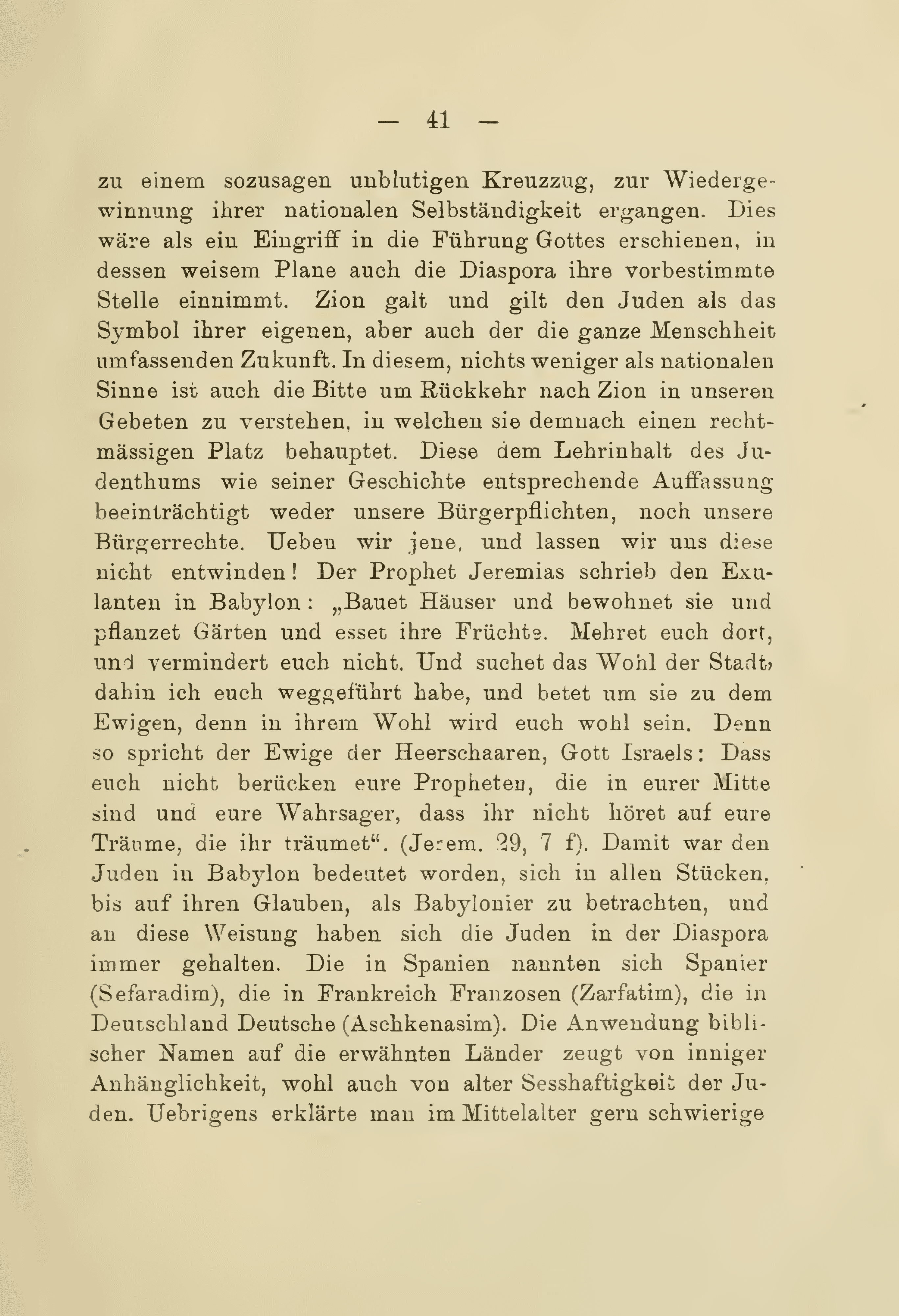
to a so-to-speak bloodless crusade, to regain their national independence. This would have appeared as an interference in God's guidance, in whose wise plan the Diaspora also occupies its predetermined place. Zion was and is for the Jews the symbol of their own future, but also of the future that encompasses all of humanity. In this, no less than national, sense is the plea for a return to Zion in our prayers to be understood, in which it therefore holds a rightful place. This understanding, which corresponds to the teachings of Judaism as well as to its history, impairs neither our civic duties nor our civil rights. Let us practice the former, and let us not allow the latter to be wrested from us! The prophet Jeremiah wrote to the exiles in Babylon: "Build houses and dwell in them; and plant gardens and eat their fruit. Multiply there, and do not decrease. And seek the welfare of the city where I have sent you into exile, and pray to the Eternal for it, for in its welfare you will find your welfare. For thus says the Eternal of Hosts, the God of Israel: Let not your prophets who are in your midst, and your diviners, deceive you, that you should not listen to your dreams which you dream". (Jerem. 29, 7 f).
By this, the Jews in Babylon were instructed to consider themselves Babylonians in all respects, except for their faith, and the Jews in the Diaspora have always adhered to this instruction. Those in Spain called themselves Spaniards (Sefaradim), those in France Frenchmen (Zarfatim), those in Germany Germans (Aschkenasim). The application of biblical names to the mentioned countries testifies to an intimate attachment, and likely also to the ancient settlement of the Jews. Moreover, in the Middle Ages, one gladly explained difficult
Show Original German Text
— 41 — zu einem sozusagen unblutigen Kreuzzug, zur Wiederge- winnung ihrer nationalen Selbständigkeit ergangen. Dies wäre als ein Eingnff in die Führung Gottes erschienen, in deſſen weiſem Plane auch die Diaspora ihre vorbestimmte Stelle einnimmt. Zion galt und gilt den Juden als das Symbol ihrer eigenen, aber auch der die ganze Menschheit umfaſſenden Zukunft. In diesem, nichts weniger als nationalen Sinne ist auch die Bitte um Rückkehr nach Zion in unſeren Gebeten zu verstehen, in welchen sie demnach einen recht- mäßigen Platz behauptet. Dieſe dem Lehnnhalt des Ju- dentums wie seiner Geschichte entsprechende Auffaſſung beeinträchtigt weder unſere Bürgerpflichten, noch unſere Bürgerrechte. Ueben wir jene, und laſſen wir uns dieſe nicht entwinden! Der Prophet Jeremias schneb den Exu- lanten in Babylon: „Bauet Häuſer und bewohnet sie und pflanzet Gärten und eſſet ihre Früchte. Mehret euch dort, und vermindert euch nicht. Und suchet das Wohl der Stadt, dahin ich euch weggeführt habe, und betet um sie zu dem Ewigen, denn in ihrem Wohl wird euch wohl sein. Denn ſo spncht der Ewige der Heerschaaren, Gott Israels: Daſſ euch nicht berücken eure Propheten, die in eurer Mitte ſind und eure Wahrsager, daſſ ihr nicht höret auf eure Träume, die ihr träumet“. (Jerem. 29, 7 f). Damit war den Juden in Babylon bedeutet worden, sich in allen Stücken, bis auf ihren Glauben, als Babylonier zu betrachten, und an diese Weisung haben sich die Juden in der Diaspora immer gehalten. Die in Spanien nannten sich Spanier (Sefaradim), die in Frankreich Franzosen (Zarfatim), die in Deutschland Deutsche (Aschkenasim). Die Anwendung bibli- scher Namen auf die erwähnten Länder zeugt von inniger Anhänglichfeit, wohl auch von alter Seſſhaftigfeit der Ju- den. Uebngens erklärte man im Mittelalter gem schwienge