National Judaism
Page 36 • Click to zoom
Page 36 of 52
— 32 —
invisible God into the masses, as executors of Israel's mission and of the prophetic promises.
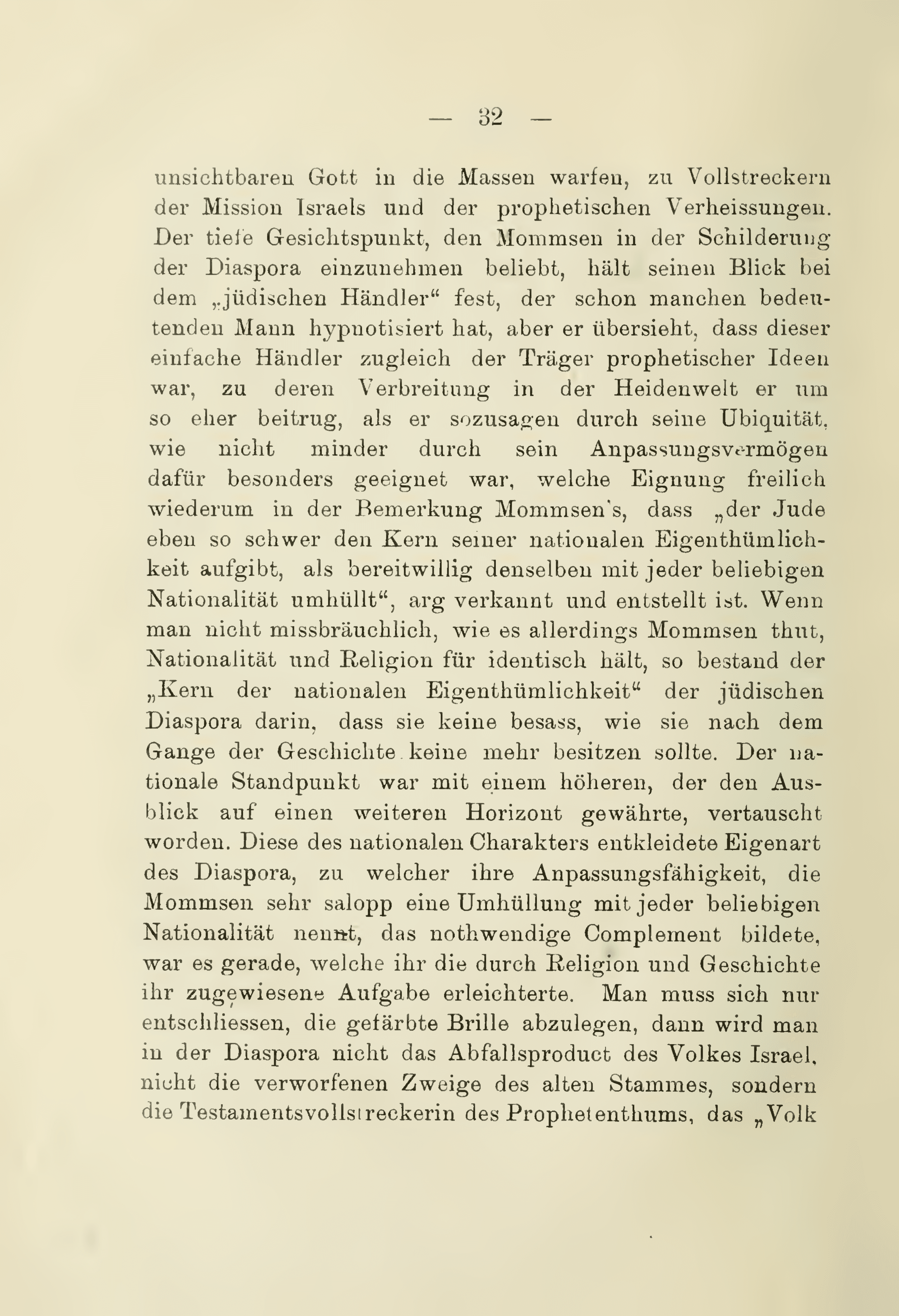
The profound viewpoint that Mommsen is fond of taking in his depiction of the Diaspora fixes his gaze on the “Jewish trader,” who has already hypnotized many a significant man, but he overlooks that this simple trader was at the same time the carrier of prophetic ideas, to whose dissemination in the pagan world he all the more contributed, as he was, so to speak, particularly suited for it through his ubiquity, as well as through his adaptability—an aptitude which, however, is in turn badly misjudged and distorted in Mommsen's remark that “the Jew gives up the core of his national peculiarity just as reluctantly as he readily envelops it with any given nationality.” If one does not improperly—as Mommsen indeed does—hold nationality and religion to be identical, then the “core of the national peculiarity” of the Jewish Diaspora consisted in the fact that it possessed none, just as according to the course of history it was no longer meant to possess any. The national standpoint had been exchanged for a higher one, which granted a view of a broader horizon. This characteristic of the Diaspora, stripped of its national character—to which its adaptability, which Mommsen very casually calls an envelopment with any given nationality, formed the necessary complement—was precisely what facilitated for it the task assigned to it by religion and history. One must only resolve to take off the colored glasses, and then one will see in the Diaspora not the waste product of the people of Israel, not the rejected branches of the old stem, but rather the executrix of the will of prophetism, the “people
Show Original German Text
— 32 — unsichtbaren Gott in die Maſſen warf, zu Vollstreckem der Miſſion Israels und der prophetischen Verheiſſungen. Der tiefe Geſichtspunkt, den Mommſen in der Schilderung der Diaspora einzunehmen beliebt, hält ſeinen Blick bei dem „jüdischen Händler“ fest, der schon manchen bedeu- tenden Mann hypnotiſiert hat, aber er überſieht, daſſ dieſer einfache Händler zugleich der Träger prophetischer Ideen war, zu deren Verbreitung in der Heidenwelt er um ſo eher beitrug, als er ſozusagen durch ſeine Ubiquität, wie nicht minder durch ſein Anpaſſungsvermögen dafür beſonders geeignet war, welche Eignung freilich wiederum in der Bemerkung Mommſen's, daſſ „der Jude eben ſo schwer den Kem ſeiner nationalen Eigentümlich- keit aufgibt, als bereitwillig denſelben mit jeder beliebigen Nationalität umhüllt“, arg verkannt und entstellt ist. Wenn man nicht miſſbräuchlich, wie es allerdings Mommſen thut, Nationalität und Religion für identisch hält, ſo bestand der „Kem der nationalen Eigentümlichkeit“ der jüdischen Diaspora dann, daſſ ſie keine beſaſſ, wie ſie nach dem Gange der Geschichte keine mehr beſitzen ſollte. Der na- tionale Standpunkt war mit einem höheren, der den Aus- blick auf einen weiteren Honzont gewährte, vertauscht worden. Dieſe des nationalen Charakters entkleidete Eigenart des Diaspora, zu welcher ihre Anpaſſungsfähigkeit, die Mommſen ſehr ſalopp eine Umhüllung mit jeder beliebigen Nationalität nennt, das nothwendige Complement bildete, war es gerade, welche ihr die durch Religion und Geschichte ihr zugewieſene Aufgabe erleichterte. Man muss ſich nur entschlieſſen, die gefärbte Bnlle abzulegen, dann wird man in der Diaspora nicht das Abfalls produkt des Volkes Israel, nicht die verworfenen Zweige des alten Stammes, ſondem die Testamentsvollstreckenn des Prophetenthums, das „Volk