Handbook of the Jewish Question (1944)
Page 81 • Click to zoom
Page 81 of 339
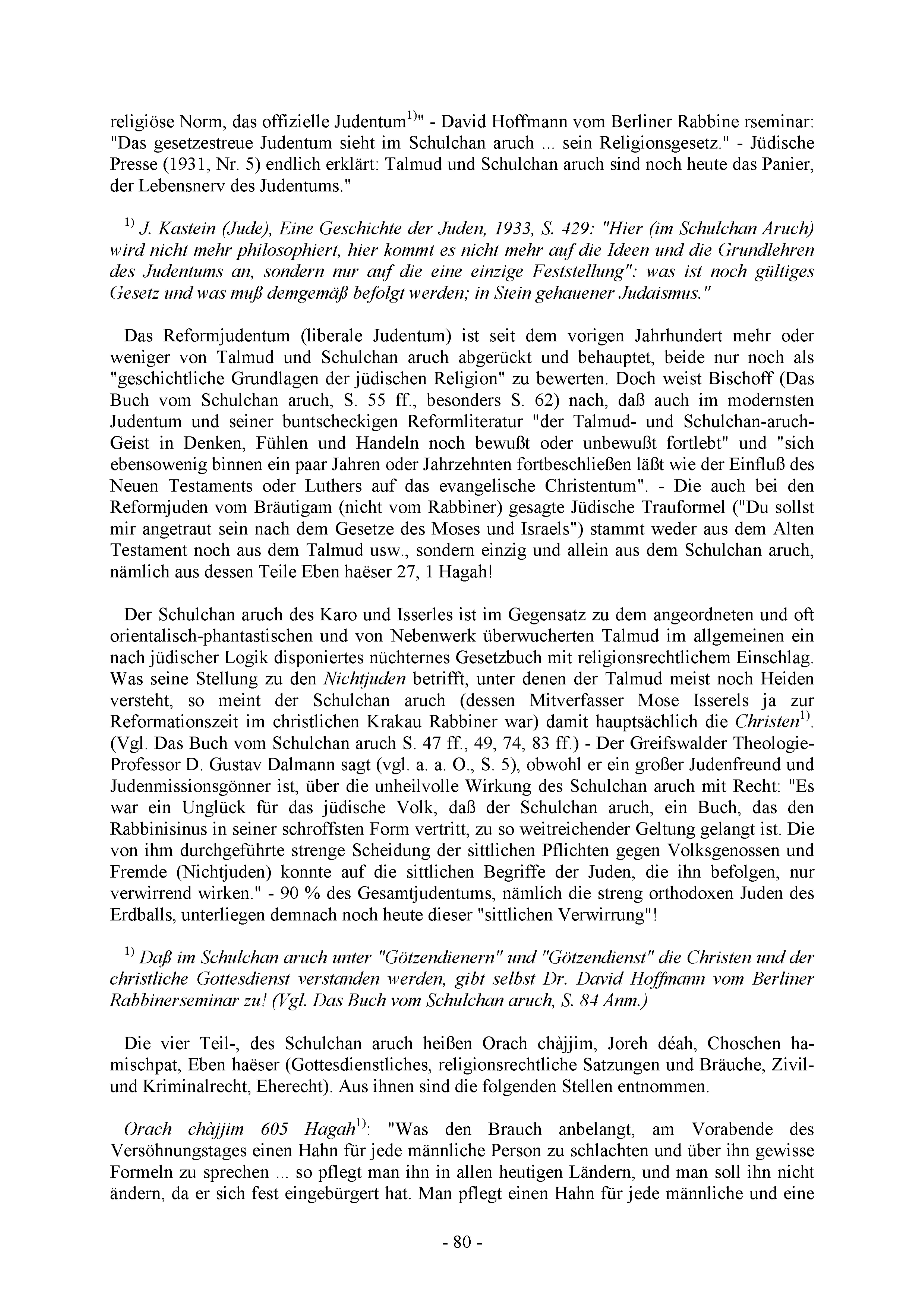
religious norm, official Judaism1)" - David Hoffmann of the Berlin Rabbinical Seminary:
'Observant Judaism sees in the Shulchan Aruch ... its religious law." - Jüdische Presse (1931, No. 5) finally declares: "Talmud and Shulchan Aruch are still today the banner, the lifeblood of Judaism."
- J. Kastein (a Jew), Eine Geschichte der Juden, 1933, p. 429: "Here (in the Shulchan Aruch) there is no more philosophizing, here it is no longer about the ideas and the basic teachings of Judaism, but only about the one single determination": what is still valid law and what must accordingly be followed; Judaism hewn in stone."
Reform Judaism (liberal Judaism) has since the last century more or less moved away from the Talmud and Shulchan Aruch and claims to value both only as "historical foundations of the Jewish religion". Yet Bischoff (Das Buch vom Schulchan aruch, p. 55 ff., especially p. 62) proves that even in the most modern Judaism and its motley reform literature, "the spirit of the Talmud and Shulchan Aruch still lives on, consciously or unconsciously, in thought, feeling, and action" and "can be voted away in a few years or decades just as little as the influence of the New Testament or Luther on Protestant Christianity". - The Jewish wedding formula spoken by the groom (not the rabbi), even among Reform Jews ("You shall be wedded to me according to the law of Moses and Israel"), comes neither from the Old Testament nor from the Talmud, etc., but solely and exclusively from the Shulchan Aruch, namely from its part Even ha-Ezer 27, 1 Hagah!
The Shulchan Aruch of Karo and Isserles is, in contrast to the ordered and often oriental-fantastic Talmud, which is overgrown with secondary material, generally a sober law book arranged according to Jewish logic with a religious-legal character. As for its position on non-Jews, by whom the Talmud mostly still understands pagans, the Shulchan Aruch (whose co-author Moses Isserles was a rabbi in Christian Krakow during the Reformation) thereby mainly means Christians1). (Cf. Das Buch vom Schulchan aruch p. 47 ff., 49, 74, 83 ff.) - The Greifswald theology professor D. Gustav Dalmann says (cf. op. cit., p. 5), although he is a great friend of the Jews and a patron of Jewish missions, rightly about the disastrous effect of the Shulchan Aruch:
"It was a misfortune for the Jewish people that the Shulchan Aruch, a book that represents Rabbinism in its starkest form, achieved such far-reaching validity. The strict separation it implemented between moral duties towards fellow countrymen and strangers (non-Jews) could only have a confusing effect on the moral concepts of the Jews who follow it."
- 90% of all Judaism, namely the strictly orthodox Jews of the globe, are therefore still subject to this "moral confusion" today!
- That in the Shulchan Aruch "idolaters" and "idolatry" are understood to mean Christians and Christian worship is admitted even by Dr. David Hoffmann of the Berlin Rabbinical Seminary! (Cf. Das Buch vom Schulchan aruch, p. 84 note)
The four parts of the Shulchan aruch are called Orach chajjim, Joreh déah, Choschen ha- mischpat, Eben haëser (Worship, religious-legal statutes and customs, civil and criminal law, marriage law). The following passages are taken from them.
Orach chajjim 605 Hagah1):
"Regarding the custom, on the eve of the Day of Atonement, of slaughtering a rooster for each male person and reciting certain formulas over it... this is practiced in all countries today, and one should not change it, as it has become firmly established. It is customary to take a rooster for each male and a
- 80 -
Show Original German Text
religiöse Norm, das offizielle Judentum1)" - David Hoffmann vom Berliner Rabbine rseminar: 'Das gesetzestreue Judentum sieht im Schulchan aruch ... sein Religionsgesetz." - Jüdische Presse (1931, Nr. 5) endlich erklärt: Talmud und Schulchan aruch sind noch heute das Panier, der Lebensnerv des Judentums." 1) J. Kastein (Jude), Eine Geschichte der Juden, 1933, S. 429: "Hier (im Schulchan Aruch) wird nicht mehr philosophiert, hier kommt es nicht mehr auf die Ideen und die Grundlehren des Judentums an, sondern nur auf die eine einzige Feststellung": was ist noch gültiges Gesetz und was muß demgemäß befolgt werden; in Stein gehauener Judaismus." Das Reformjudentum (liberale Judentum) ist seit dem vorigen Jahrhundert mehr oder weniger von Talmud und Schulchan aruch abgerückt und behauptet, beide nur noch als "geschichtliche Grundlagen der jüdischen Religion" zu bewerten. Doch weist Bischoff (Das Buch vom Schulchan aruch, S. 55 ff ., besonders S. 62) nach, daß auch im modernsten Judentum und seiner buntscheckigen Reformliteratur "der Talmud- und Schulchan-aruch- Geist in Denken, Fühlen und Handeln noch bewußt oder unbewußt fortlebt" und "sich ebensowenig binnen ein paar Jahren oder Jahrzehnten fortbeschließen läßt wie der Einfluß des Neuen Testaments oder Luthers auf das evangelische Christentum". - Die auch bei den Reformjuden vom Bräutigam (nicht vom Rabbiner) gesagte Jüdische Trauformel ("Du sollst mir angetraut sein nach dem Gesetze des Moses und Israels") stammt weder aus dem Alten Testament noch aus dem Talmud usw ., sondern einzig und allein aus dem Schulchan aruch, nämlich aus dessen Teile Eben haëser 27, 1 Hagah! Der Schulchan aruch des Karo und Isserles ist im Gegensatz zu dem angeordneten und oft orientalisch-phantastischen und von Nebenwerk überwucherten Talmud im allgemeinen ein nach jüdischer Logik disponiertes nüchternes Gesetzbuch mit religionsrechtlichem Einschlag. Was seine Stellung zu den Nichtjuden betrifft, unter denen der Talmud meist noch Heiden versteht, so meint der Schulchan aruch (dessen Mitverfasser Mose Isserels ja zur Reformationszeit im christlichen Krakau Rabbiner war) damit hauptsächlich die Christen1). (Vgl. Das Buch vom Schulchan aruch S. 47 ff ., 49, 74, 83 ff.) - Der Greifswalder Theologie- Professor D. Gustav Dalmann sagt (vgl. a. a. O ., S. 5), obwohl er ein großer Judenfreund und Judenmissionsgönner ist, über die unheilvolle Wirkung des Schulchan aruch mit Recht: "Es war ein Unglück für das jüdische Volk, daß der Schulchan aruch, ein Buch, das den Rabbinisinus in seiner schroffsten Form vertritt, zu so weitreichender Geltung gelangt ist. Die von ihm durchgeführte strenge Scheidung der sittlichen Pflichten gegen Volksgenossen und Fremde (Nichtjuden) konnte auf die sittlichen Begriffe der Juden, die ihn befolgen, nur verwirrend wirken." - 90 % des Gesamtjudentums, nämlich die streng orthodoxen Juden des Erdballs, unterliegen demnach noch heute dieser "sittlichen Verwirrung"! 1) Daß im Schulchan aruch unter "Götzendienern" und "Götzendienst" die Christen und der christliche Gottesdienst verstanden werden, gibt selbst Dr. David Hoffmann vom Berliner Rabbinerseminar zu! (Vgl. Das Buch vom Schulchan aruch, S. 84 Anm.) Die vier Teil -, des Schulchan aruch heißen Orach chajjim, Joreh déah, Choschen ha- mischpat, Eben haëser (Gottesdienstliches, religionsrechtliche Satzungen und Bräuche, Zivil- und Kriminalrecht, Eherecht). Aus ihnen sind die folgenden Stellen entnommen. Orach chajjim 605 Hagah1): "Was den Brauch anbelangt, am Vorabende des Versöhnungstages einen Hahn für jede männliche Person zu schlachten und über ihn gewisse Formeln zu sprechen ... so pflegt man ihn in allen heutigen Ländern, und man soll ihn nicht ändern, da er sich fest eingebürgert hat. Man pflegt einen Hahn für jede männliche und eine - 80 -