Handbook of the Jewish Question (1944)
Page 71 • Click to zoom
Page 71 of 339
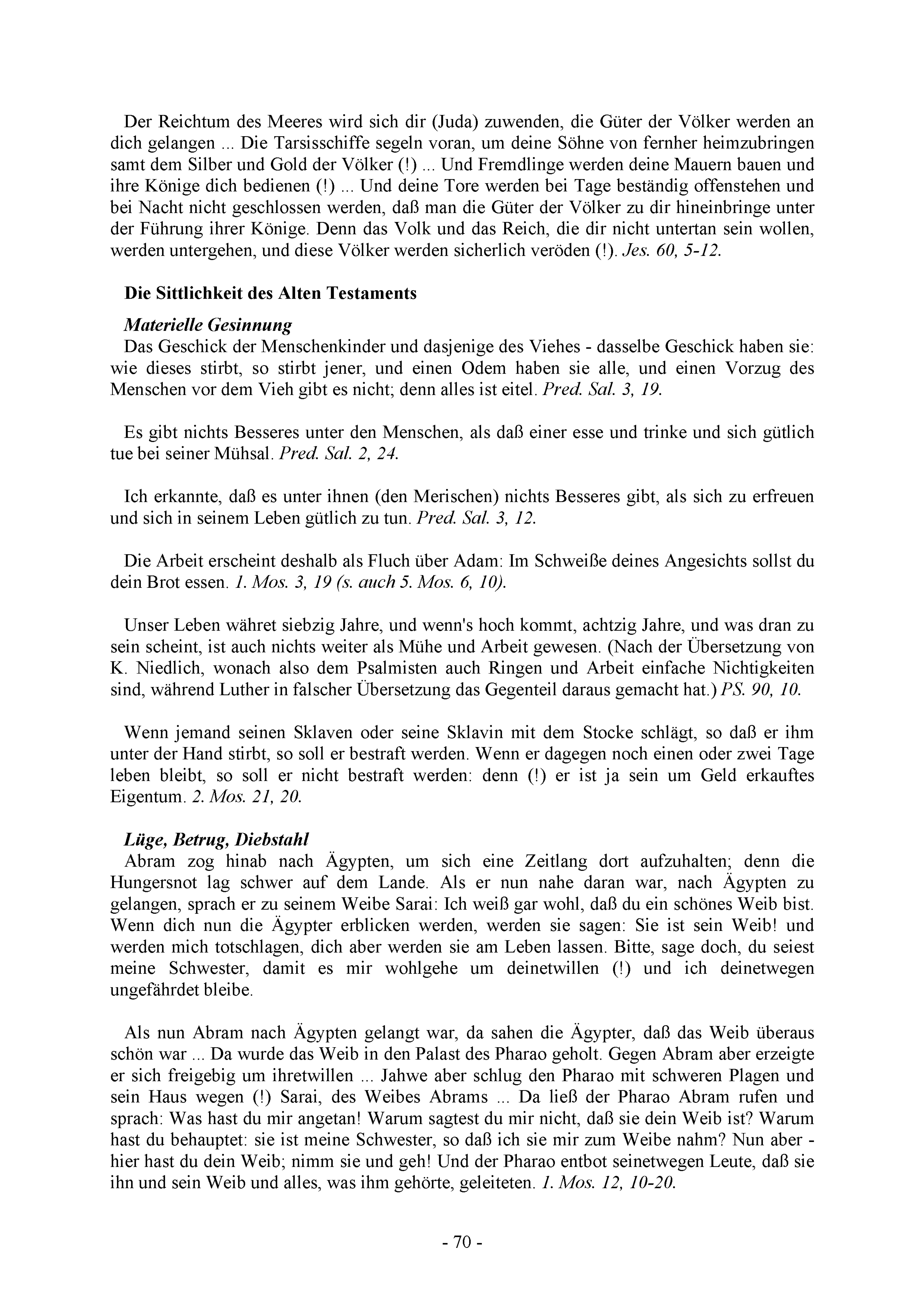
The wealth of the sea will turn to you (Judah), the goods of the nations will come to you ... The ships of Tarshish sail in the lead, to bring your sons home from afar with the silver and gold of the nations (!) ... And foreigners will build your walls and their kings will serve you (!) ... And your gates will be open continually by day and by night not be shut, that the goods of the nations may be brought in to you under the leadership of their kings. For the nation and kingdom that will not be subject to you, shall perish, and these nations shall surely be laid waste (!). Isa. 60:5-12.
The Morality of the Old Testament
Materialistic Attitude
The fate of the children of men and that of the beasts—they have the same fate: as this one dies, so dies that one, and they all have one breath, and there is no advantage for man over the beast; for all is vanity. Eccl. 3:19.
There is nothing better among men than that one should eat and drink and enjoy himself in his toil. Eccl. 2:24.
I perceived that there is nothing better among them (men) than to be joyful and to enjoy themselves in their lives. Eccl. 3:12.
Work therefore appears as a curse upon Adam: In the sweat of your face you shall eat your bread. Gen. 3:19 (see also Deut. 6:10).
The days of our years are seventy years, and if by reason of strength, eighty years, and what seems to have been of them was also nothing more than toil and labor. (According to the translation by K. Niedlich, whereby to the psalmist struggle and work are also simple vanities, whereas Luther, in a false translation, has made the opposite of it.) Ps. 90:10.
If a man strikes his male or female slave with a rod, so that he dies under his hand, he shall be punished. But if he survives a day or two, he is not to be punished: for (!) he is his property, bought for money. Ex. 21:20.
Lies, Deception, Theft
Abram went down to Egypt to sojourn there for a time; for the famine was severe in the land. When he was about to enter Egypt, he said to his wife Sarai: I know very well that you are a beautiful woman. Now when the Egyptians see you, they will say: She is his wife! and they will kill me, but they will let you live. Please, say you are my sister, so that I may be treated well for your sake (!) and that my life may be spared because of you.
Now when Abram had come to Egypt, the Egyptians saw that the woman was exceedingly beautiful ... Then the woman was taken into Pharaoh's palace. But he was generous to Abram for her sake ... But Yahweh afflicted Pharaoh and his house with severe plagues because of (!) Sarai, the wife of Abram ... Then Pharaoh had Abram called and said: What have you done to me! Why did you not tell me that she is your wife? Why did you claim: she is my sister, so that I took her to be my wife? But now— here is your wife; take her and go! And Pharaoh sent men with him to escort him and his wife and all that belonged to him. Gen. 12:10-20.
Show Original German Text
Der Reichtum des Meeres wird sich dir (Juda) zuwenden, die Güter der Völker werden an dich gelangen ... Die Tarsisschiffe segeln voran, um deine Söhne von fernher heimzubringen samt dem Silber und Gold der Völker (!) ... Und Fremdlinge werden deine Mauern bauen und ihre Könige dich bedienen (!) ... Und deine Tore werden bei Tage beständig offenstehen und bei Nacht nicht geschlossen werden, daß man die Güter der Völker zu dir hineinbringe unter der Führung ihrer Könige. Denn das Volk und das Reich, die dir nicht untertan sein wollen, werden untergehen, und diese Völker werden sicherlich veröden (!). Jes. 60, 5-12. Die Sittlichkeit des Alten Testaments Materielle Gesinnung Das Geschick der Menschenkinder und dasjenige des Viehes - dasselbe Geschick haben sie: wie dieses stirbt, so stirbt jener, und einen Odem haben sie alle, und einen Vorzug des Menschen vor dem Vieh gibt es nicht; denn alles ist eitel. Pred. Sal. 3, 19. Es gibt nichts Besseres unter den Menschen, als daß einer esse und trinke und sich gütlich tue bei seiner Mühsal. Pred. Sal. 2, 24. Ich erkannte, daß es unter ihnen (den Merischen) nichts Besseres gibt, als sich zu erfreuen und sich in seinem Leben gütlich zu tun. Pred. Sal. 3, 12. Die Arbeit erscheint deshalb als Fluch über Adam: Im Schweiße deines Angesichts sollst du dein Brot essen. 1. Mos. 3, 19 (s. auch 5. Mos. 6, 10). Unser Leben währet siebzig Jahre, und wenn's hoch kommt, achtzig Jahre, und was dran zu sein scheint, ist auch nichts weiter als Mühe und Arbeit gewesen. (Nach der Übersetzung von K. Niedlich, wonach also dem Psalmisten auch Ringen und Arbeit einfache Nichtigkeiten sind, während Luther in falscher Übersetzung das Gegenteil daraus gemacht hat.) PS. 90, 10. Wenn jemand seinen Sklaven oder seine Sklavin mit dem Stocke schlägt, so daß er ihm unter der Hand stirbt, so soll er bestraft werden. Wenn er dagegen noch einen oder zwei Tage leben bleibt, so soll er nicht bestraft werden: denn (!) er ist ja sein um Geld erkauftes Eigentum. 2. Mos. 21, 20. Lüge, Betrug, Diebstahl Abram zog hinab nach Ägypten, um sich eine Zeitlang dort aufzuhalten; denn die Hungersnot lag schwer auf dem Lande. Als er nun nahe daran war, nach Agypten zu gelangen, sprach er zu seinem Weibe Sarai: Ich weiß gar wohl, daß du ein schönes Weib bist. Wenn dich nun die Ägypter erblicken werden, werden sie sagen: Sie ist sein Weib! und werden mich totschlagen, dich aber werden sie am Leben lassen. Bitte, sage doch, du seiest meine Schwester, damit es mir wohlgehe um deinetwillen (!) und ich deinetwegen ungefährdet bleibe. Als nun Abram nach Ägypten gelangt war, da sahen die Ägypter, daß das Weib überaus schön war ... Da wurde das Weib in den Palast des Pharao geholt. Gegen Abram aber erzeigte er sich freigebig um ihretwillen ... Jahwe aber schlug den Pharao mit schweren Plagen und sein Haus wegen (!) Sarai, des Weibes Abrams ... Da ließ der Pharao Abram rufen und sprach: Was hast du mir angetan! Warum sagtest du mir nicht, daß sie dein Weib ist? Warum hast du behauptet: sie ist meine Schwester, so daß ich sie mir zum Weibe nahm? Nun aber - hier hast du dein Weib; nimm sie und geh! Und der Pharao entbot seinetwegen Leute, daß sie ihn und sein Weib und alles, was ihm gehörte, geleiteten. 1. Mos. 12, 10-20. - 70 -