Handbook of the Jewish Question (1944)
Page 301 • Click to zoom
Page 301 of 339
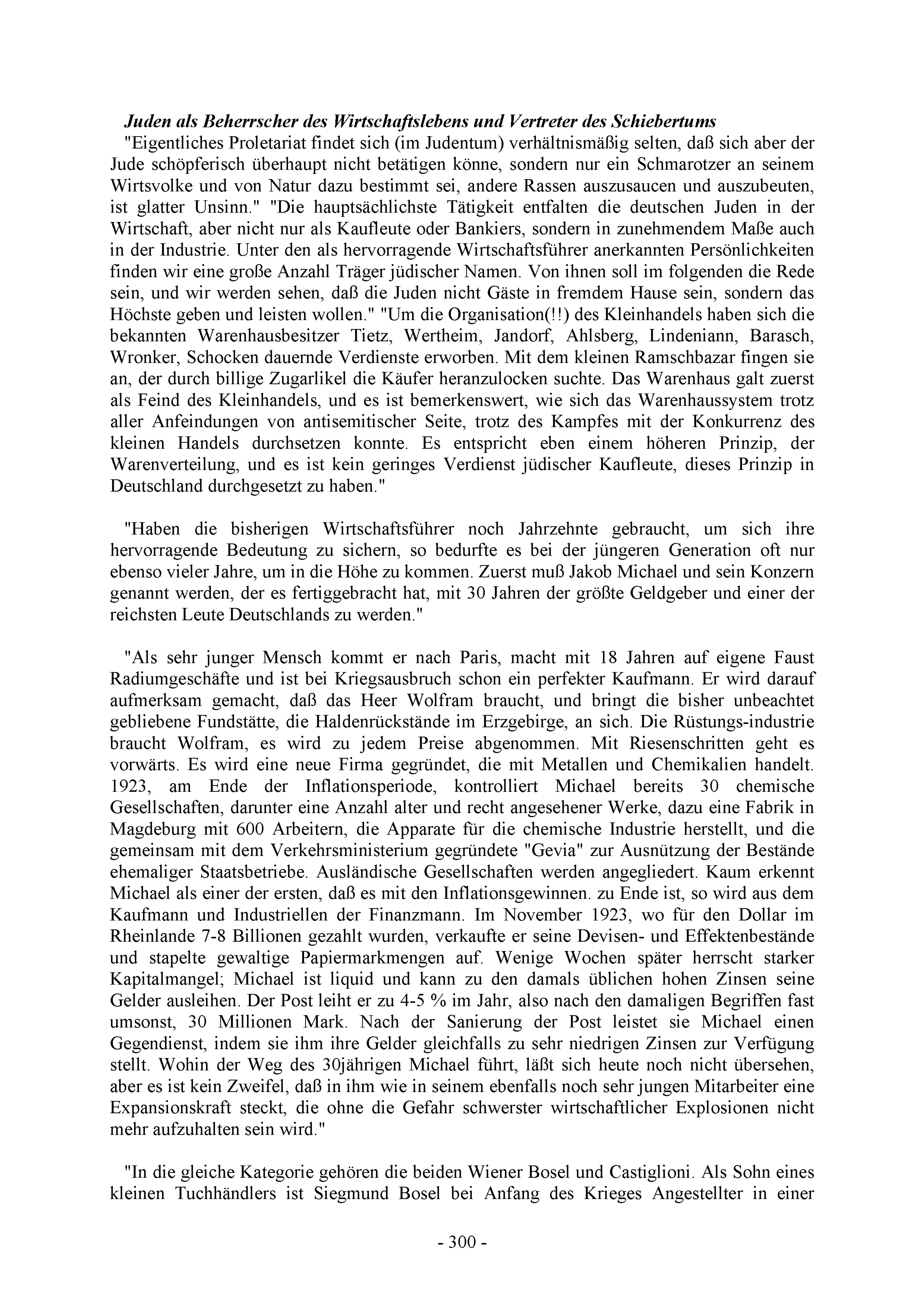
Jews as Rulers of Economic Life and Representatives of Profiteering
“Actual proletariat is found (in Judaism) relatively seldom, but that the Jew is altogether incapable of creative activity, but is only a parasite on his host people and is by nature destined to suck out and exploit other races, is sheer nonsense." "German Jews unfold their main activity in the economy, but not only as merchants or bankers, but also to an increasing extent in industry. Among the personalities recognized as outstanding economic leaders, we find a large number of bearers of Jewish names. They shall be the subject of the following, and we shall see that the Jews do not want to be guests in a foreign house, but rather want to give and achieve the highest." "The well-known department store owners Tietz, Wertheim, Jandorf, Ahlsberg, Lindenmann, Barasch, Wronker, and Schocken have earned lasting merits for the organization(!!) of retail trade. They started with the small bargain bazaar, which sought to attract buyers with cheap promotional items. The department store was first considered the enemy of the retail trade, and it is remarkable how the department store system was able to assert itself despite all the animosity from the antisemitic side, despite the battle with the competition of small trade. It corresponds to a higher principle, that of goods distribution, and it is no small merit of Jewish merchants to have implemented this principle in Germany."
"While the previous economic leaders still needed decades to secure their outstanding importance, the younger generation often needed only as many years to rise to the top. First, Jakob Michael and his concern must be mentioned, who managed, at the age of 30, to become the largest financier and one of the richest people in Germany."
"As a very young man, he comes to Paris, does radium deals on his own at the age of 18, and is already a perfect merchant at the outbreak of the war. His attention is drawn to the fact that the army needs tungsten, and he acquires the hitherto unnoticed find, the mine tailings in the Ore Mountains. The armaments industry needs tungsten, it is bought at any price. Things move forward by leaps and bounds. A new company is founded that deals in metals and chemicals. In 1923, at the end of the inflation episode, Michael already controls 30 chemical companies, including a number of old and quite respected works, plus a factory in Magdeburg with 600 workers that produces apparatus for the chemical industry, and the "Gevia," founded jointly with the Ministry of Transport, for the utilization of the stocks of former state enterprises. Foreign companies are affiliated. Scarcely does Michael recognize, as one of the first, that the inflation profits are coming to an end, than the merchant and industrialist becomes a financier. In November 1923, when 7-8 trillion were being paid for the dollar in the Rhineland, he sold his foreign currency and securities holdings and piled up enormous quantities of paper Marks. A few weeks later, there is a severe capital shortage; Michael is liquid and can lend his money at the high interest rates common at the time. He lends 30 million Marks to the Post Office at 4-5% per year, which, according to the standards of the time, was almost for free. After the reorganization of the Post Office, it does Michael a service in return by making its funds available to him, likewise at very low interest rates. Where the path of the 30-year-old Michael leads cannot yet be foreseen today, but there is no doubt that within him, as in his likewise still very young associate, there is a force of expansion that can no longer be stopped without the danger of the most severe economic explosions."
"In the same category belong the two Viennese, Bosel and Castiglioni. As the son of a small cloth merchant, Siegmund Bosel was an employee in a
- 300 -
Show Original German Text
Juden als Beherrscher des Wirtschaftslebens und Vertreter des Schiebertums „Eigentliches Proletanat findet sich (im Judentum) verhältnismäßig selten, daß sich aber der Jude schöpfensch überhaupt nicht betätigen könne, sondem nur ein Schmarotzer an seinem Wirtsvolke und von Natur dazu bestimmt sei, andere Rassen auszusaugen und auszubeuten, ist glatter Unsinn." "Die hauptsächlichste Tätigkeit entfalten die deutschen Juden in der Wirtschaft, aber nicht nur als Kaufleute oder Bankiers, sondem in zunehmendem Maße auch in der Industne. Unter den als hervorragende Wirtschaftsführer anerkannten Perſönlichkeiten finden wir eine große Anzahl Träger jüdischer Namen. Von ihnen ſoll im folgenden die Rede ſein, und wir werden ſehen, daß die Juden nicht Gäste in fremdem Hauſe ſein, ſondem das Höchste geben und leisten wollen." "Um die Organiſation(!!) des Kleinhandels haben ſich die bekannten Warenhausbeſitzer Tietz, Wertheim, Jandorf, Ahlsberg, Lindeniann, Barasch, Wronker, Schocken dauemde Verdienste erworben. Mit dem kleinen Ramschbazar fingen ſie an, der durch billige Zugartikel die Käufer heranzulocken ſuchte. Das Warenhaus galt zuerst als Feind des Kleinhandels, und es ist bemerkenswert, wie ſich das Warenhaussystem trotz aller Anfeindungen von antisemitischer Seite, trotz des Kampfes mit der Konkurrenz des kleinen Handels durchſetzen konnte. Es entspncht eben einem höheren Pnnzip, der Warenverteilung, und es ist kein gennges Verdienst jüdischer Kaufleute, dieſes Pnnzip in Deutschland durchgeſetzt zu haben." "Haben die bishengen Wirtschaftsführer noch Jahrzehnte gebraucht, um ſich ihre hervorragende Bedeutung zu ſichem, ſo bedurfte es bei der jüngeren Generation oft nur ebenso vieler Jahre, um in die Höhe zu kommen. Zuerst muß Jakob Michael und ſein Konzem genannt werden, der es fertiggebracht hat, mit 30 Jahren der größte Geldgeber und einer der reichsten Leute Deutschlands zu werden." "Als ſehr junger Mensch kommt er nach Pans, macht mit 18 Jahren auf eigene Faust Radiumgeschäfte und ist bei Knegsausbruch schon ein perfekter Kaufmann. Er wird darauf aufmerkſam gemacht, daß das Heer Wolfram braucht, und bnngt die bisher unbeachtet gebliebene Fundstätte, die Haldenrückstände im Erzgebirge, an ſich. Die Rüstungs-industne braucht Wolfram, es wird zu jedem Preise abgenommen. Mit Rieſenschntten geht es vorwärts. Es wird eine neue Firma gegründet, die mit Metallen und Chemikalien handelt. 1923, am Ende der Inflationsepisode, kontrolliert Michael bereits 30 chemische Geſellschaften, darunter eine Anzahl alter und recht angeſehener Werke, dazu eine Fabnk in Magdeburg mit 600 Arbeitem, die Apparate für die chemische Industne herstellt, und die gemeinſam mit dem Verkehrsministenum gegründete "Gevia" zur Ausnützung der Bestände ehemaliger Staatsbetnebe. Ausländische Geſellschaften werden angegliedert. Kaum erkennt Michael als einer der ersten, daß es mit den Inflationsgewinnen zu Ende ist, ſo wird aus dem Kaufmann und Industnellen der Finanzmann. Im November 1923, wo für den Dollar im Rheinlande 7-8 Billionen gezahlt wurden, verkaufte er ſeine Deviſen- und Effektenbestände und stapelte gewaltige Papierſmarkmengen auf. Wenige Wochen später herrscht starker Kapitalmangel; Michael ist liquid und kann zu den damals üblichen hohen Zinſen ſeine Gelder ausleihen. Der Post leiht er zu 4-5 % im Jahr, alſo nach den damaligen Begnffen fast umſonst, 30 Millionen Mark. Nach der Sanierung der Post leistet ſie Michael einen Gegendienst, indem ſie ihm ihre Gelder gleichfalls zu ſehr niedngen Zinſen zur Verfügung stellt. Wohin der Weg des 30jähngen Michael führt, läßt ſich heute noch nicht überſehen, aber es ist kein Zweifel, daß in ihm wie in ſeinem ebenfalls noch ſehr jungen Mitarbeiter eine Expanſionskraft steckt, die ohne die Gefahr schwerster wirtschafflicher Exploſionen nicht mehr aufzuhalten ſein wird." "In die gleiche Kategone gehören die beiden Wiener Boſel und Castiglioni. Als Sohn eines kleinen Tuchhändlers ist Siegmund Boſel bei Anfang des Kneges Angestellter in einer - 300 -