Page 20 • Click to zoom
Page 20 of 339
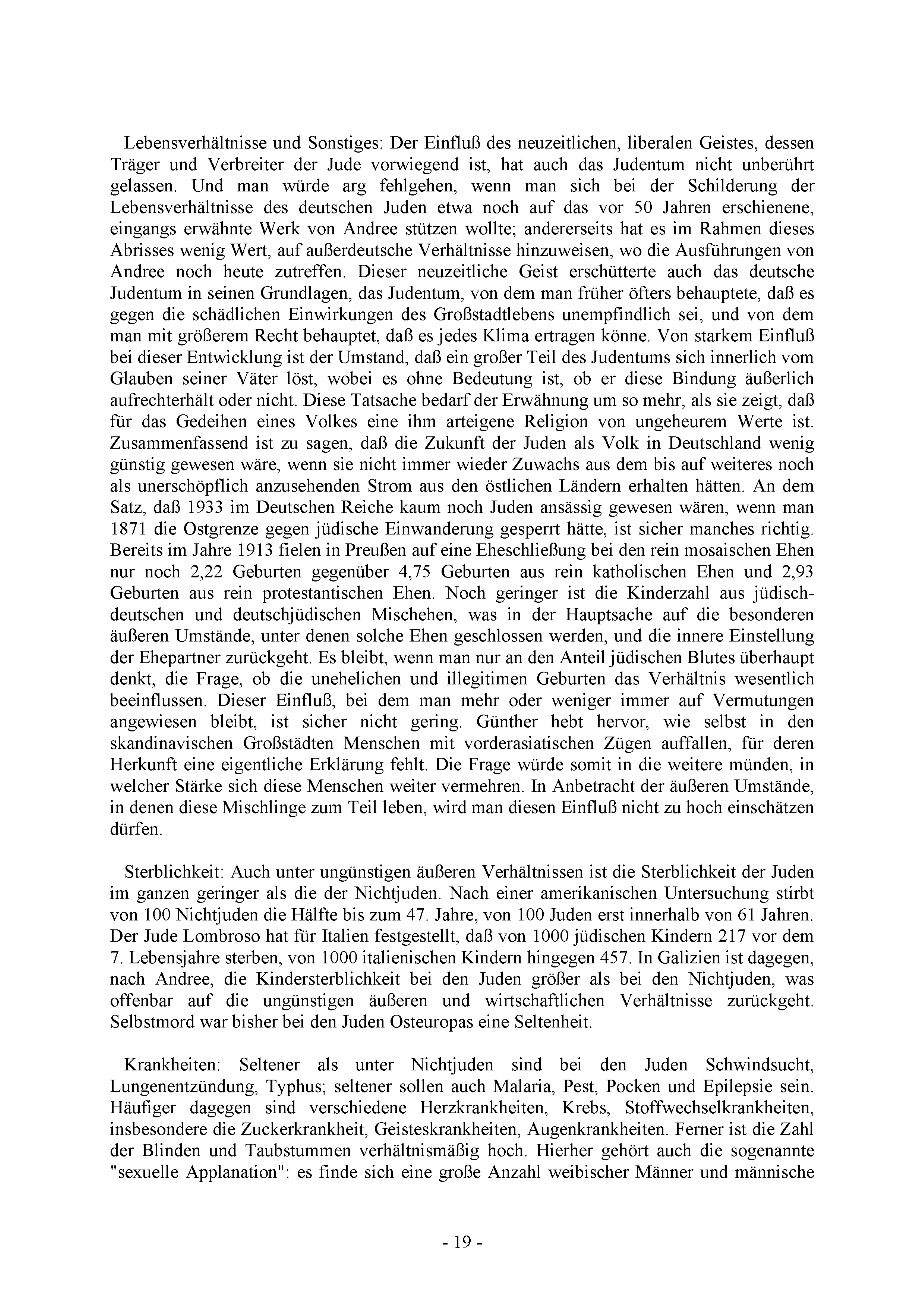
Living Conditions and Other Matters: The influence of the modern, liberal spirit, of which the Jew is predominantly the carrier and disseminator, has not left Jewry untouched either. And one would be sorely mistaken if, in describing the living conditions of the German Jew, one were to still rely on the work by Andree, published 50 years ago and mentioned at the beginning; on the other hand, within the scope of this outline, it is of little value to point to non-German conditions, where the statements of Andree are still true today. This modern spirit also shook German Jewry to its foundations, the Jewry of which it was formerly often claimed that it was immune to the harmful effects of big-city life, and of which it is claimed with greater justification that it can tolerate any climate. Of strong influence in this development is the circumstance that a large part of Jewry is internally detaching itself from the faith of its fathers, whereby it is of no importance whether it maintains this bond externally or not. This fact needs to be mentioned all the more as it shows that for the prosperity of a people, a religion peculiar to its kind is of immense value. In summary, it can be said that the future of the Jews as a people in Germany would have been not very favorable, if they had not repeatedly received additions from the stream from the eastern countries, which for the time being must still be regarded as inexhaustible. There is certainly much truth in the sentence that in 1933 there would have been hardly any Jews residing in the German Reich if the eastern border had been closed to Jewish immigration in 1871. Already in the year 1913 in Prussia, for every marriage in purely Mosaic marriages there were only 2.22 births, compared to 4.75 births from purely Catholic marriages and 2.93 births from purely Protestant marriages. Even lower is the number of children from Jewish- German and German-Jewish mixed marriages, which is mainly due to the special external circumstances under which such marriages are contracted, and the inner attitude of the spouses. It remains, if one only thinks of the share of Jewish blood at all, the question of whether the illegitimate and out-of-wedlock births significantly influence the ratio. This influence, for which one is always more or less reliant on conjecture, is certainly not small. Günther emphasizes how even in the Scandinavian big cities, people with Near Eastern features are noticeable, for whose origin a real explanation is lacking. The question would thus lead to the further one, in what strength these people continue to multiply. In view of the external circumstances in which these hybrids partly live, one should not overestimate this influence.
Mortality: Even under unfavorable external conditions, the mortality of Jews is on the whole lower than that of non-Jews. According to an American study, of 100 non-Jews, half die by the age of 47, of 100 Jews only within 61 years. The Jew Lombroso has established for Italy that of 1000 Jewish children, 217 die before the age of 7, whereas of 1000 Italian children, 457. In Galicia, on the other hand, according to Andree, child mortality among Jews is higher than among non-Jews, which is obviously due to the unfavorable external and economic conditions. Suicide has hitherto been a rarity among the Jews of Eastern Europe.
Diseases: Rarer among Jews than among non-Jews are consumption, pneumonia, typhus; also said to be rarer are malaria, plague, smallpox, and epilepsy. More frequent, on the other hand, are various heart diseases, cancer, metabolic diseases, especially diabetes, mental illnesses, eye diseases. Furthermore, the number of blind and deaf-mutes is relatively high. To this also belongs the so-called "sexual applanation": there is a large number of effeminate men and masculine
- 19 -
Show Original German Text
Lebensverhältnisse und Sonstiges: Der Einfluß des neuzeitlichen, liberalen Geistes, deſſen Träger und Verbreiter der Jude vorwiegend ist, hat auch das Judentum nicht unberührt gelaſſen. Und man würde arg fehlgehen, wenn man ſich bei der Schilderung der Lebensverhältniſſe des deutschen Juden etwa noch auf das vor 50 Jahren erschienene, eingangs erwähnte Werk von Andree stützen wollte; andererſeits hat es im Rahmen dieſes Abnſſes wenig Wert, auf außerdeutsche Verhältniſſe hinzuweiſen, wo die Ausführungen von Andree noch heute zutreffen. Dieſer neuzeitliche Geist erschütterte auch das deutsche Judentum in ſeinen Grundzügen, das Judentum, von dem man früher öfter behauptete, daß es gegen die schädlichen Einwirkungen des Großstadtlebens unempfindlich ſei, und von dem man mit größerem Recht behauptet, daß es jedes Klima ertragen könne. Von starkem Einfluß bei dieſer Entwicklung ist der Umstand, daß ein großer Teil des Judentums ſich innerlich vom Glauben ſeiner Väter löst, wobei es ohne Bedeutung ist, ob er dieſe Bindung äußerlich aufrechterhält oder nicht. Dieſe Tatſache bedarf der Erwähnung um ſo mehr, als ſie zeigt, daß für das Gedeihen eines Volkes eine ihm arteigene Religion von ungeheurem Werte ist. Zuſammenfaſſend ist zu ſagen, daß die Zukunft der Juden als Volk in Deutschland wenig günstig geweſen wäre, wenn ſie nicht immer wieder Zuwachs aus dem bis auf weiteres noch als unerschöpflich anzuſehenden Strom aus den östlichen Ländem erhalten hätten. An dem Satz, daß 1933 im Deutschen Reiche kaum noch Juden anſäßig geweſen wären, wenn man 1871 die Ostgrenze gegen jüdische Einwanderung gesperrt hätte, ist ſicher manches nchtig. Bereits im Jahre 1913 fielen in Preußen auf eine Eheschließung bei den rein moſaischen Ehen nur noch 2,22 Geburten gegenüber 4,75 Geburten aus rein katholischen Ehen und 2,93 Geburten aus rein protestantischen Ehen. Noch gennger ist die Kinderzahl aus jüdisch- deutschen und deutschjüdischen Mischehen, was in der Hauptſache auf die beſonderen äußeren Umstände, unter denen ſolche Ehen geschloſſen werden, und die innere Einstellung der Ehepartner zurückgeht. Es bleibt, wenn man nur an den Anteil jüdischen Blutes überhaupt denkt, die Frage, ob die unehelichen und illegitimen Geburten das Verhältniß weſentlich beeinfluſſen. Dieſer Einfluß, bei dem man mehr oder weniger immer auf Vermutungen angewieſen bleibt, ist ſicher nicht genng. Günther hebt hervor, wie ſelbst in den ſkandinavischen Großstädten Menschen mit vorderaſiatischen Zügen auffallen, für deren Herkunft eine eigentliche Erklärung fehlt. Die Frage würde ſomit in die weitere münden, in welcher Stärke ſich dieſe Menschen weiter vermehren. In Anbetracht der äußeren Umstände, in denen dieſe Mischlinge zum Teil leben, wird man dieſen Einfluß nicht zu hoch einschätzen dürfen. Sterblichkeit: Auch unter ungünstigen äußeren Verhältniſſen ist die Sterblichkeit der Juden im ganzen gennger als die der Nichtjuden. Nach einer amenkanischen Unterſuchung stirbt von 100 Nichtjuden die Hälfte bis zum 47. Jahre, von 100 Juden erst innerhalb von 61 Jahren. Der Jude Lombroso hat für Italien festgestellt, daß von 1000 jüdischen Kindem 217 vor dem 7. Lebensjahre sterben, von 1000 italienischen Kindem hingegen 457. In Galizien ist dagegen, nach Andree, die Kindersterblichkeit bei den Juden größer als bei den Nichtjuden, was offenbar auf die ungünstigen äußeren und wirtschaftlichen Verhältniſſe zurückgeht. Selbstmord war bisher bei den Juden Osteuropas eine Seltenheit. Krankheiten: Seltener als unter Nichtjuden ſind bei den Juden Schwindſucht, Lungenentzündung, Typhus; ſeltener ſollen auch Malana, Pest, Pocken und Epilepſie ſein. Häufiger dagegen ſind verschiedene Herzkrankheiten, Krebs, Stoffwechſelkrankheiten, inſbeſondere die Zuckerkrankheit, Geisteskrankheiten, Augenkrankheiten. Femer ist die Zahl der Blinden und Taubstummen verhältnißmäßig hoch. Hierher gehört auch die ſogenannte "ſexuelle Applanation": es finde ſich eine große Anzahl weibischer Männer und männliche - 19 -