Handbook of the Jewish Question (1944)
Page 162 • Click to zoom
Page 162 of 339
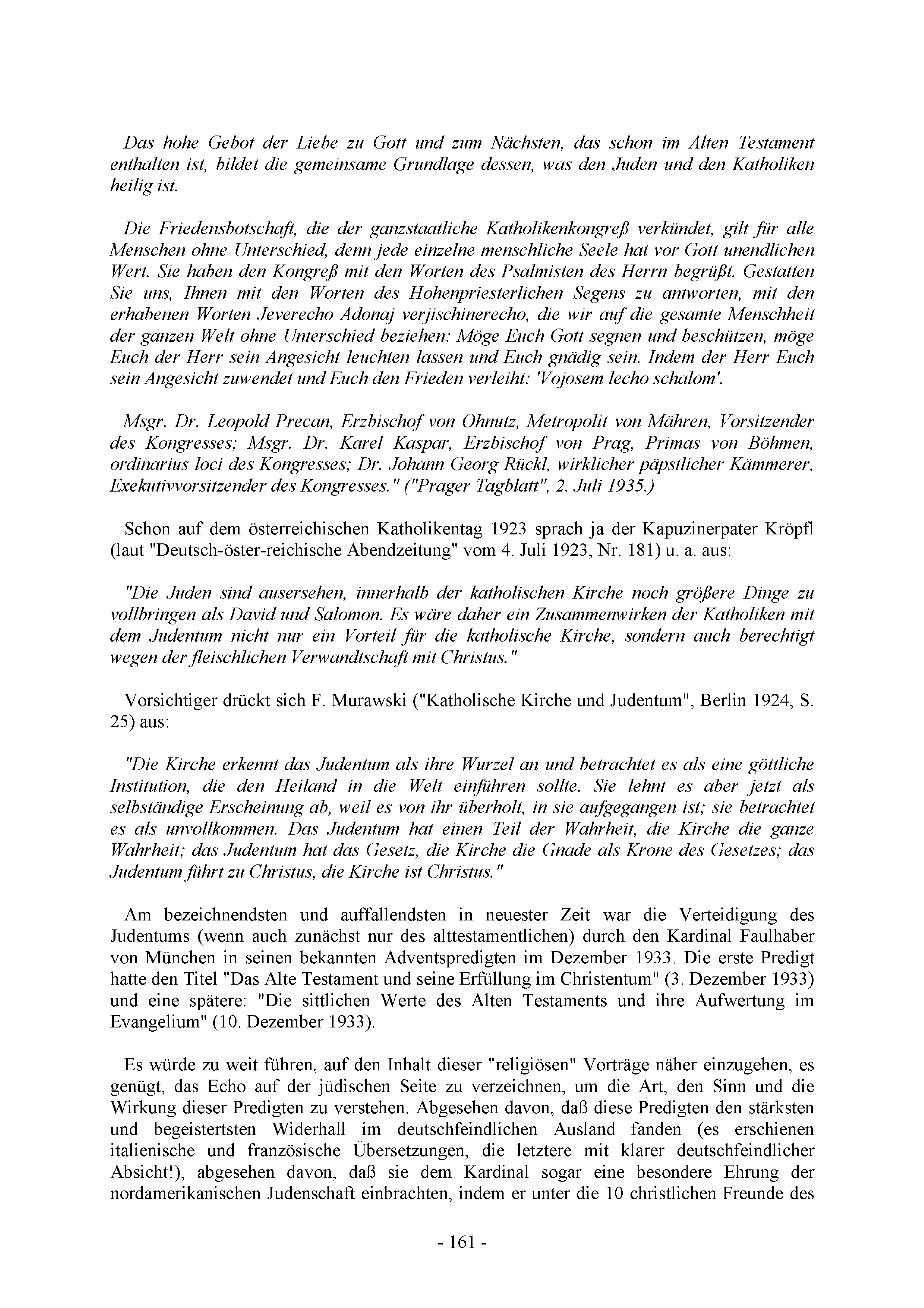
The great commandment of love for God and for one's neighbor, which is already contained in the Old Testament, forms the common basis of what is sacred to Jews and to Catholics.
The message of peace proclaimed by the national Catholic Congress applies to all people without distinction, for every single human soul has infinite value before God. You have greeted the Congress with the words of the Lord's psalmist. Allow us to answer you with the words of the High Priestly Blessing, with the sublime words Jeverecho Adonaj verjischinerecho, which we apply to all of humanity of the whole world without distinction: May God bless you and protect you, may the Lord make His face shine upon you and be gracious to you. As the Lord turns His face toward you and grants you peace: 'Vojosem lecho schalom'.
Msgr. Dr. Leopold Precan, Archbishop of Olomouc, Metropolitan of Moravia, Chairman of the Congress; Msgr. Dr. Karel Kaspar, Archbishop of Prague, Primate of Bohemia, ordinarius loci of the Congress; Dr. Johann Georg Rückl, actual Papal Chamberlain, Executive Chairman of the Congress." ("Prager Tagblatt", July 2, 1935.)
Already at the Austrian Catholic Day in 1923, the Capuchin Father Kröpfl stated (according to "Deutsch-österreichische Abendzeitung" of July 4, 1923, No. 181), among other things:
"The Jews are destined to accomplish even greater things within the Catholic Church than David and Solomon. A collaboration of Catholics with Judaism would therefore not only be an advantage for the Catholic Church, but also justified because of the carnal relationship with Christ.'"
F. Murawski.
"Catholic Church and Judaism", Berlin 1924, p.
- expresses himself more cautiously:
"The Church recognizes Judaism as its root and regards it as a divine institution that was to introduce the Savior into the world. However, it now rejects it as an independent phenomenon because it has been surpassed by it, has been absorbed into it; it regards it as imperfect. Judaism has a part of the truth, the Church has the whole truth; Judaism has the Law, the Church has Grace as the crown of the Law; Judaism leads to Christ, the Church is Christ.'"
Most characteristic and striking in recent times was the defense of Judaism (though initially only that of the Old Testament) by Cardinal Faulhaber of Munich in his well-known Advent sermons in December 1933. The first sermon was titled "The Old Testament and its Fulfillment in Christianity" (December 3, 1933) and a later one: "The Moral Values of the Old Testament and their Revaluation in the Gospel" (December 10, 1933).
It would lead too far to go into the content of these "religious" lectures in detail; it is sufficient to record the echo on the Jewish side in order to understand the nature, meaning, and effect of these sermons. Apart from the fact that these sermons found the strongest and most enthusiastic response in foreign countries hostile to Germany (Italian and French translations appeared, the latter with a clear anti-German intent!), apart from the fact that they even earned the Cardinal a special honor from the North American Jewish community, placing him among the 10 Christian friends of the
- 161 -
Show Original German Text
Das hohe Gebot der Liebe zu Gott und zum Nächsten, das schon im Alten Testament enthalten ist, bildet die gemeinſame Grundlage deſſen, was den Juden und den Katholiken heilig ist. Die Fnedensbotschaft, die der ganzstaatliche Katholikenkongreß verkündet, gilt für alle Menschen ohne Unterschied, denn jede einzelne menschliche Seele hat vor Gott unendlichen Wert. Sie haben den Kongreß mit den Worten des Pſalmisten des Herm begrüßt. Gestatten Sie uns, Ihnen mit den Worten des Hohenpnesterlichen Segens zu antworten, mit den erhabenen Worten Jeverecho Adonaj verjischinerecho, die wir auf die geſamte Menschheit der ganzen Welt ohne Unterschied beziehen: Möge Euch Gott ſegnen und beschützen, möge Euch der Herr ſein Angeſicht leuchten laſſen und Euch gnädig ſein. Indem der Herr Euch ſein Angeſicht zuwendet und Euch den Fneden verleiht: 'Vojosem lecho schalom'. Msgr. Dr. Leopold Precan, Erzbischof von Ohmutz, Metropolit von Mähren, Vorsitzender des Kongresses; Msgr. Dr. Karel Kaspar, Erzbischof von Prag, Pnmas von Böhmen, ordinanus loci des Kongresses; Dr. Johann Georg Rückl, wirklicher päpstlicher Kämmerer, Exekutivvorsitzender des Kongresses." ("Prager Tagblatt", 2. Juli 1935.) Schon auf dem österreichischen Katholikentag 1923 sprach ja der Kapuzinerpater Kröpfl (laut "Deutsch-öster-reichische Abendzeitung" vom 4. Juli 1923, Nr. 181) u. a. aus: "'Die Juden ſind außerſehn, innerhalb der katholischen Kirche noch größere Dinge zu vollbnngen als David und Salomon. Es wäre daher ein Zuſammenwirken der Katholiken mit dem Judentum nicht nur ein Vorteil für die katholische Kirche, ſondem auch berechtigt wegen der fleischlichen Verwandtschaft mit Chnstus.'" Vorſichtiger drückt ſich F. Murawski ("Katholische Kirche und Judentum", Berlin 1924, S. 25) aus: "'Die Kirche erkennt das Judentum als ihre Wurzel an und betrachtet es als eine göttliche Institution, die den Heiland in die Welt einführen ſollte. Sie lehnt es aber jetzt als ſelbständige Erscheinung ab, weil es von ihr überholt, in ſie aufgegangen ist; ſie betrachtet es als unvollkommen. Das Judentum hat einen Teil der Wahrheit, die Kirche die ganze Wahrheit; das Judentum hat das Geſetz, die Kirche die Gnade als Krone des Geſetzes; das Judentum führt zu Chnstus, die Kirche ist Chnstus.'" Am bezeichnendsten und auffallendsten in neuester Zeit war die Verteidigung des Judentums (wenn auch zunächst nur des alttestamentlichen) durch den Kardinal Faulhaber von München in ſeinen bekannten Adventspredigten im Dezember 1933. Die erste Predigt hatte den Titel "Das Alte Testament und ſeine Erfüllung im Chnstentum" (3. Dezember 1933) und eine spätere: "Die ſittlichen Werte des Alten Testaments und ihre Aufwertung im Evangelium" (10. Dezember 1933). Es würde zu weit führen, auf den Inhalt dieſer "religiöſen" Vorträge näher einzugehen, es genügt, das Echo auf der jüdischen Seite zu verzeichnen, um die Art, den Sinn und die Wirkung dieſer Predigten zu verstehen. Abgeſehen davon, daß dieſe Predigten den stärksten und begeistertsten Widerhall im deutschfeindlichen Ausſland fanden (es erschienen italienische und franzöſische Überſetzungen, die letztere mit klarer deutschfeindlicher Abſicht!), abgeſehen davon, daß ſie dem Kardinal ſogar eine beſondere Ehrung der nordamenkanischen Judenschaft einbrachten, indem er unter die 10 chnstlichen Freunde des - 161 -