The Antisemitic Catechism (1893)
Page 83 • Click to zoom
Page 83 of 436
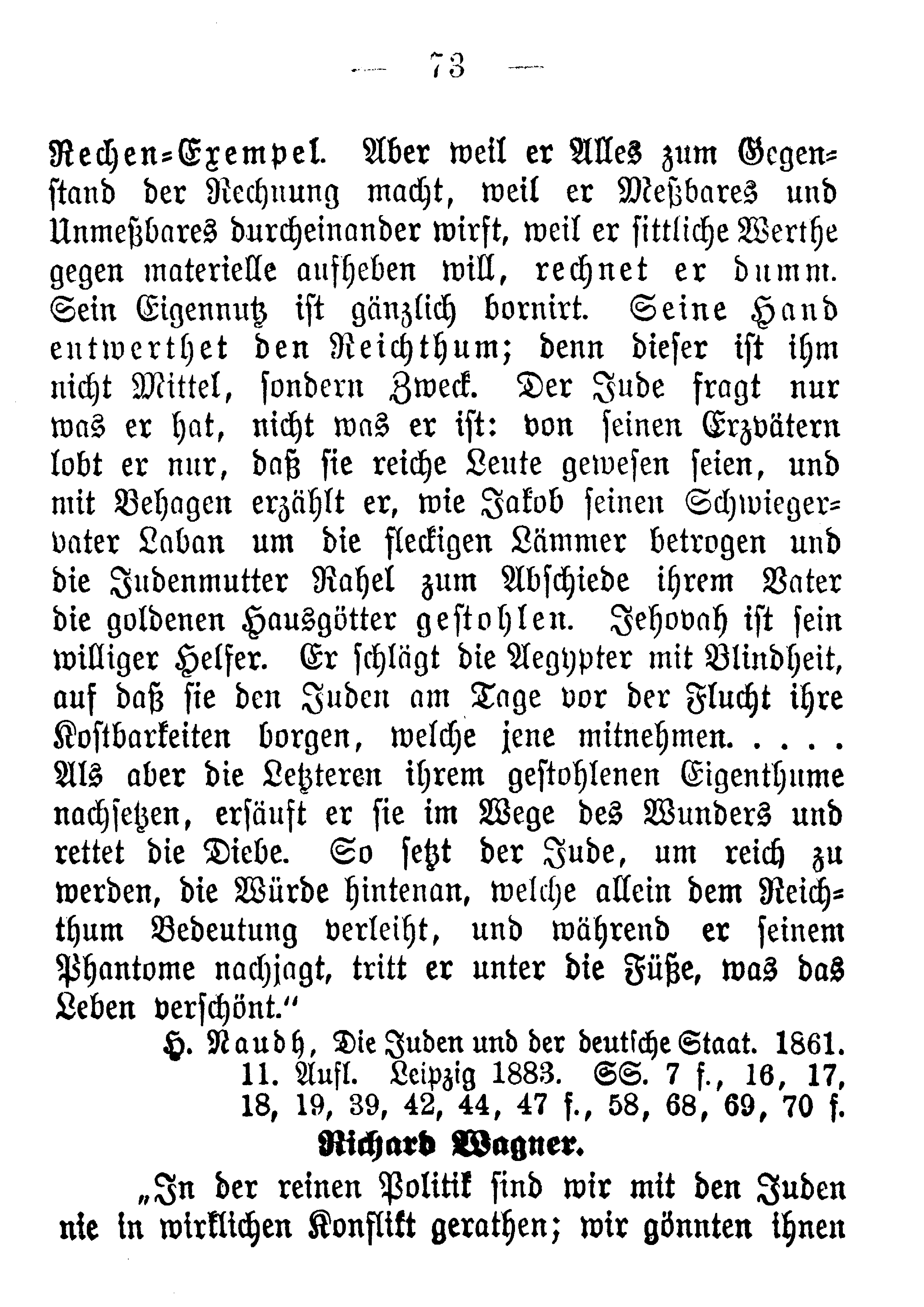
an arithmetic problem. But because he makes everything an object of calculation, because he mixes the measurable and the immeasurable, because he wants to cancel out moral values against material ones, he calculates foolishly.
His self-interest is completely narrow-minded. His hand devalues wealth; for to him it is not a means, but an end. The Jew asks only what he has, not what he is: of his forefathers, he praises only that they were rich people, and with relish he recounts how Jacob cheated his father-in-law Laban out of the spotted lambs and how the Jewish mother Rachel, upon her departure, stole the golden household gods from her father.
Jehovah is his willing helper. He strikes the Egyptians with blindness, so that on the day before the flight they lend the Jews their valuables, which the latter take with them. . . . . But when the latter pursue their stolen property, he drowns them by way of a miracle and saves the thieves.
So the Jew, in order to become rich, puts aside the dignity which alone gives meaning to wealth, and while he chases his phantom, he tramples underfoot that which beautifies life.”
S. Naudh, The Jews and the German State. 1861. 11th ed. Leipzig 1883. pp. 7 f., 16, 17, 18, 19, 39, 42, 44, 47 f., 58, 68, 69, 70 f.
Richard Wagner.
“In pure politics, we have never come into real conflict with the Jews; we granted them
Show Original German Text
— 73 — Rechen-Exempel. Aber weil er Alles zum Gegen- stand der Rechnung macht, weil er Meßbares und Unmeßbares durcheinander wirft, weil er sittliche Werthe gegen matenelle aufheben will, rechnet er dumm. Sein Eigennuß ist gänzlich bomirt. Seine Hand entwerthet den Reichthum; denn dieser ist ihm nicht Mittel, sondem Zweck. Der Jude fragt nur was er hat, nicht was er ist: von seinen Erzvåtem lobt er nur, daß sie reiche Leute gewesen seien, und mit Behagen erzählt er, wie Jakob seinen Schwiegervater Laban um die fleckigen Lämmer betrogen und die Judenmutter Rahel zum Abschiede ihrem Vater die goldenen Hausgötter gestohlen. Jehovah ist sein williger Helfer. Er schlägt die Aegypter mit Blindheit, auf daß sie den Juden am Tage vor der Flucht ihre Kostbarkeiten borgen, welche jene mitnehmen. . . . . Als aber die Letzteren ihrem gestohlenen Eigenthume nachsetzen, ersäuft er sie im Wege des Wunders und rettet die Diebe. So seht der Jude, um reich zu werden, die Würde hintenan, welche allein dem Reichthum Bedeutung verleiht, und während er seinem Phantome nachjagt, tntt er unter die Füße, was das Leben verschönt.“ S. Naudh, Die Juden und der deutsche Staat. 1861. 11. Aufl. Leipzig 1883. S. 7 f., 16, 17, 18, 19, 39, 42, 44, 47 f., 58, 68, 69, 70 f. Richard Wagner. „In der reinen Politik sind wir mit den Juden nie in wirklichen Konflikt gerathen; wir gönnten ihnen