The Antisemitic Catechism (1893)
Page 82 • Click to zoom
Page 82 of 436
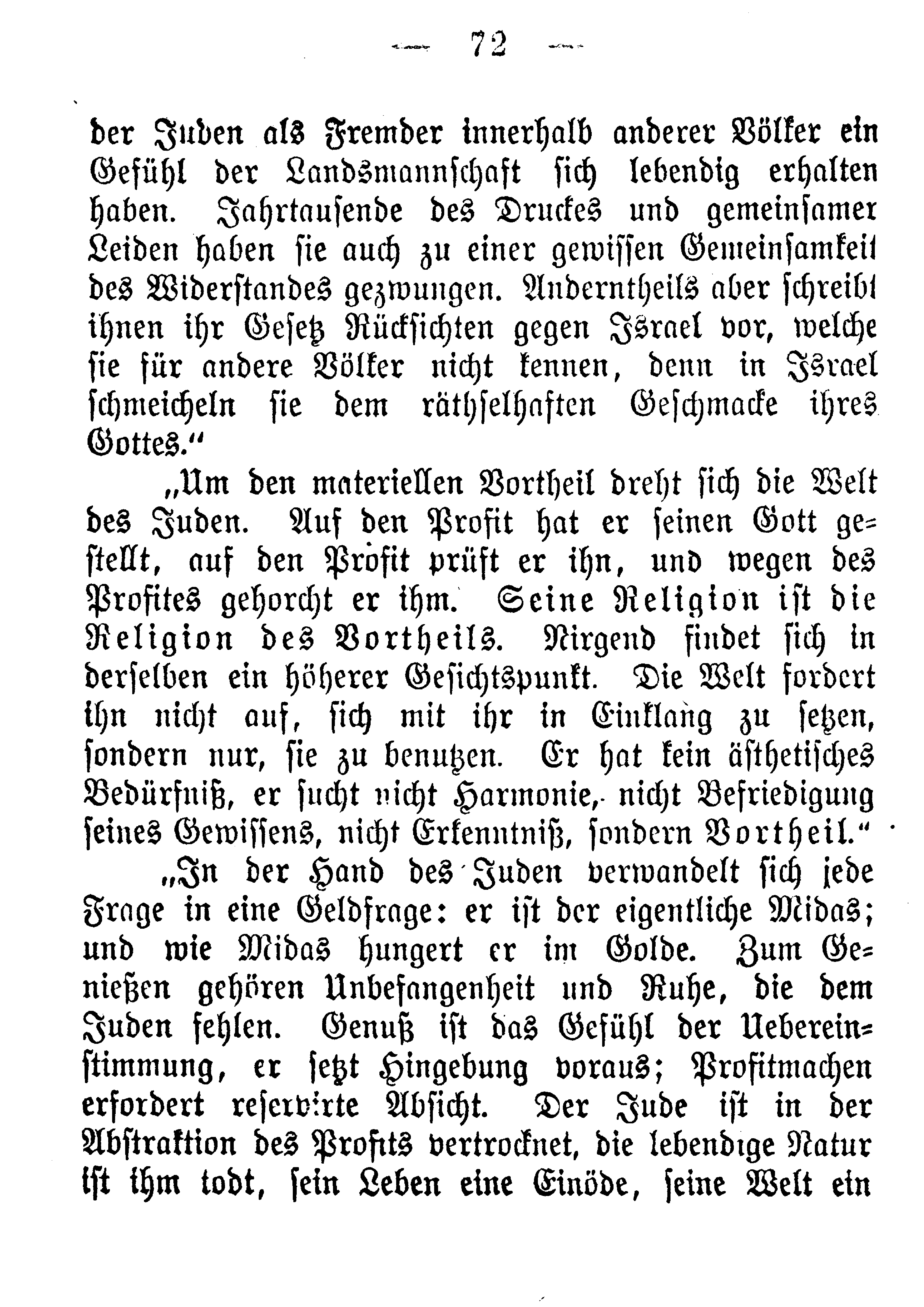
of the Jews as foreigners among other peoples, a feeling of compatriotism may have been kept alive.
Millennia of oppression and common suffering have also forced them into a certain commonality of resistance. On the other hand, however, their law prescribes considerations for Israel which they do not know for other peoples, for in Israel they flatter the enigmatic taste of their God.”
“The world of the Jew revolves around material advantage. He has placed his God on profit, he tests him by profit, and he obeys him for the sake of profit. His religion is the religion of advantage. Nowhere in it is a higher point of view to be found. The world does not call on him to bring himself into harmony with it, but only to use it. He has no aesthetic need, he seeks not harmony, not satisfaction of his conscience, not knowledge, but advantage.”
“In the hands of the Jew, every question turns into a question of money: he is the real Midas; and like Midas, he starves amidst gold. Enjoyment requires impartiality and tranquility, which the Jew lacks. Enjoyment is the feeling of harmony, it presupposes devotion; profit-making requires reserved intention. The Jew has withered in the abstraction of profit, living nature is dead to him, his life a wasteland, his world a
Show Original German Text
72 der Juden als Fremder innerhalb anderer Völker ein Gefühl der Landsmannschaft sich lebendig erhalten haben. Jahrtausende des Druckes und gemeinsamer Leiden haben sie auch zu einer gewissen Gemeinsamkeit des Widerstandes gezwungen. Andemtheils aber schreibt ihnen ihr Gesetz Rücksichten gegen Israel vor, welche sie für andere Völker nicht kennen, denn in Israel schmeicheln sie dem räthselhaften Geschmacke ihres Gottes.“ „Um den matenellen Vortheil dreht sich die Welt des Juden. Auf den Profit hat er seinen Gott gestellt, auf den Profit prüft er ihn, und wegen des Profites gehorcht er ihm. Seine Religion ist die Religion des Vortheils. Nirgend findet sich in derselben ein höherer Gesichtspunkt. Die Welt fordert ihn nicht auf, sich mit ihr in Einklang zu setzen, sondem nur, sie zu benützen. Er hat kein ästhetisches Bedürfniß, er sucht nicht Harmonie, nicht Befnedigung seines Gewissens, nicht Erkenntniß, sondem Vortheil.“ „In der Hand des Juden verwandelt sich jede Frage in eine Geldfrage: er ist der eigentliche Midas; und wie Midas hungert er im Golde. Zum Genießen gehören Unbefangenheit und Ruhe, die dem Juden fehlen. Genuß ist das Gefühl der Uebereinstimmung, er setzt Hingebung voraus; Profitmachen erfordert reservirte Absicht. Der Jude ist in der Abstraktion des Profits vertrocknet, die lebendige Natur ist ihm todt, sein Leben eine Einöde, seine Welt ein