The Antisemitic Catechism (1893)
Page 209 • Click to zoom
Page 209 of 436
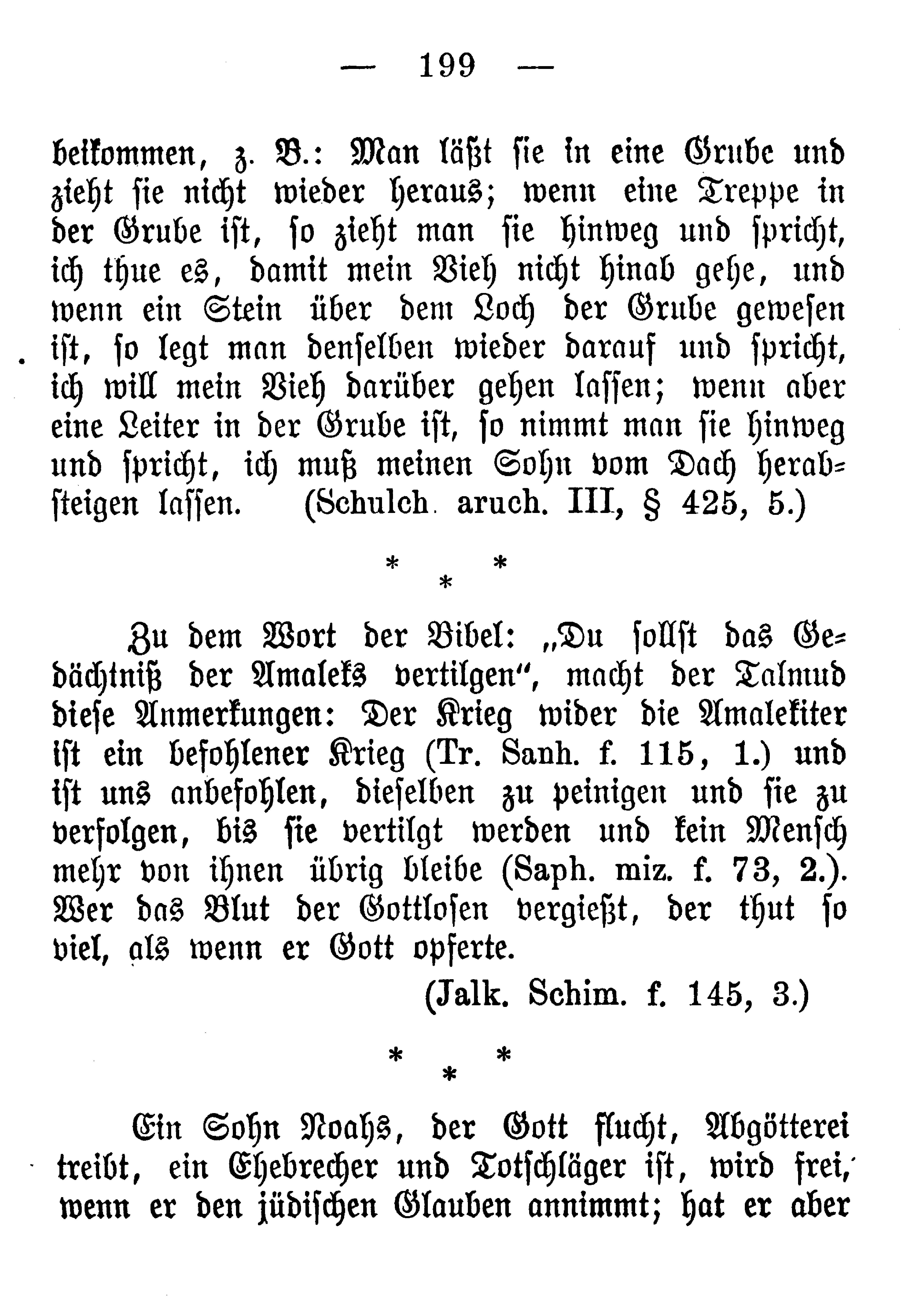
e.g.: One lets them into a pit and does not pull them out again; if there is a staircase in the pit, one removes it and says, I am doing this so that my cattle do not go down, and if there has been a stone over the hole of the pit, one puts it back on top and says, I want to let my cattle walk over it; but if there is a ladder in the pit, one takes it away and says, I must let my son climb down from the roof. (Shulch. aruch. III, § 425, 5.)
To the word of the Bible: "You shall blot out the remembrance of the Amalekites," the Talmud makes these comments: The war against the Amalekites is a commanded war (Tr. Sanh. f. 115, 1.) and it is commanded to us to torment them and to pursue them until they are exterminated and not a single person of them remains (Saph. miz. f. 73, 2.). Whoever sheds the blood of the godless does as much as if he were making a sacrifice to God. (Yalk. Shim. f. 145, 3.)
A son of Noah who curses God, practices idolatry, is an adulterer and a murderer, becomes free if he accepts the Jewish faith; but if he has
Show Original German Text
— 199 — bekommen, z. B.: Man läßt sie in eine Grube und zieht sie nicht wieder heraus; wenn eine Treppe in der Grube ist, so zieht man sie hinweg und spncht, ich thue es, damit mein Vieh nicht hinab gehe, und wenn ein Stein über dem Loch der Grube gewesen ist, so legt man denselben wieder darauf und spncht, ich will mein Vieh darüber gehen lassen; wenn aber eine Leiter in der Grube ist, so nimmt man sie hinweg und spncht, ich muß meinen Sohn vom Dach herabsteigen laſſen. (Schulch. aruch. III, § 425, 5.) * * * Zu dem Wort der Bibel: „Du sollst das Gedächtniß der Amaleks vertilgen“, macht der Talmud diese Anmerkungen: Der Kneg wider die Amalekiter ist ein befohlener Kneg (Tr. Sanh. f. 115, 1.) und ist uns anbefohlen, dieselben zu peinigen und sie zu verfolgen, bis sie vertilgt werden und kein Mensch mehr von ihnen übng bleibe (Saph. miz. f. 73, 2.). Wer das Blut der Gottlosen vergießt, der thut so viel, als wenn er Gott opferte. (Talk. Schim. f. 145, 3.) * * * Ein Sohn Noahs, der Gott flucht, Abgötterei treibt, ein Ehebrecher und Totschläger ist, wird frei, wenn er den jüdischen Glauben annimmt; hat er aber