The Antisemitic Catechism (1893)
Page 202 • Click to zoom
Page 202 of 436
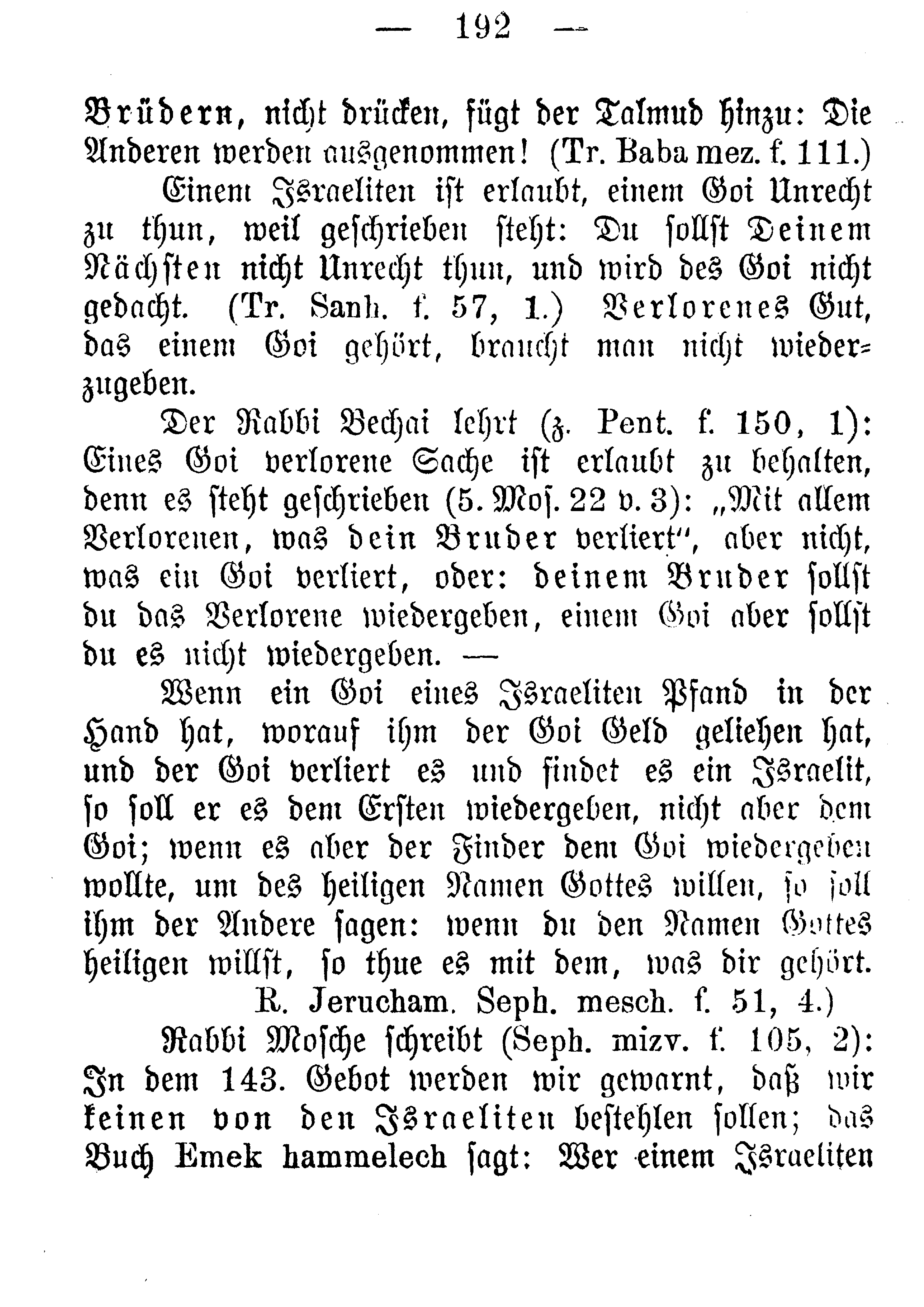
brothers, the Talmud adds: The others are excluded! (Tractate Baba mez. f. 111.)
An Israelite is permitted to do a Goi wrong, because it is written: You shall not do your neighbor wrong, and the Goi is not mentioned. (Tractate Sanh. f. 57, 1.) Lost property that belongs to a Goi does not need to be returned.
Rabbi Bechaj teaches (3. Pent. f. 150, 1): A Goi's lost item is permitted to be kept, for it is written (Deut. 22 v. 3): "With any lost thing of your brother's which he has lost," but not what a Goi loses, or: to your brother you shall return the lost item, but to a Goi you shall not return it. —
If a Goi holds an Israelite's pledge in his hand, for which the Goi has lent him money, and the Goi loses it and an Israelite finds it, he shall return it to the first one, but not to the Goi; but if the finder wanted to return it to the Goi for the sake of the holy name of God, then the other should say to him: if you want to sanctify the name of God, do it with what belongs to you. R. Jerucham. Seph. mesch. f. 51, 4.)
Rabbi Mosche writes (Seph. mizv. f. 105, 2): In the 143rd commandment we are warned that we should not steal from any of the Israelites; the book Emek hammelech says: Whoever an Israelite's
Show Original German Text
— 192 — Brüdem, nicht drücken, fügt der Talmud hinzu: Die Anderen werden ausgenommen! (Tr. Baba mez. f. 111.) Einem Israeliten ist erlaubt, einem Goi Unrecht zu thun, weil geschneben steht: Du sollst Deinem Nächsten nicht Unrecht thun, und wird des Goi nicht gedacht. (Tr. Sanh. f. 57, 1.) Verlorenes Gut, das einem Goi gehört, braucht man nicht wiederzugeben. Der Rabbi Bechaj lehrt (3. Pent. f. 150, 1): Eines Goi verlorene Sache ist erlaubt zu behalten, denn es steht geschneben (5. Mos. 22 v. 3): „Mit allem Verlorenen, was dein Bruder verliert“, aber nicht, was ein Goi verliert, oder: deinem Bruder sollst du das Verlorene wiedergeben, einem Goi aber sollst du es nicht wiedergeben. — Wenn ein Goi eines Israeliten Pfand in der Hand hat, worauf ihm der Goi Geld geliehen hat, und der Goi verliert es und findet es ein Israelit, so soll er es dem Ersten wiedergeben, nicht aber dem Goi; wenn es aber der Finder dem Goi wiedergeben wollte, um des heiligen Namen Gottes willen, so soll ihm der Andere sagen: wenn du den Namen Gottes heiligen willst, so thue es mit dem, was dir gehört. R. Jerucham. Seph. mesch. f. 51, 4.) Rabbi Mosche schreibt (Seph. mizv. f. 105, 2): In dem 143. Gebot werden wir gewamt, daß wir keinen von den Israeliten bestehlen sollen; das Buch Emek hammelech sagt: Wer einem Israeliten