The Antisemitic Catechism (1893)
Page 148 • Click to zoom
Page 148 of 436
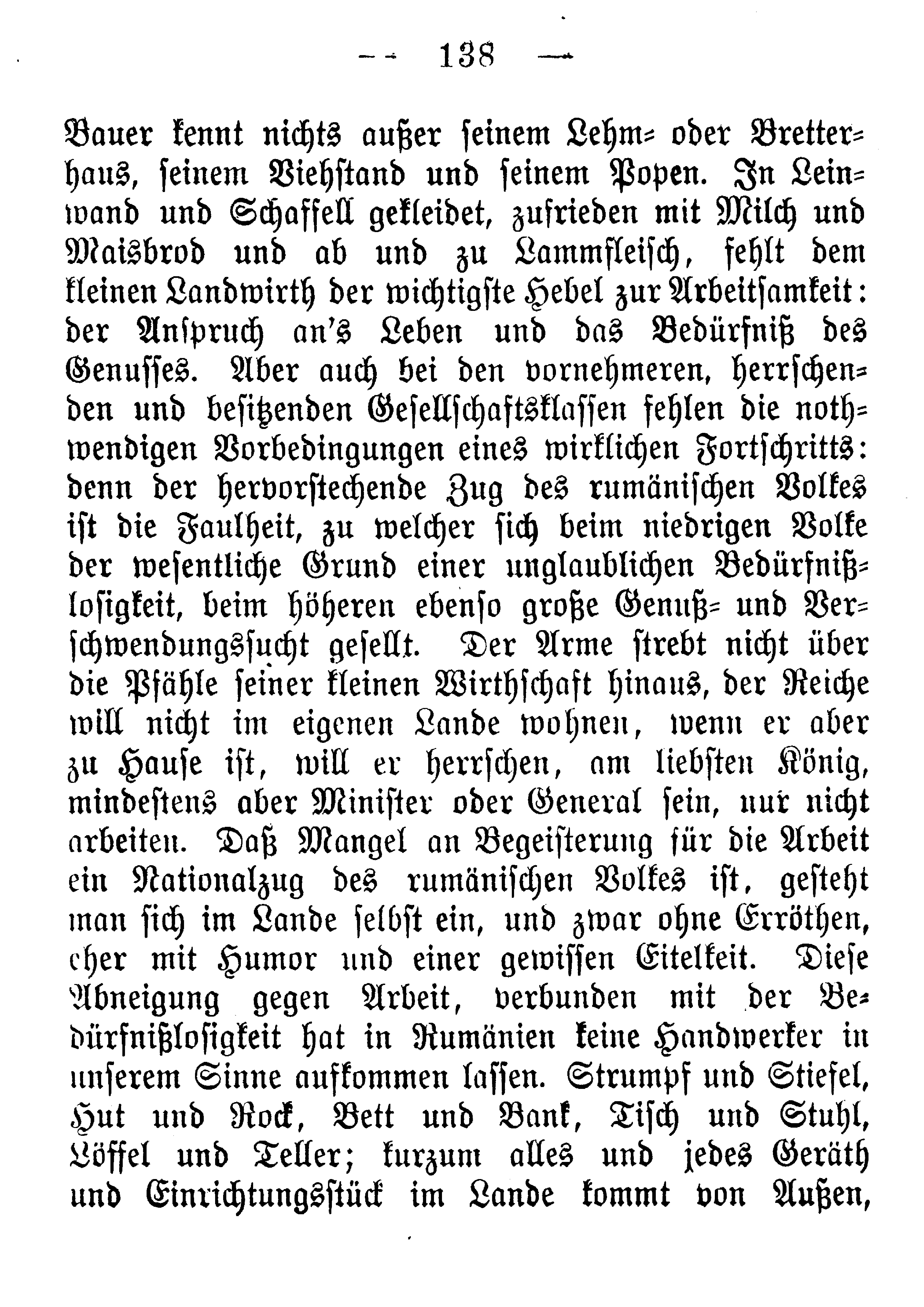
peasant knows nothing besides his clay or wooden house, his livestock, and his priest. Dressed in linen and sheepskin, content with milk and cornbread and occasionally lamb, the small farmer lacks the most important lever for industriousness: the demands on life and the need for enjoyment. But even among the more distinguished, ruling, and propertied social classes, the necessary preconditions for real progress are lacking: for the prominent trait of the Romanian people is laziness, to which, among the lower class, is added the essential reason of an unbelievable lack of needs, and among the higher class, an equally great lust for pleasure and extravagance. The poor man does not strive beyond the confines of his small farmstead, the rich man does not want to live in his own country, but when he is at home, he wants to rule, preferably to be king, or at least a minister or general, just not to work. That a lack of enthusiasm for work is a national trait of the Romanian people is something they admit in the country itself, and without blushing, rather with humor and a certain vanity. This aversion to work, combined with the lack of needs, has not allowed craftsmen in our sense of the word to emerge in Romania. Stocking and boot, hat and coat, bed and bench, table and chair, spoon and plate; in short, each and every tool and piece of furniture in the country comes from abroad,
Show Original German Text
--- 138 --- Bauer kennt nichts außer seinem Lehm- oder Bretterhaus, seinem Viehstand und seinemPopen. In Leinwand und Schaffell gekleidet, zufneden mit Milch und Maisbrod und ab und zu Lammfleisch, fehlt dem kleinen Landwirth der wichtigste Hebel zur Arbeitsamkeit: der Anspruch an's Leben und das Bedürfniß des Genusses. Aber auch bei den vomehmeren, herrschenden und besitzenden Gesellschaftsklassen fehlen die nothwendigen Vorbedingungen eines wirklichen Fortschntts: denn der hervorstechende Zug des rumänischen Volkes ist die Faulheit, zu welcher sich beim niedngen Volke der wesentliche Grund einer unglaublichen Bedürfnißlosigkeit, beim höheren ebenso große Genuß- und Verschwendungsfucht gesellt. Der Arme strebt nicht über die Pfähle seiner kleinen Wirthschaft hinaus, der Reiche will nicht im eigenen Lande wohnen, wenn er aber zu Hause ist, will er herrschen, am liebsten König, mindestens aber Minister oder General sein, nur nicht arbeiten. Daß Mangel an Begeisterung für die Arbeit ein Nationalzug des rumänischen Volkes ist, gesteht man sich im Lande selbst ein, und zwar ohne Erröthen, cher mit Humor und einer gewissen Eitelkeit. Diese Abneigung gegen Arbeit, verbunden mit der Bedürfnißlosigkeit hat in Rumänien keine Handwerker in unserem Sinne aufkommen lassen. Strumpf und Stiefel, Hut und Rock, Bett und Bank, Tisch und Stuhl, Löffel und Teller; kurzum alles und jedes Geräth und Einnchtungstück im Lande kommt von Außen,