The Antisemitic Catechism (1893)
Page 52 • Click to zoom
Page 52 of 436
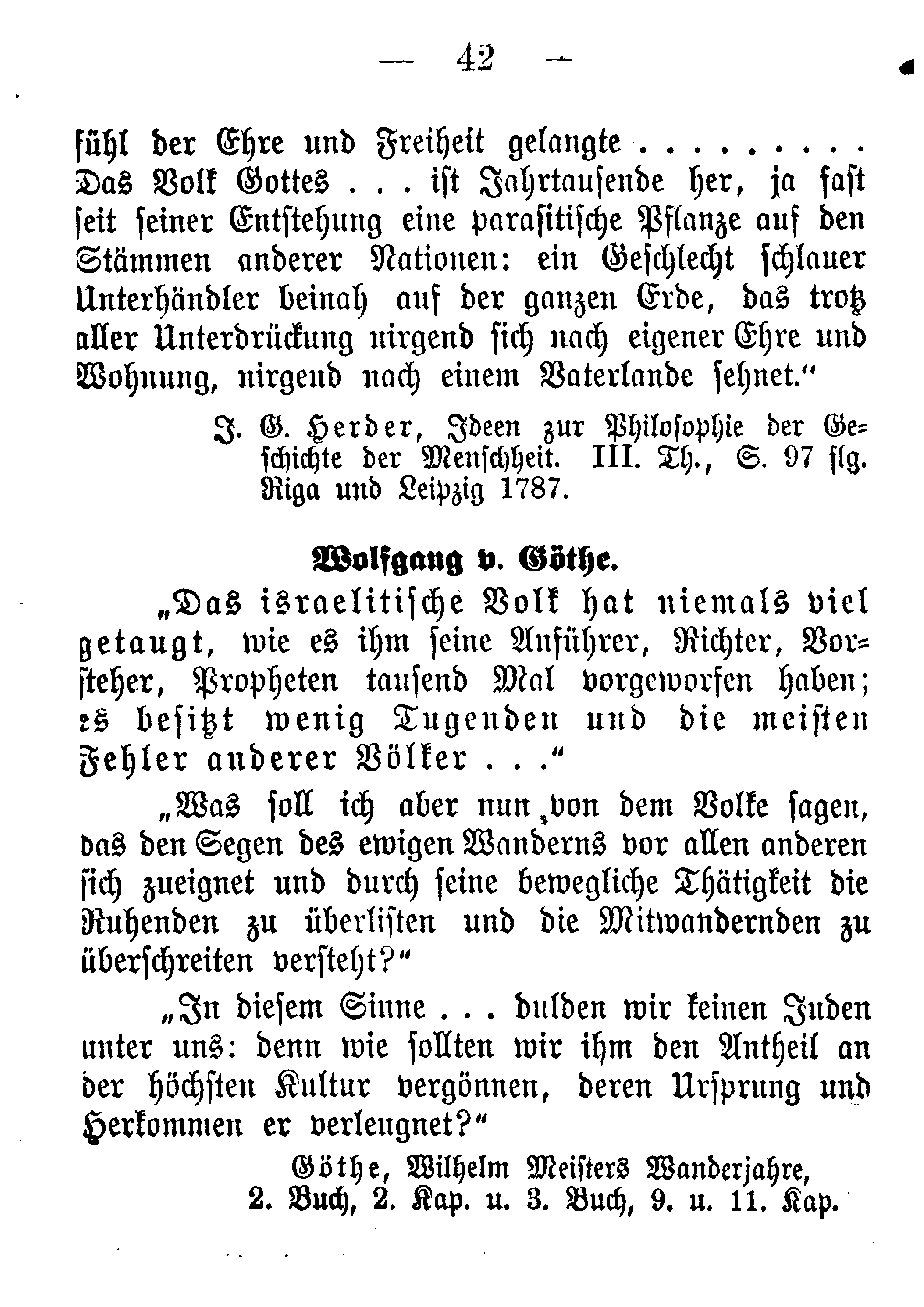
ing of honor and freedom . . . . . . .
The people of God . . . have for millennia, indeed almost since their origin, been a parasitic plant on the trunks of other nations: a race of cunning middlemen over almost the entire earth, which despite all oppression nowhere longs for its own honor and home, nowhere for a fatherland."
J. G. Herder, Ideas for the Philosophy of the History of Mankind. Part III, p. 97 ff. Riga and Leipzig 1787.
Wolfgang v. Goethe.
"The Israelite people were never worth much, as their leaders, judges, heads, and prophets have reproached them a thousand times; it possesses few virtues and most of the faults of other peoples . . ."
"But what shall I now say of the people that appropriates the blessing of eternal wandering above all others and knows how to outwit the sedentary and to surpass their fellow wanderers through its mobile activity?"
"In this sense . . . we tolerate no Jew among us: for how could we grant him a share in the highest culture, whose origin and descent he denies?"
Goethe, Wilhelm Meister's Journeyman Years, Book 2, Chap. 2 and Book 3, Chap. 9 and 11.
Show Original German Text
— 42 — fühl der Ehre und Freiheit gelangte . . . . . . . Das Volk Gottes . . . ist Jahrtausende her, ja fast seit seiner Entstehung eine parasitische Pflanze auf den Stämmen anderer Nationen: ein Geschlecht schlauer Unterhändler beinah auf der ganzen Erde, das trotz aller Unterdrückung nirgend sich nach eigener Ehre und Wohnung, nirgend nach einem Vaterlande sehnet." J. G. Herder, Ideen zur Philosophie der Ge schichte der Menschheit. III. Th., S. 97 flg. Riga und Leipzig 1787. Wolfgang v. Goethe. „Das israelitische Volk hat niemals viel getaugt, wie es ihm seine Anführer, Richter, Vorsteher, Propheten tausend Mal vorgeworfen haben; es besitzt wenig Tugenden und die meisten Fehler anderer Völker . . ." „Was soll ich aber nun von dem Volke sagen, das den Segen des ewigen Wandems vor allen anderen sich zueignet und durch seine bewegliche Thätigkeit die Ruhenden zu überlisten und die Mitwandemden zu überschreiten versteht?" „In diesem Sinne . . . dulden wir keinen Juden unter uns: denn wie sollten wir ihm den Antheil an der höchsten Kultur vergönnen, deren Ursprung und Herkommen er verleugnet?" Goethe, Wilhelm Meisters Wanderjahre, 2. Buch, 2. Kap. u. 3. Buch, 9. u. 11. Kap.