The Antisemitic Catechism (1893)
Page 317 • Click to zoom
Page 317 of 436
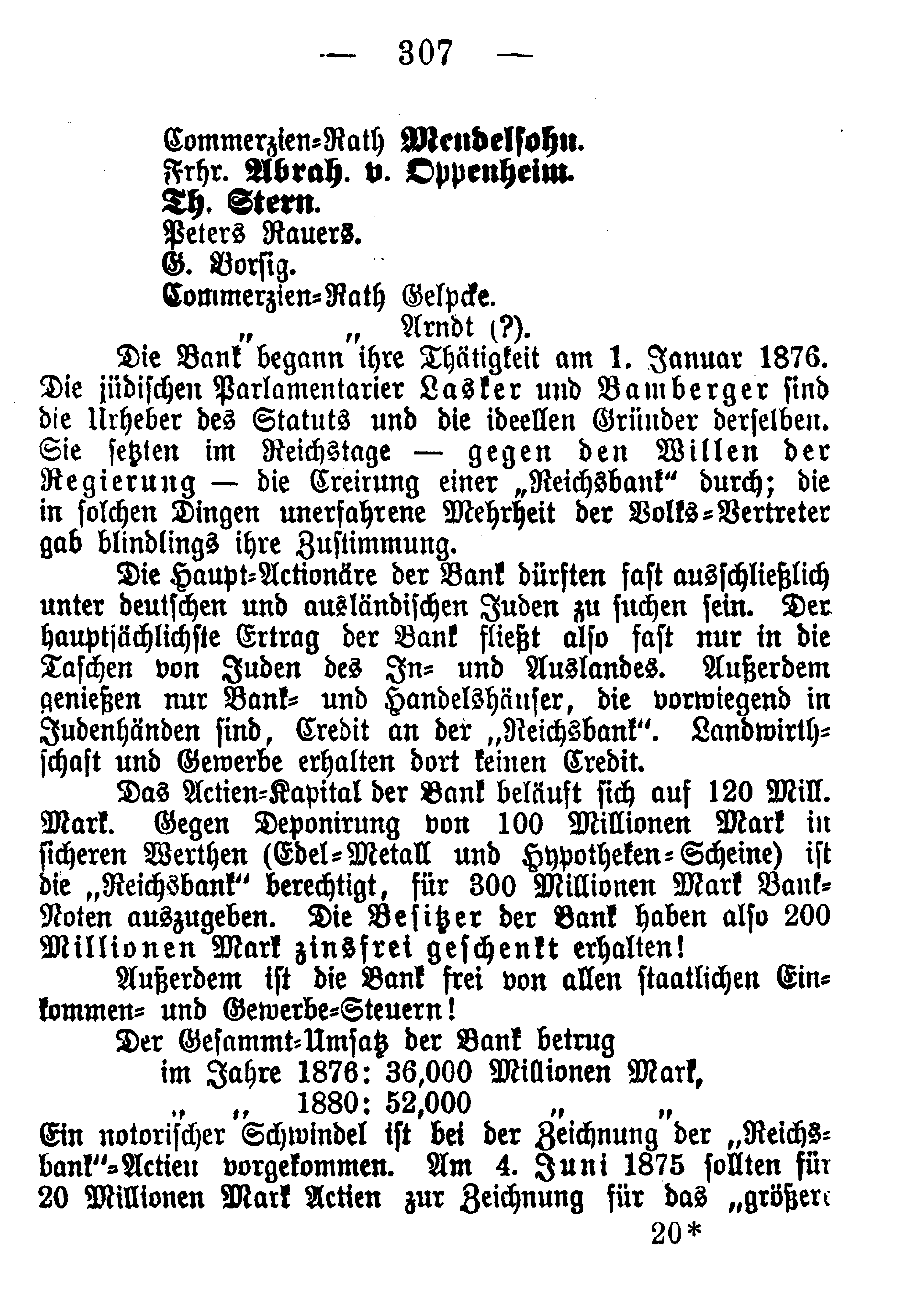
Councilor of Commerce Mendelsohn. Baron Abrah. v. Oppenheim. Th. Stem. Peters Mauers. G. Vostig. Councilor of Commerce Gelpcke. Amdt (?).
The bank began its activities on January 1, 1876.
The Jewish parliamentarians Laster and Bamberger are the authors of the statute and the ideological founders of the same. They pushed through the creation of a "Reichsbank" in the Reichstag — against the will of the government; the majority of the people's representatives, inexperienced in such matters, gave their consent blindly.
The main shareholders of the bank are likely to be found almost exclusively among German and foreign Jews. The main profit of the bank thus flows almost exclusively into the pockets of Jews from home and abroad. Furthermore, only banking and commercial houses, which are predominantly in Jewish hands, enjoy credit at the "Reichsbank". Agriculture and trade receive no credit there.
The share capital of the bank amounts to 120 million marks. In exchange for depositing 100 million marks in secure assets (precious metals and mortgage bonds), the "Reichsbank" is entitled to issue 300 million marks in banknotes. The owners of the bank have thus received 200 million marks interest-free as a gift!
In addition, the bank is free from all state income and business taxes!
The total turnover of the bank amounted to in the year 1876: 36,000 million marks, 1880: 52,000 A notorious "swindle" occurred during the subscription for the "Reichs- bank" shares. On June 4, 1875, shares worth 20 million marks were to be offered for subscription to the "wider 20*
Show Original German Text
— 307 — Commerzien-Rath Mendelsohn. Frhr. Abrah. v. Oppenheim. Th. Stem. Peters Mauers. G. Vostig. Commerzien-Rath Gelpcke. Amdt (?). Die Bank begann ihre Thätigkeit am 1. Januar 1876. Die jüdischen Parlamentaner Laster und Bamberger sind die Urheber des Statuts und die ideellen Gründer derselben. Sie seßten im Reichstage — gegen den Willen der Regierung — die Erreichung einer „Reichsbank“ durch; die in solchen Dingen unerfahrene Mehrheit der Volks-Vertreter gab blindlings ihre Zustimmung. Die Haupt-Actionäre der Bank dürften fast ausschließlich unter deutschen und ausländischen Juden zu suchen sein. Der hauptsächlichste Ertrag der Bank fließt also fast nur in die Taschen von Juden des In- und Auslandes. Außerdem genießen nur Bank- und Handelshäuser, die vorwiegend in Judenhänden sind, Credit an der „Reichsbank“. Landwirth- schaft und Gewerbe erhalten dort keinen Credit. Das Actien-Kapital der Bank beläuft sich auf 120 Mill. Mark. Gegen Deponirung von 100 Millionen Mark in sicheren Werthen (Edel-Metall und Hypotheken-Scheine) ist die „Reichsbank“ berechtigt, für 300 Millionen Mark Bank- Noten auszugeben. Die Besitzer der Bank haben also 200 Millionen Mark zinsfrei geschenkt erhalten! Außerdem ist die Bank frei von allen staatlichen Ein- kommen- und Gewerbe-Steuem! Der Gesamm-Umsaß der Bank betrug im Jahre 1876: 36,000 Millionen Mark, 1880: 52,000 Ein notonscher „Schwindel“ ist bei der Zeichnung der „Reichs- bank“-Actien vorgekommen. Am 4. Juni 1875 sollten für 20 Millionen Mark Actien zur Zeichnung für das „größere 20*