The Antisemitic Catechism (1893)
Page 295 • Click to zoom
Page 295 of 436
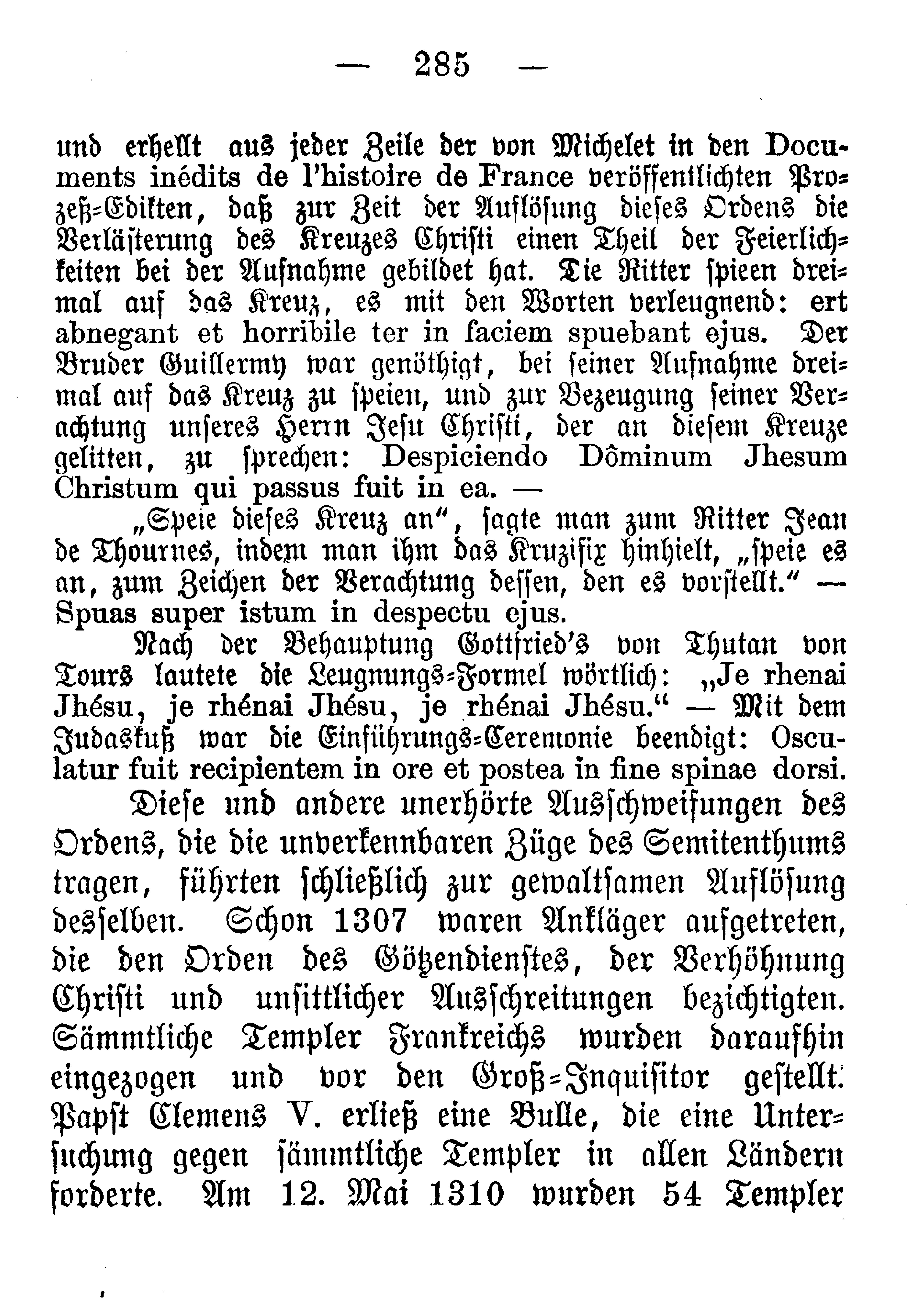
and is evident from every line of the trial edicts published by Michelet in the Documents inédits de l'histoire de France, that at the time of the dissolution of this order, the blasphemy of the Cross of Christ formed part of the ceremonies at the initiation. The knights spat three times on the cross, denying it with the words: et abnegant et horribile ter in faciem spuebant ejus. Brother Guillermy was forced, at his initiation, to spit on the cross three times and, as a testament to his contempt for our Lord Jesus Christ, who suffered on this cross, to say: Despiciendo Dominum Thesum Chnstum qui passus fuit in ea. —
"Spit on this cross," they said to the knight Jean de Thoumes, holding out the crucifix to him, "spit on it, as a sign of contempt for him whom it represents." — Spuas super istum in despectu ejus.
According to the assertion of Gottfried von Thutan of Tours, the formula of denial was literally: "Je rhenai Jhésu, je rhénai Jhésu, jo rhénai Jhésu." — The initiation ceremony was concluded with the kiss of Judas: Osculatur fuit recipientem in ore et postea in fine spinae dorsi.
These and other unheard-of debaucheries of the order, which bear the unmistakable features of Semitism, finally led to its violent dissolution. As early as 1307, accusers had appeared who charged the order with idolatry, mockery of Christ, and immoral excesses. All the Templars of France were thereupon arrested and brought before the Grand Inquisitor: Pope Clement V issued a bull that called for an investigation against all Templars in all countries. On May 12, 1310, 54 Templars were
Show Original German Text
- 285 - und erhellt aus jeder Zeile der von Michelet in den Docu- ments inédits de l'histoire de France veröffentlichten Pro- zeß-Edikten, daß zur Zeit der Auflösung dieses Ordens die Verlästerung des Kreuzes Chnsti einen Theil der Feierlich- keiten bei der Aufnahme gebildet hat. Die Ritter spieen drei- mal auf das Kreuz, es mit den Worten verleugnend: ert abnegant et hornbile ter in faciem spuebant ejus. Der Bruder Guillermy war genöthigt, bei seiner Aufnahme drei- mal auf das Kreuz zu speien, und zur Bezeugung seiner Ver- achtung unseres Herm Jesu Chnsti, der an diesem Kreuze gelitten, zu sprechen: Despiciendo Dominum Thesum Chnstum qui passus fuit in ea. — „Speie dieses Kreuz an“, sagte man zum Ritter Jean de Thoumes, indem man ihm das Kruzifix hinhielt, „speie es an, zum Zeichen der Verachtung dessen, den es vorstellt.“ — Spuas super istum in despectu ejus. Nach der Behauptung Gottfned’s von Thutan von Tours lautete die Leugnungs-Formel wörtlich: „Je rhenai Jhésu, je rhénai Jhésu, jo rhénai Jhésu.“ — Mit dem Judasfuß war die Einführungs-Ceremonie beendigt: Oscu- latur fuit recipientem in ore et postea in fine spinae dorsi. Diese und andere unerhörte Ausschweifungen des Ordens, die die unverkennbaren Züge des Semitenthums tragen, führten schließlich zur gewaltsamen Auflösung desselben. Schon 1307 waren Ankläger aufgetreten, die den Orden des Götzendienstes, der Verhöhnung Chnsti und unsittlicher Ausschreitungen bezichtigten. Sämmtliche Templer Frankreichs wurden daraufhin eingezogen und vor den Groß-Inquisitor gestellt: Papst Clemens V. erließ eine Bulle, die eine Untersuchung gegen sämmtliche Templer in allen Ländem forderte. Am 12. Mai 1310 wurden 54 Templer