The World
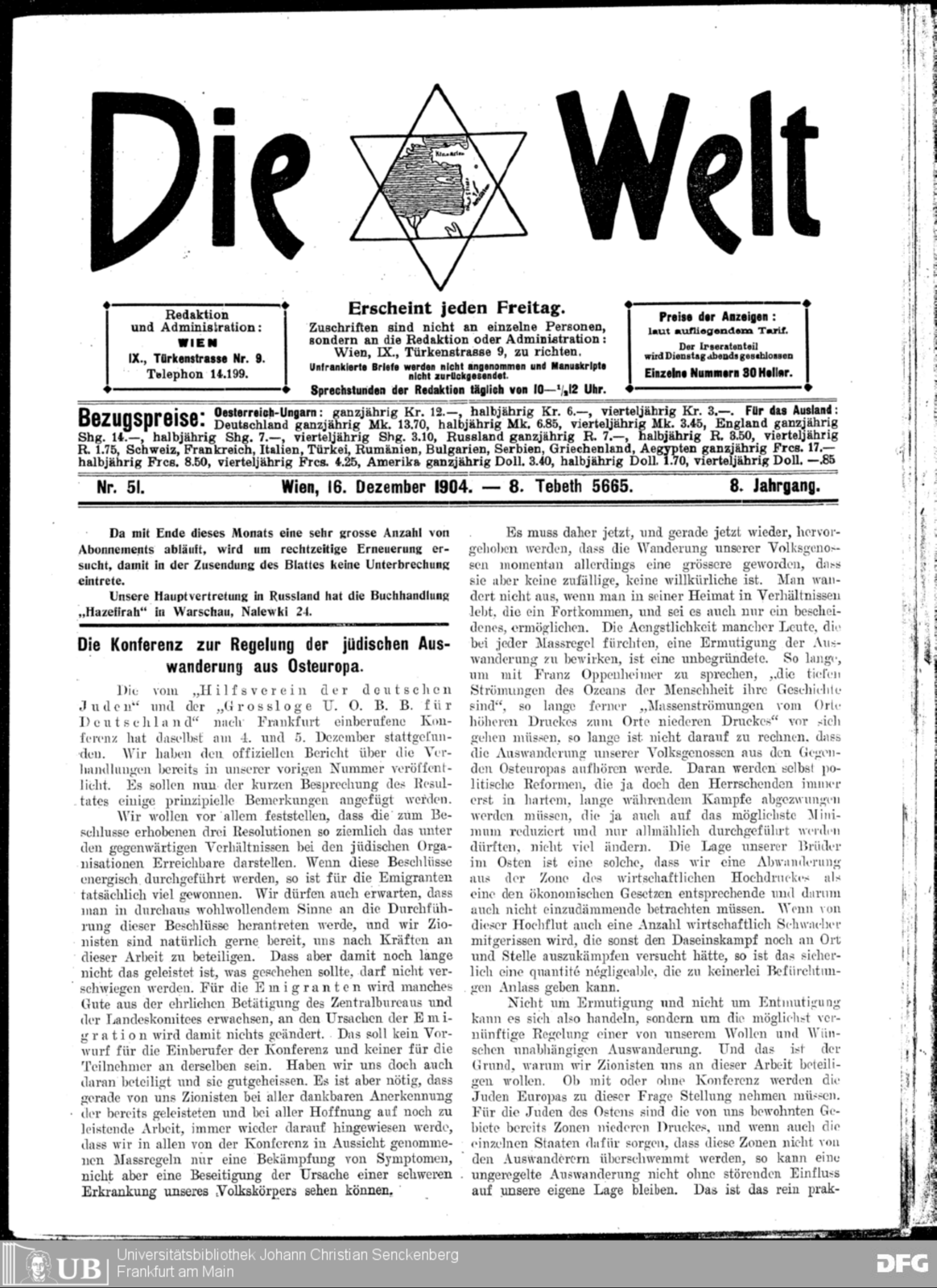
Die Welt
Editorial Office and Administration: VIENNA, IX., Türkenstrasse No. 9. Telephone 14.199. — Published every Friday. Correspondence is to be addressed not to individual persons but to the Editorial Office or Administration: Vienna, IX., Türkenstrasse 9. Unstamped letters are not accepted, and manuscripts are not returned. Editorial office hours daily from 10 to ½12 o'clock. — Advertisement rates: according to the tariff on file. The advertisement section closes on Tuesday evening. Single numbers 30 Heller.
Subscription rates: Austria-Hungary: yearly Kr. 12.—, half-yearly Kr. 6.—, quarterly Kr. 3.—. Abroad: Germany yearly Mk. 13.70, half-yearly Mk. 6.85, quarterly Mk. 3.45; England yearly Shg. 14.—, half-yearly Shg. 7.—, quarterly Shg. 3.10; Russia yearly R. 7.—, half-yearly R. 3.50, quarterly R. 1.75; Switzerland, France, Italy, Turkey, Roumania, Bulgaria, Servia, Greece, Egypt yearly Frcs. 17.—, half-yearly Frcs. 8.50, quarterly Frcs. 4.25; America yearly Doll. 3.40, half-yearly Doll. 1.70, quarterly Doll. —.85
No. 51. | Vienna, 16th December 1904. — 8th Tebeth 5665. | 8th Year.
As a very large number of subscriptions expire at the end of this month, subscribers are requested to renew in good time, so that no interruption may occur in the delivery of the paper.
Our chief agency in Russia is the "Hazefirah" bookshop in Warsaw, Nalewki 24.
The Conference for the Regulation of Jewish Emigration from Eastern Europe.
The Conference summoned to Frankfort by the "Hilfsverein der deutschen Juden" and the "Grand Lodge U. O. B. B. for Germany" took place there on the 4th and 5th of December. We have already published the official report of the proceedings in our last number. A few remarks of principle shall now be added to a brief discussion of the result.
We wish, above all, to state that the three resolutions raised to decisions represent pretty well what is attainable among the Jewish organisations under present conditions. If these decisions are energetically carried out, much will in fact have been gained for the emigrants. We may also expect that the carrying out of these decisions will be approached in a thoroughly well-disposed spirit, and we Zionists are, of course, gladly prepared to take part in this work to the best of our powers. But it must not be passed over in silence that this is still far from accomplishing what ought to be done. Much good will accrue to the emigrants from the honest activity of the Central Bureau and the National Committees; the causes of the emigration will not be altered thereby. This is meant as no reproach to those who convened the Conference, nor to those who took part in it. Did we not, indeed, take part in it ourselves and approve of it? It is necessary, however, that we Zionists in particular, with all grateful recognition of the work already accomplished and with all hope for the work still to be done, should point out again and again that in all the measures contemplated by the Conference we can see only a combating of symptoms, and not a removal of the cause of a grave disease of our national body.
It must therefore be emphasised now, and now especially, once again, that the migration of our fellow Jews has at the moment certainly grown greater, but that it is no accidental, no arbitrary one. People do not emigrate when they live at home in circumstances that make it possible to get on, be it only modestly. The anxiety of certain people, who fear with every measure that they will bring about an encouragement of emigration, is unfounded. So long as, to speak with Franz Oppenheimer, "the deep currents of the ocean of mankind are its history," so long, further, as "mass currents from the place of higher pressure to the place of lower pressure" must take place, so long is it not to be reckoned upon that the emigration of our fellow Jews from the regions of Eastern Europe will cease. Even political reforms will not alter much in this — reforms which must always first be wrung from the rulers in a hard and long-continued struggle, and which are, besides, likely to be reduced to the smallest possible minimum and carried out only gradually. The situation of our brethren in the East is such that we must regard an exodus from the zone of economic high pressure as one conforming to economic laws, and therefore not to be dammed. If a number of the economically weak, who would otherwise have tried to fight out the struggle for existence on the spot, are also swept along by this flood-tide, that is surely a quantité négligeable, which can give occasion for no apprehension whatever.
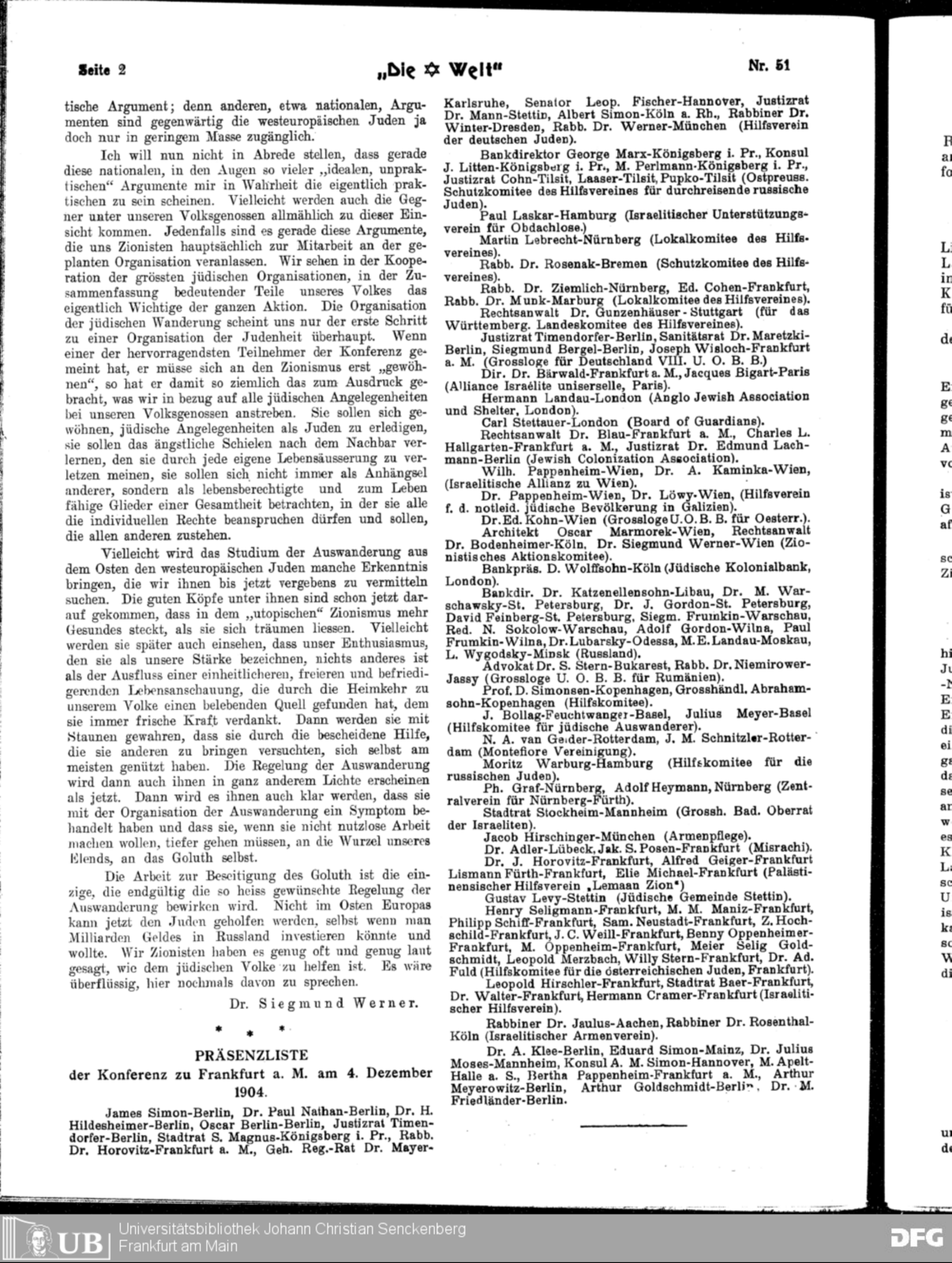
It cannot, then, be a question of encouragement or of discouragement, but of the most rational possible regulation of an emigration that is independent of our will and wishes. And that is the reason why we Zionists wish to take part in this work. With or without a Conference, the Jews of Europe will have to take a position on this question. For the Jews of the East, the territories inhabited by us are already zones of low pressure, and even if the individual States take care that these zones are not flooded by the emigrants, an unregulated emigration cannot remain without a disturbing influence upon our own situation. That is the purely prac-