The World
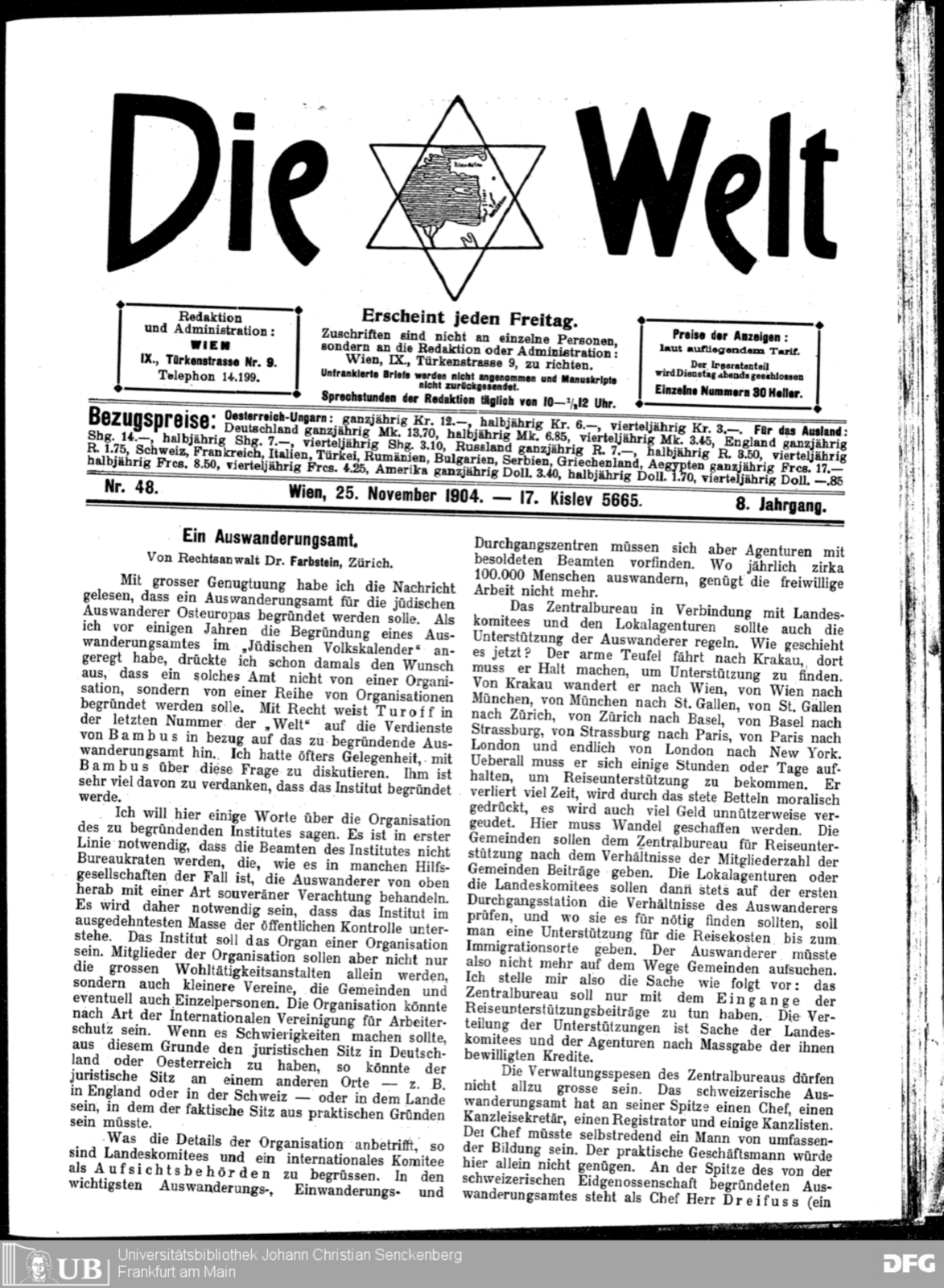
Die Welt
Editorial Office and Administration: VIENNA, IX., Türkenstrasse No. 9. Telephone 14.199.
Published every Friday. Communications are to be addressed not to individual persons but to the Editorial Office or the Administration: Vienna, IX., Türkenstrasse 9. Unstamped letters are not accepted and manuscripts are not returned. The Editorial Office receives callers daily from 10 to half-past 11 o'clock.
Advertisement rates: according to the tariff available on request. The advertising section closes on Tuesday evening. Single numbers 30 Heller.
Subscription rates: Austria-Hungary: yearly Kr. 12.—, half-yearly Kr. 6.—, quarterly Kr. 3.—. Abroad: Germany yearly Mk. 13.70, half-yearly Mk. 6.85, quarterly Mk. 3.45; England yearly Shg. 14.—, half-yearly Shg. 7.—, quarterly Shg. 3.10; Russia yearly R. 7.—, half-yearly R. 3.50, quarterly R. 1.75; Switzerland, France, Italy, Turkey, Roumania, Bulgaria, Servia, Greece, Egypt yearly Frcs. 17.—, half-yearly Frcs. 8.50, quarterly Frcs. 4.25; America yearly Doll. 3.40, half-yearly Doll. 1.70, quarterly Doll. —.85
No. 48. Vienna, 25 November 1904. — 17 Kislev 5665. Eighth Year.
An Emigration Bureau.
By Dr. Farbstein, Advocate, Zurich.
It was with great satisfaction that I read the news that an emigration bureau is to be founded for the Jewish emigrants of Eastern Europe. When, some years ago, I proposed the founding of an emigration bureau in the "Jüdischer Volkskalender," I already expressed the wish that such a bureau should be founded not by one organisation but by a number of organisations. Turoff, in the last number of "Die Welt," rightly points to the services of Bambus in respect of the bureau now to be founded. I have often had occasion to discuss this question with Bambus. It is in very great measure owing to him that the institution is to be founded.
I wish to say a few words here on the organisation of the institution to be founded. It is necessary in the first place that the officials of the institution shall not become bureaucrats who, as is the case in certain relief societies, treat the emigrants from above with a kind of sovereign contempt. It will therefore be necessary that the institution be subject in the widest measure to public control. The institution is to be the organ of an organisation. The members of the organisation, however, are to be not the great charitable institutions alone, but smaller societies as well, the communities, and possibly private persons also. The organisation might be modelled on the International Association for the Protection of Labour. Should difficulties arise on this account in having its legal seat in Germany or Austria, the legal seat might be in some other place — for instance in England or Switzerland — or in the country in which the actual seat would have to be for practical reasons.
As regards the details of the organisation, national committees and an international committee as supervising bodies are to be welcomed. In the most important centres of emigration, immigration and transit, however, there must be agencies with salaried officials. Where some 100,000 persons emigrate every year, voluntary work no longer suffices.
The central bureau, in conjunction with the national committees and the local agencies, should also regulate the relief of the emigrants. How is it done at present? The poor devil travels to Cracow; there he must halt in order to find relief. From Cracow he wanders to Vienna, from Vienna to Munich, from Munich to St. Gallen, from St. Gallen to Zurich, from Zurich to Basle, from Basle to Strasburg, from Strasburg to Paris, from Paris to London, and at last from London to New York. Everywhere he must stop for some hours or days in order to obtain travelling relief. He loses much time, he is morally depressed by the constant begging, and much money, too, is uselessly squandered. Here a change must be made. The communities should contribute to the central bureau for travelling relief in proportion to the number of their members. The local agencies or the national committees should then always examine the emigrant's circumstances at the first transit station, and where they find it necessary, a grant should be given towards the cost of the journey as far as the place of immigration. The emigrant would thus no longer have to seek out communities along the way. I therefore conceive the matter as follows: the central bureau is to have to do only with the receipt of the contributions for travelling relief. The distribution of the grants is the business of the national committees and the agencies, according to the credits allowed them.
The administrative expenses of the central bureau must not be too great. The Swiss Emigration Bureau has at its head a chief, a chancery secretary, a registrar and several clerks. The chief would of course have to be a man of wide culture. The practical man of business alone would not suffice here. At the head of the emigration bureau founded by the Swiss Confederation stands as chief Herr Dreifuss (a