The World
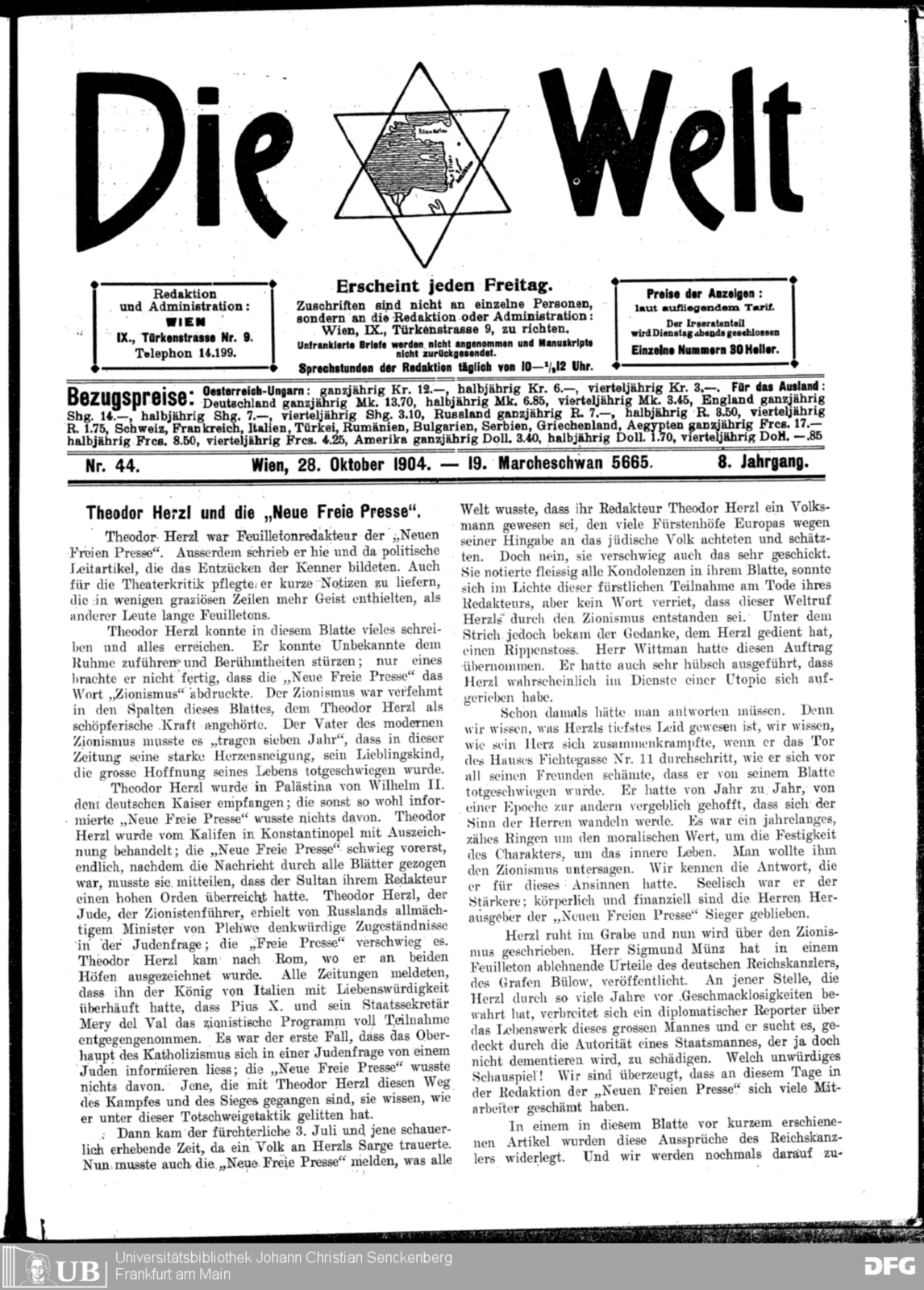
Die Welt
Appears every Friday.
Editorial Office and Administration: VIENNA, IX., Türkenstrasse No. 9. Telephone 14.199.
Communications are to be addressed not to individual persons but to the Editorial Office or the Administration: Vienna, IX., Türkenstrasse 9. Unstamped letters are not accepted, and manuscripts are not returned. Editorial consulting hours daily from 10 to half past 11.
Advertisement rates: according to the tariff available on request. The advertising section closes on Tuesday evening. Single numbers 30 Heller.
Subscription rates: Austria-Hungary: yearly Kr. 12.—, half-yearly Kr. 6.—, quarterly Kr. 3.—. Abroad: Germany yearly Mk. 13.70, half-yearly Mk. 6.85, quarterly Mk. 3.45; England yearly Shg. 14.—, half-yearly Shg. 7.—, quarterly Shg. 3.10; Russia yearly R. 7.—, half-yearly R. 3.50, quarterly R. 1.75; Switzerland, France, Italy, Turkey, Roumania, Bulgaria, Servia, Greece, Egypt yearly Frcs. 17.—, half-yearly Frcs. 8.50, quarterly Frcs. 4.25; America yearly Doll. 3.40, half-yearly Doll. 1.70, quarterly Doll. —.85
No. 44. Vienna, 28 October 1904. — 19 Marcheshvan 5665. 8th Year.
Theodor Herzl and the "Neue Freie Presse".
Theodor Herzl was feuilleton editor of the "Neue Freie Presse". Besides this he wrote now and again political leading articles which were the delight of connoisseurs. For the dramatic criticism, too, he was wont to supply short notices which in a few graceful lines held more wit than other people's long feuilletons.
Theodor Herzl could write a great deal in this paper and achieve everything. He could lead the unknown to fame and cast down celebrities; one thing only he could not bring about: that the "Neue Freie Presse" should print the word "Zionism". Zionism was under ban in the columns of this paper, to which Theodor Herzl belonged as a creative force. The father of modern Zionism had to "bear it seven years" that in this newspaper the strong inclination of his heart, his favourite child, the great hope of his life, was killed by silence.
Theodor Herzl was received in Palestine by Wilhelm II., the German Emperor; the otherwise so well-informed "Neue Freie Presse" knew nothing of it. Theodor Herzl was treated with distinction by the Caliph in Constantinople; the "Neue Freie Presse" kept silent at first, and at last, after the news had gone the round of all the papers, it was obliged to report that the Sultan had presented its editor with a high order. Theodor Herzl, the Jew, the Zionist leader, obtained from Russia's all-powerful Minister von Plehwe memorable concessions on the Jewish question; the "Freie Presse" suppressed it. Theodor Herzl came to Rome, where he was distinguished at both courts. All the newspapers reported that the King of Italy had overwhelmed him with kindness, that Pius X. and his Secretary of State Mery del Val had received the Zionist programme with full sympathy. It was the first instance of the head of Catholicism letting himself be informed on a Jewish question by a Jew; the "Neue Freie Presse" knew nothing of it. Those who have gone with Theodor Herzl along this road of struggle and victory know how he suffered under this tactic of killing by silence.
Then came the dreadful 3rd of July, and that time, at once harrowing and exalting, when a people mourned at Herzl's bier. Now the "Neue Freie Presse", too, was obliged to report what all the world knew: that its editor Theodor Herzl had been a man of the people, whom many princely courts of Europe esteemed and valued for his devotion to the Jewish people. But no—it very skilfully suppressed that as well. It diligently noted all the condolences in its pages and basked in the light of this princely sympathy at the death of its editor, but not a word betrayed that Herzl's world-wide fame had arisen through Zionism. Below the line, however, the idea which Herzl had served received a dig in the ribs. Herr Wittman had undertaken this commission. He had also set forth very prettily that Herzl had probably worn himself out in the service of a Utopia.
Even then an answer ought to have been given. For we know what Herzl's deepest sorrow was; we know how his heart contracted whenever he passed through the gate of the house at No. 11 Fichtegasse, how he was ashamed before all his friends that he was killed by silence in his own paper. From year to year, from one epoch to the next, he had hoped in vain that the gentlemen would change their minds. It was a stubborn struggle of years for moral worth, for firmness of character, for the inner life. They wished to forbid him Zionism. We know the answer he had for this demand. In soul he was the stronger; in body and in purse the gentlemen publishers of the "Neue Freie Presse" have remained the victors.
Herzl rests in the grave, and now Zionism is written about. Herr Sigmund Münz has published in a feuilleton adverse judgments of the German Imperial Chancellor, Count Bülow. In that very place which Herzl for so many years preserved from tastelessness, a diplomatic reporter holds forth upon the life-work of this great man, and seeks to damage it, sheltered by the authority of a statesman who, after all, will not issue a denial. What an unworthy spectacle! We are convinced that on that day many contributors in the editorial office of the "Neue Freie Presse" were ashamed.
In an article which appeared recently in this paper these utterances of the Imperial Chancellor were refuted. And we shall once more re-