The World
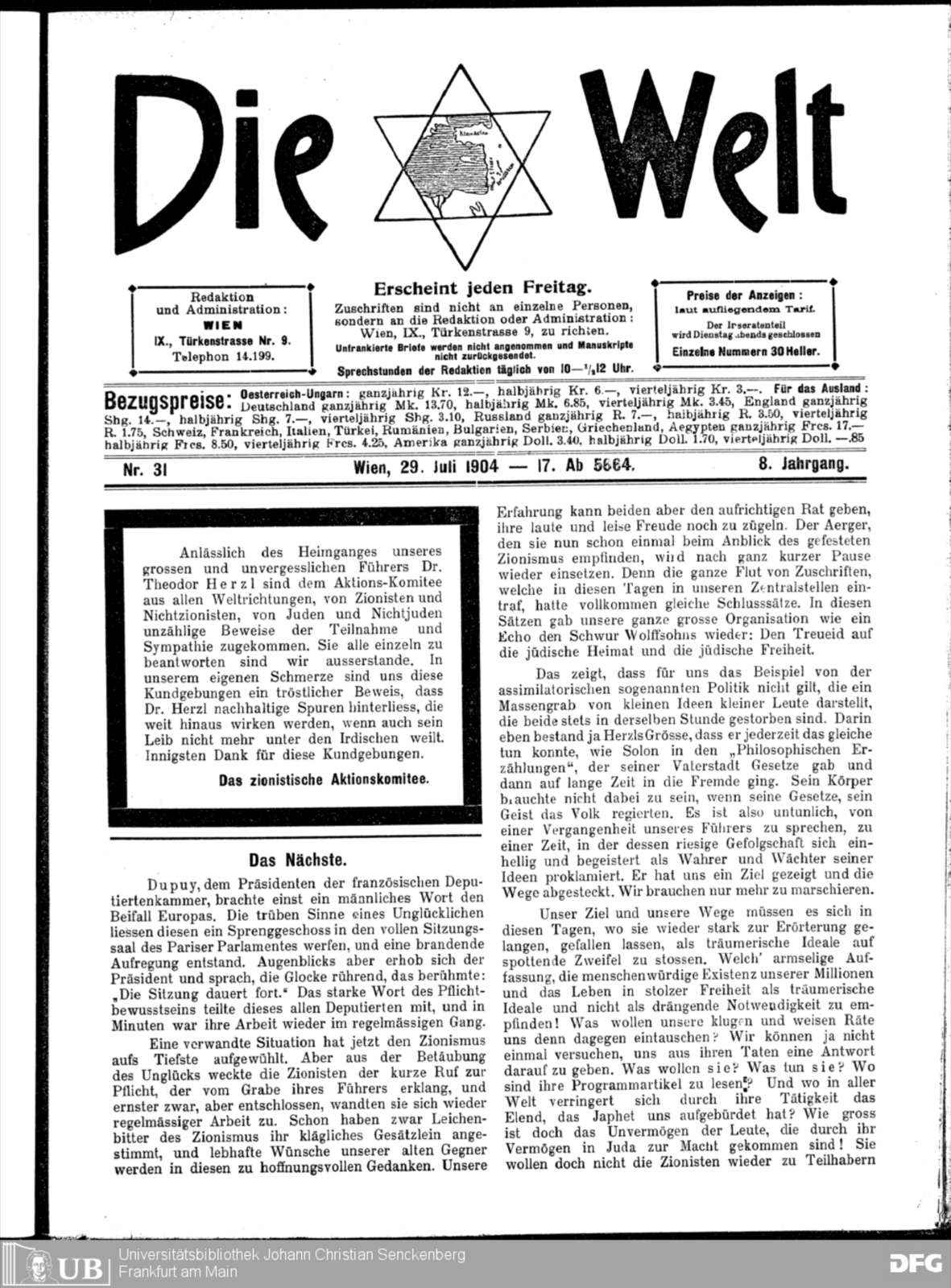
Die Welt
Editorial Office and Administration: VIENNA, IX., Türkenstrasse No. 9. Telephone 14.199.
Published every Friday. Correspondence is to be addressed not to individual persons but to the Editorial Office or Administration: Vienna, IX., Türkenstrasse 9. Unstamped letters are not accepted, and manuscripts are not returned. Editorial consulting hours daily from 10 to half past 11 o'clock.
Advertising rates: according to the tariff on file. The advertisement section closes on Tuesday evenings. Single numbers 30 Heller.
Subscription rates: Austria-Hungary: yearly Kr. 12.—, half-yearly Kr. 6.—, quarterly Kr. 3.—. Abroad: Germany yearly Mk. 13.70, half-yearly Mk. 6.85, quarterly Mk. 3.45; England yearly Shg. 14.—, half-yearly Shg. 7.—, quarterly Shg. 3.10; Russia yearly R. 7.—, half-yearly R. 3.50, quarterly R. 1.75; Switzerland, France, Italy, Turkey, Roumania, Bulgaria, Servia, Greece, Egypt yearly Frcs. 17.—, half-yearly Frcs. 8.50, quarterly Frcs. 4.25; America yearly Doll. 3.40, half-yearly Doll. 1.70, quarterly Doll. —.85
No. 31 | Vienna, 29 July 1904 — 17 Ab 5664. | 8th Year.
On the passing of our great and unforgettable leader, Dr. Theodor Herzl, countless tokens of sympathy and fellow-feeling have reached the Actions Committee from every quarter of the world, from Zionists and non-Zionists, from Jews and non-Jews. We are unable to answer them all individually. In our own grief these manifestations are a consoling proof to us that Dr. Herzl has left lasting traces, which will work far into the future, even though his body no longer dwells among the living. Our most heartfelt thanks for these manifestations.
The Zionist Actions Committee.
The Next Thing.
A manly word once won Dupuy, the President of the French Chamber of Deputies, the applause of Europe. The clouded mind of an unfortunate wretch led him to hurl an explosive into the crowded session-hall of the Paris Parliament, and a surging commotion arose. But at that instant the President rose and, ringing his bell, spoke the famous words: "The sitting continues." This strong word of duty conveyed itself to all the Deputies, and within minutes their work was once more going its regular course.
A kindred situation has now stirred Zionism to its very depths. But the short call to duty that sounded from their leader's grave roused the Zionists from the stupor of misfortune, and, graver indeed, yet resolute, they have turned once more to their regular work. The undertaker's men of Zionism, to be sure, have already struck up their pitiful little dirge, and in them the lively wishes of our old opponents are turning into hopeful thoughts. Our experience, however, allows us to give both the sincere counsel to rein in their joy, loud and quiet alike, for a while yet. The vexation which they have felt once already at the sight of a strengthened Zionism will set in again after a very short pause. For the whole flood of letters which reached our central offices in these days had entirely identical closing sentences. In those sentences our whole great organisation echoed Wolffsohn's vow: the oath of fealty to the Jewish homeland and to Jewish freedom.
This shows that for us the example of the so-called assimilationist policy does not hold, which is a common grave of the small ideas of small men, both of which have always died in the same hour. For in this very thing lay Herzl's greatness, that at any time he could do the same as Solon in the "Philosophical Tales," who gave his native city laws and then went abroad for a long time. His body had no need to be present while his laws, his spirit, governed the people. It is therefore unfitting to speak of our leader as belonging to the past, at a time when his vast following proclaims itself, unanimously and with enthusiasm, the keeper and guardian of his ideas. He has shown us a goal and marked out the ways. We need only march on.
Our goal and our ways must be content, in these days when they again come much into discussion, to meet with mocking doubts as dreamy ideals. What a paltry conception, to feel the existence worthy of human beings of our millions and a life in proud freedom as dreamy ideals and not as a pressing necessity! What, then, would our clever and wise councillors give us in exchange? We cannot even attempt to find ourselves an answer to that in their deeds. What do they want? What do they do? Where is their programme to be read? And where in all the world is the misery that Japhet has laid upon us lessened by their activity? How great indeed is the incapacity of the men who have come to power in Judah through their capital! Surely they do not wish the Zionists once more to be partners