The World
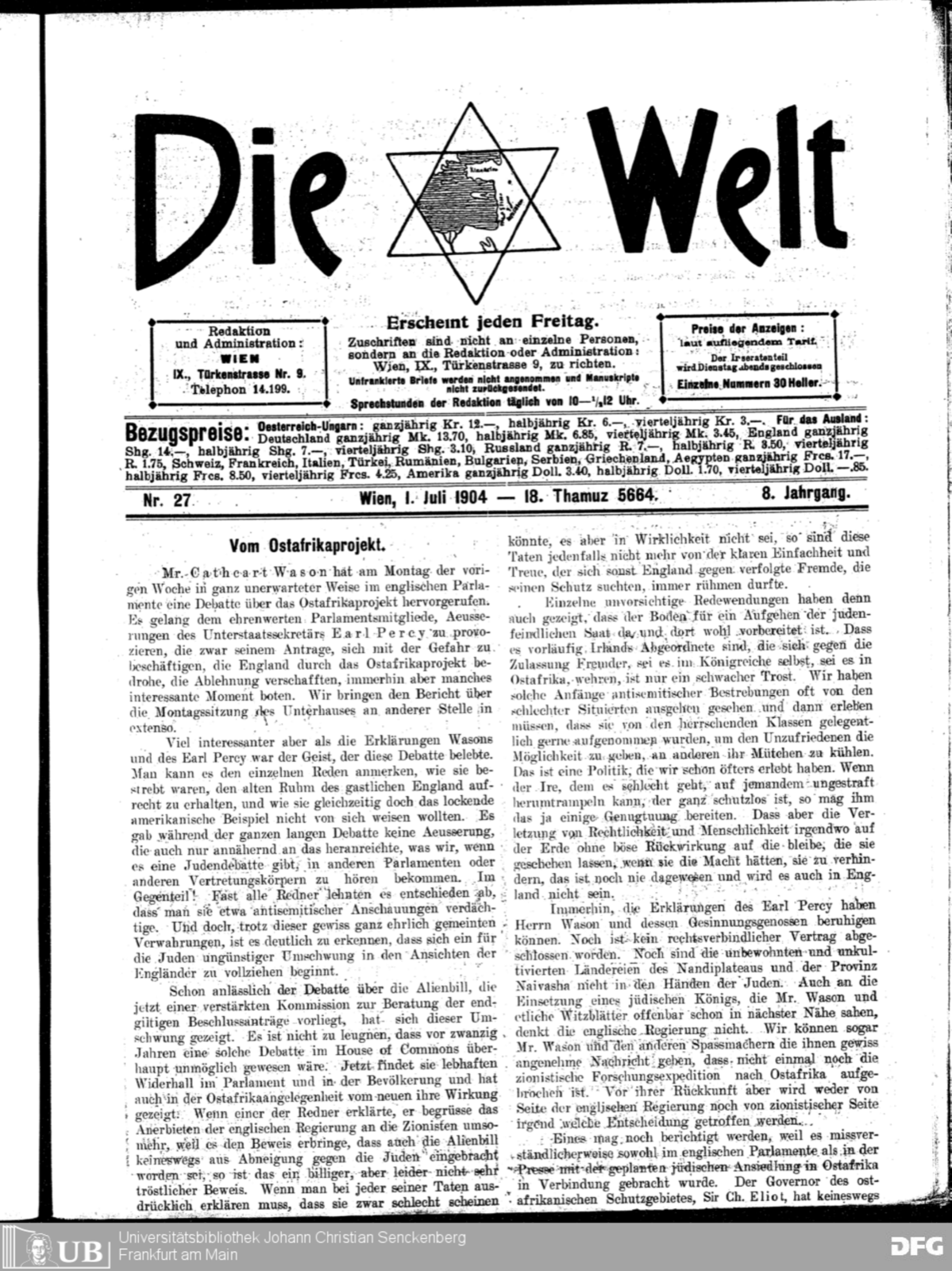
Die Welt
Editorial and Business Offices: VIENNA, IX., Türkenstrasse No. 9. Telephone 14.199.
Published every Friday. Correspondence is to be addressed not to individual persons but to the Editorial Office or the Business Office: Vienna, IX., Türkenstrasse 9. Unstamped letters are not accepted and manuscripts are not returned. The Editorial Office receives visitors daily from 10—1/212 o'clock.
Advertising rates: according to the published tariff. The advertisement section closes on Tuesday evening. Single numbers 30 Heller.
Subscription prices: Austria-Hungary: yearly Kr. 12.—, half-yearly Kr. 6.—, quarterly Kr. 3.—. Abroad: Germany yearly Mk. 13.70, half-yearly Mk. 6.85, quarterly Mk. 3.45; England yearly Shg. 14.—, half-yearly Shg. 7.—, quarterly Shg. 3.10; Russia yearly R. 7.—, half-yearly R. 3.50, quarterly R. 1.75; Switzerland, France, Italy, Turkey, Roumania, Bulgaria, Servia, Greece, Egypt yearly Frcs. 17.—, half-yearly Frcs. 8.50, quarterly Frcs. 4.25; America yearly Doll. 3.40, half-yearly Doll. 1.70, quarterly Doll. —.85.
No. 27. — Vienna, 1 July 1904 — 18 Thamuz 5664. — 8th Year.
On the East Africa Project.
On Monday of last week Mr. Cathcart Wason, in a wholly unexpected manner, provoked a debate in the English Parliament upon the East Africa project. The honourable Member succeeded in drawing from the Under-Secretary of State, Earl Percy, statements which, while they secured the rejection of his motion to consider the danger with which the East Africa project threatens England, nevertheless offered several points of interest. We print the report of Monday's sitting of the House of Commons in extenso elsewhere.
Far more interesting, however, than the declarations of Wason and of Earl Percy was the spirit that animated this debate. One can perceive in the several speeches how they strove to uphold the ancient fame of hospitable England, and how at the same time they were unwilling to put from them the alluring American example. In the whole of the long debate there was no utterance that came even near to what we are accustomed to hear in other parliaments or other representative bodies whenever there is a debate upon the Jews. On the contrary! Almost all the speakers emphatically refused to be suspected of anything like antisemitic views. And yet, in spite of these protestations, doubtless quite honestly meant, it is plainly to be seen that a change unfavourable to the Jews is beginning to take place in the opinions of Englishmen.
This change had already shown itself on the occasion of the debate on the Aliens Bill, which now lies before an enlarged committee for deliberation upon the final resolutions. It cannot be denied that twenty years ago such a debate in the House of Commons would have been altogether impossible. Now it finds a lively echo in Parliament and among the people, and it has shown its effect anew in the East Africa affair as well. When one of the speakers declared that he welcomed the English Government's offer to the Zionists all the more because it furnished proof that the Aliens Bill, too, had by no means been introduced out of dislike of the Jews, that is a cheap proof, but unhappily not a very comforting one. When one must expressly declare of each of one's deeds that, though it might appear bad, it is not so in reality, then those deeds are at all events no longer of that clear simplicity and good faith of which England was otherwise always entitled to boast towards persecuted strangers who sought her protection.
Certain incautious turns of phrase, indeed, have shown that the soil is here and there well prepared for the sprouting of the anti-Jewish seed. That it is for the present the Members for Ireland who resist the admission of strangers, be it in the Kingdom itself or in East Africa, is but a feeble consolation. We have often seen such beginnings of antisemitic endeavour proceed from the less well-situated, and then have had to witness how they were at times gladly taken up by the ruling classes, in order to give the discontented the opportunity of venting their spleen upon others. That is a policy we have witnessed more than once. If the Irishman, who fares badly, can trample with impunity upon someone who is wholly defenceless, it may well afford him some satisfaction. But that the violation of justice and humanity anywhere on earth should remain without evil reaction upon those who allow it to happen when they have the power to prevent it, — that has never yet been, and it will not be so in England either.
Be that as it may, the declarations of Earl Percy were able to reassure Mr. Wason and those of like mind with him. As yet no legally binding agreement has been concluded. As yet the uninhabited and uncultivated lands of the Nandi plateau and of the province of Naivasha are not in the hands of the Jews. Nor is the English Government contemplating the installation of a Jewish king, which Mr. Wason and sundry comic papers evidently already saw close at hand. We can even give Mr. Wason and the other jesters the news, doubtless agreeable to them, that the Zionist expedition of inquiry to East Africa has not yet so much as set out. And before its return no decision whatever will be taken, either on the part of the English Government or on the Zionist side.
One thing more may be corrected, because it has been mistakenly connected, both in the English Parliament and in the press, with the proposed Jewish settlement in East Africa. The Governor of the East Africa Protectorate, Sir Ch. Eliot, has by no means