The World
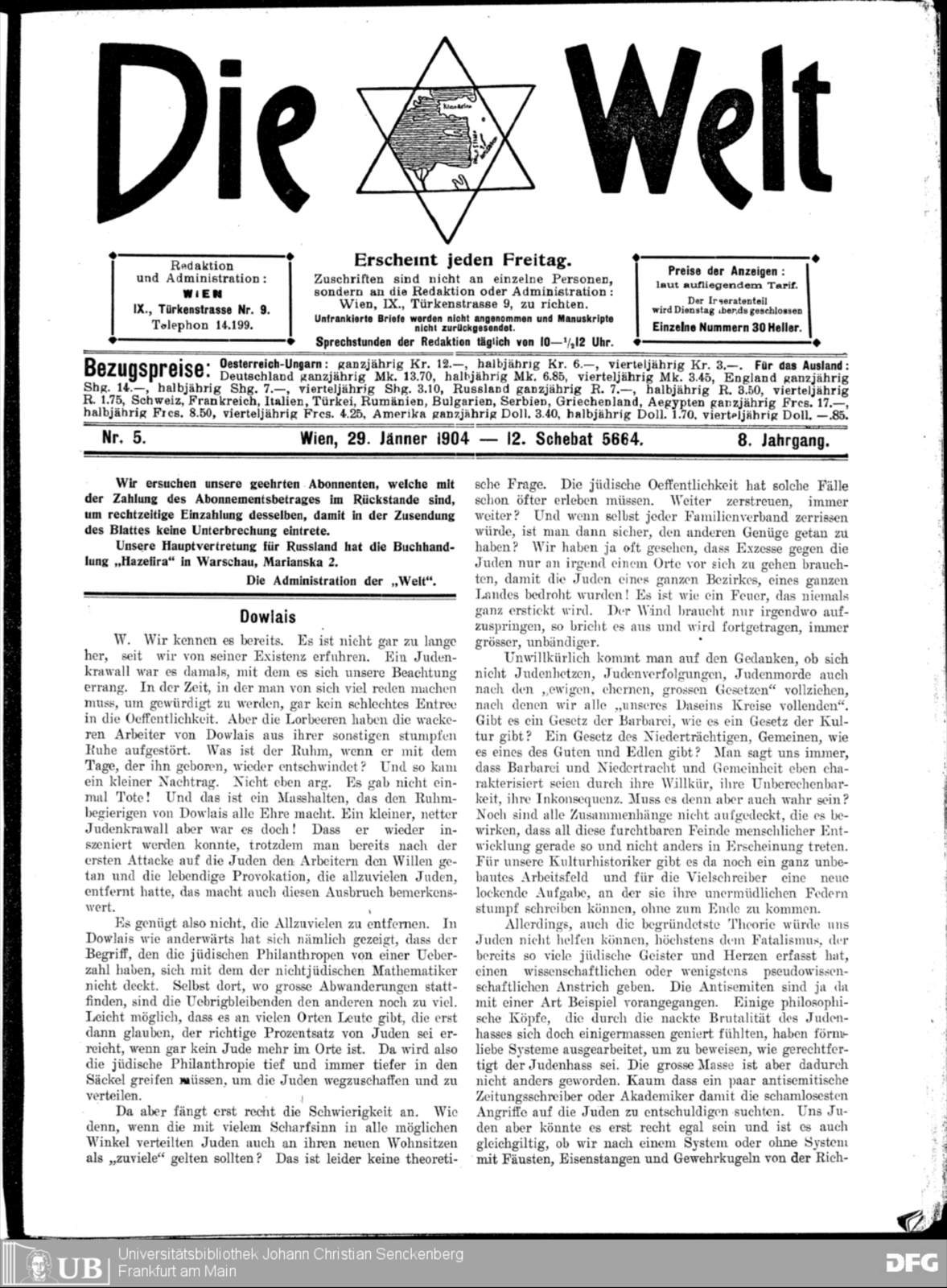
Die Welt
Editorial Office and Administration: VIENNA, IX., Türkenstrasse No. 9. Telephone 14.199.
Published every Friday. Correspondence is to be addressed not to individuals but to the Editorial Office or the Administration: Vienna, IX., Türkenstrasse 9. Unstamped letters are not accepted, and manuscripts are not returned. Editorial office hours daily from 10 to half past 11.
Advertisement rates: according to the tariff available on request. The advertisement section closes on Tuesday evening. Single numbers 30 Heller.
Subscription rates: Austria-Hungary: yearly Kr. 12.—, half-yearly Kr. 6.—, quarterly Kr. 3.—. Abroad: Germany yearly Mk. 13.70, half-yearly Mk. 6.85, quarterly Mk. 3.45; England yearly Shg. 14.—, half-yearly Shg. 7.—, quarterly Shg. 3.10; Russia yearly R. 7.—, half-yearly R. 3.50, quarterly R. 1.75; Switzerland, France, Italy, Turkey, Roumania, Bulgaria, Servia, Greece, Egypt yearly Frcs. 17.—, half-yearly Frcs. 8.50, quarterly Frcs. 4.25; America yearly Doll. 3.40, half-yearly Doll. 1.70, quarterly Doll. —.85.
No. 5. | Vienna, 29 January 1904 — 12 Shebat 5664. | 8th Year.
We request those of our esteemed subscribers who are in arrears with the payment of their subscription to remit it in good time, so that no interruption may occur in the delivery of the paper.
Our chief agency for Russia is the bookshop "Hazefira" in Warsaw, Marianska 2.
The Administration of "Die Welt."
Dowlais
W. We know it already. It is not so very long since we learned of its existence. It was a riot against the Jews by which it then won our notice. In an age when one must make oneself much talked of in order to be deemed worthy of regard, no bad entrance at all upon the public stage. But the laurels have roused the worthy workmen of Dowlais from their otherwise dull repose. What is fame, if it vanishes again with the day that gave it birth? And so there came a little sequel. Not so very bad. There were not even any dead! And that is a moderation which does all honour to the seekers after glory in Dowlais. But a nice little riot against the Jews it was, none the less! That it could be staged anew, although after the first attack upon the Jews the workmen had already been given their way and the living provocation, the all-too-many Jews, had been removed — that is what makes this outbreak, too, noteworthy.
It is not enough, then, to remove the all-too-many. For in Dowlais, as elsewhere, it has become evident that the notion which Jewish philanthropists hold of an excess in numbers does not coincide with that of the non-Jewish mathematicians. Even where great emigrations take place, those who remain are still too many for the others. It is quite possible that in many places there are people who will only believe the proper percentage of Jews to have been reached when there is no Jew left in the place at all. Jewish philanthropy will thus have to dip deep, and ever deeper, into its purse in order to remove the Jews and to distribute them.
But it is just there that the difficulty truly begins. What, then, if the Jews, distributed with much ingenuity into every possible corner, should be counted "too many" in their new homes as well? That, unhappily, is no theoretical question. The Jewish public has already had to witness such cases more than once. Scatter them further, ever further? And even if every family bond were torn asunder, can one then be sure of having satisfied the others? We have often enough seen that excesses against the Jews need only take place in some one locality for the Jews of a whole district, of a whole country, to be threatened! It is like a fire that is never quite extinguished. The wind need only spring up somewhere, and it breaks out and is carried onward, ever greater, ever more ungovernable.
Involuntarily the thought arises whether agitations against the Jews, persecutions of the Jews, murders of Jews, are not also accomplished according to those "eternal, iron, great laws" by which we all "complete the circles of our being." Is there a law of barbarism, as there is a law of culture? A law of the base and the vile, as there is one of the good and the noble? We are always told that barbarism and baseness and vileness are characterized precisely by their caprice, their incalculability, their inconsistency. But must that, then, be true? Not all the connections have yet been uncovered which cause all these fearful enemies of human development to appear precisely thus and not otherwise. For our historians of culture there is here a field of work still wholly untilled, and for the scribblers a new and tempting task, upon which they may write their untiring pens blunt without ever coming to an end.
To be sure, even the best-founded theory could not help us Jews; at most it would lend a scientific, or at least a pseudo-scientific, colouring to the fatalism that has already seized so many Jewish minds and hearts. The antisemites, indeed, have gone before with a kind of example in this. Some philosophical heads, who felt themselves after all somewhat embarrassed by the naked brutality of the hatred of the Jews, have worked out regular systems to prove how justified the hatred of the Jews is. The great mass, however, has not become any different thereby. Hardly more than a few antisemitic journalists or academics have sought to excuse by it the most shameless attacks upon the Jews. To us Jews, however, it could matter even less, and it is indeed a matter of indifference, whether we, according to a system or without a system, with fists, iron bars and rifle bullets, of the Rich-