The World
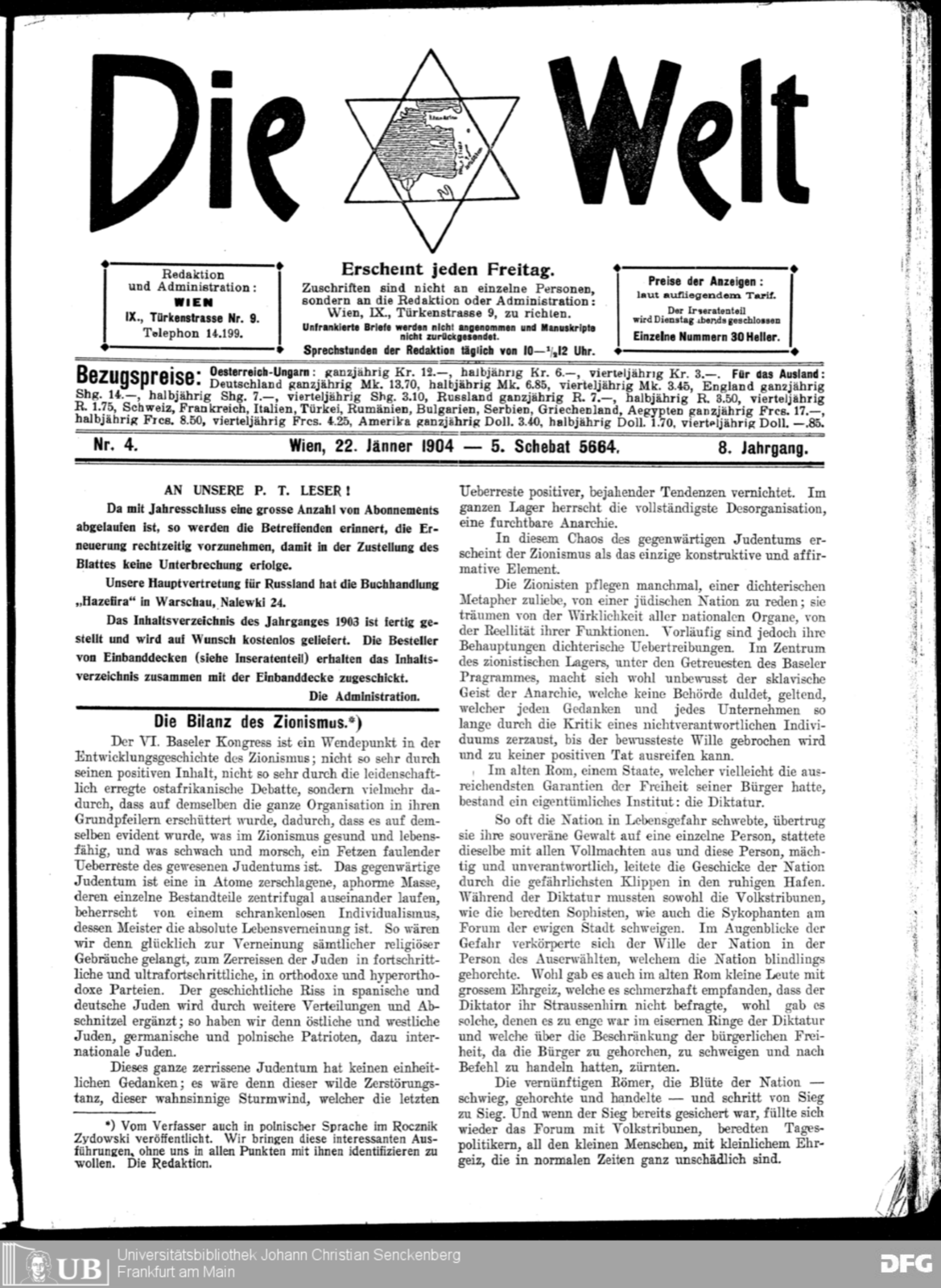
Die Welt
Editorial Office and Administration: VIENNA, IX., Türkenstrasse No. 9. Telephone 14.199.
Published every Friday. Correspondence is to be addressed not to individual persons but to the Editorial Office or the Administration: Vienna, IX., Türkenstrasse 9. Unstamped letters are not accepted, and manuscripts are not returned. Editorial consulting hours daily from 10 to half past 11 o'clock.
Advertising rates: according to the tariff on file. The advertisement section closes on Tuesday evenings. Single numbers 30 Heller.
Subscription rates: Austria-Hungary: yearly Kr. 12.—, half-yearly Kr. 6.—, quarterly Kr. 3.—. Abroad: Germany yearly Mk. 13.70, half-yearly Mk. 6.85, quarterly Mk. 3.45; England yearly Shg. 14.—, half-yearly Shg. 7.—, quarterly Shg. 3.10; Russia yearly R. 7.—, half-yearly R. 3.50, quarterly R. 1.75; Switzerland, France, Italy, Turkey, Roumania, Bulgaria, Servia, Greece, Egypt yearly Frcs. 17.—, half-yearly Frcs. 8.50, quarterly Frcs. 4.25; America yearly Doll. 3.40, half-yearly Doll. 1.70, quarterly Doll. —.85.
No. 4. — Vienna, 22nd January 1904 — 5th Shebat 5664. — 8th Year.
TO OUR ESTEEMED READERS!
As a large number of subscriptions expired with the close of the year, those concerned are reminded to renew them in good time, so that no interruption may occur in the delivery of the paper.
Our chief agency for Russia is the bookshop "Hazefira" in Warsaw, Nalewki 24.
The index to the 1903 volume has been completed and will be supplied free of charge on request. Those ordering binding covers (see the advertisement section) will receive the index together with the binding cover.
The Administration.
The Balance-Sheet of Zionism.*)
The Sixth Basle Congress is a turning-point in the history of the development of Zionism; not so much through its positive content, not so much through the passionately heated East African debate, but rather through the fact that at it the whole Organisation was shaken to its foundation pillars, through the fact that at it it became evident what in Zionism is sound and capable of life, and what is weak and rotten, a shred of the decaying remnants of a Judaism that has been. Present-day Jewry is an amorphous mass shattered into atoms, whose several parts fly centrifugally asunder, ruled by a boundless individualism whose master is absolute denial of life. And so we have happily arrived at the denial of all religious usages, at the rending of the Jews into progressive and ultra-progressive, into orthodox and hyper-orthodox parties. The historical cleft into Spanish and German Jews is supplemented by further divisions and parings; and so we have Eastern and Western Jews, Germanic and Polish patriots, and, besides, international Jews.
This whole rent and riven Jewry has no single unifying thought; unless it be this wild dance of destruction, this frenzied whirlwind which annihilates the last remnants of positive, affirmative tendencies. Throughout the whole camp there reigns the most complete disorganisation, a fearful anarchy.
In this chaos of present-day Jewry, Zionism appears as the sole constructive and affirmative element.
The Zionists are sometimes wont, for the sake of a poetic metaphor, to speak of a Jewish nation; they dream of the reality of all the national organs, of the reality of their functions. For the present, however, their assertions are poetic exaggerations. In the very centre of the Zionist camp, among the most faithful adherents of the Basle Programme, there makes itself felt, no doubt unconsciously, the slavish spirit of anarchy, which tolerates no authority, and which tears every thought and every undertaking to pieces through the criticism of some irresponsible individual, until the most resolute will is broken and can ripen into no positive deed.
In ancient Rome, a State which perhaps possessed the most ample guarantees of the liberty of its citizens, there existed a peculiar institution: the dictatorship.
Whenever the nation hovered in mortal danger, it transferred its sovereign power to a single person, endowed him with every authority, and this person, mighty and answerable to none, guided the destinies of the nation past the most perilous reefs into the quiet haven. During the dictatorship the tribunes of the people, the eloquent sophists, and the sycophants in the Forum of the Eternal City alike had to keep silent. In the hour of danger the will of the nation was embodied in the person of the chosen one, whom the nation blindly obeyed. There were, no doubt, in ancient Rome too, small men of great ambition who felt it painfully that the Dictator did not consult their ostrich-brains; there were, no doubt, those who found the iron ring of the dictatorship too narrow, and who were wroth at the restriction of civic liberty, since the citizens had to obey, to keep silent, and to act upon command.
The sensible Romans, the flower of the nation — kept silent, obeyed and acted — and passed from victory to victory. And when victory was already secured, the Forum filled once more with tribunes of the people, eloquent politicians of the day, all the little men of petty ambition who in normal times are quite harmless.
*) Published by the author in the Polish language also, in the Rocznik Zydowski. We print these interesting observations without wishing to identify ourselves with them on every point. The Editors.