The World
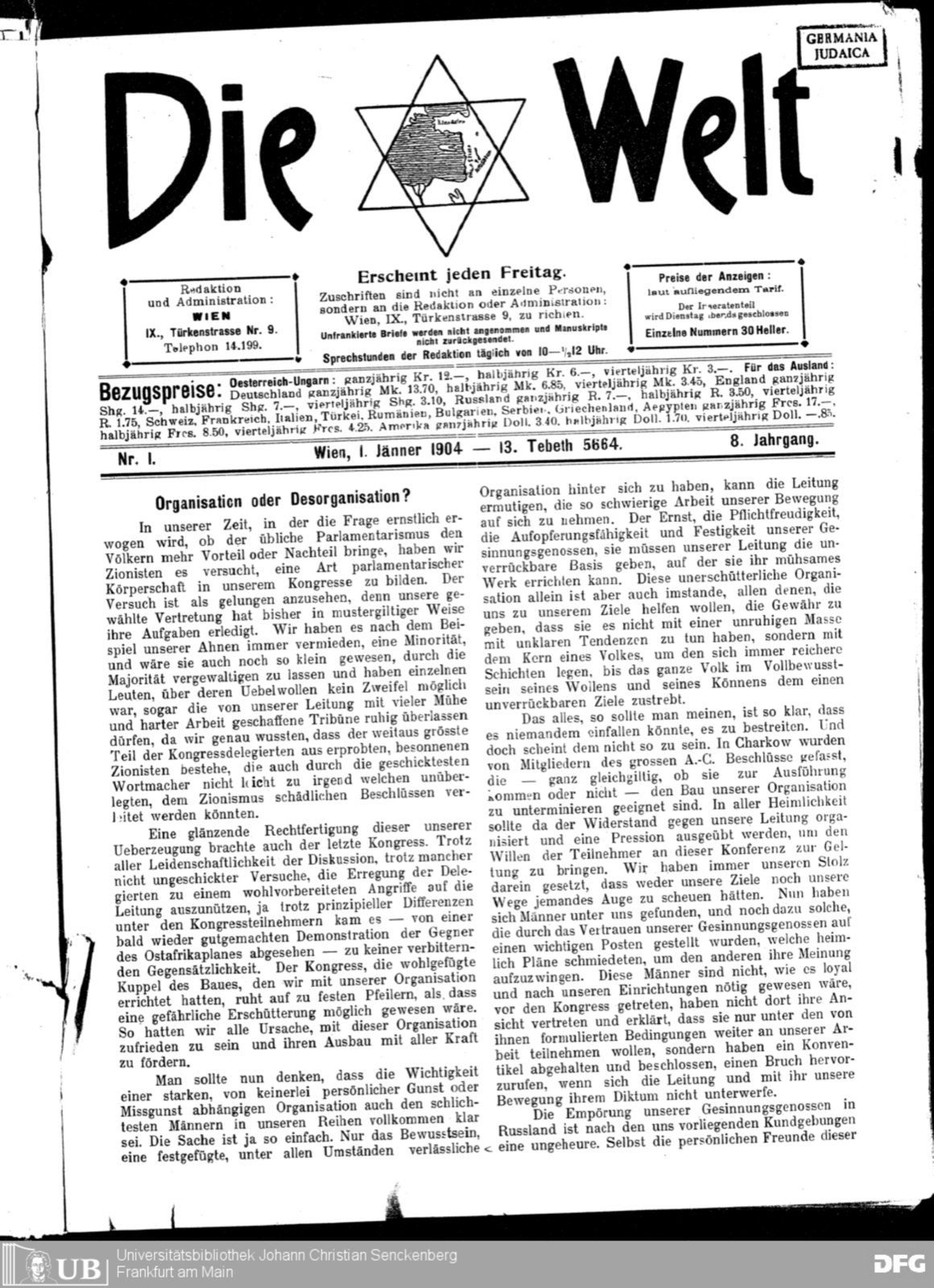
Die Welt
Published every Friday.
Editorial Office and Administration: VIENNA, IX., Türkenstrasse No. 9. Telephone 14.199.
Correspondence is to be addressed not to individual persons but to the Editorial Office or the Administration: Vienna, IX., Türkenstrasse 9. Unstamped letters are not accepted, and manuscripts are not returned. The editors receive daily from 10 to half-past 11 o'clock.
Advertising rates: according to the published tariff. The advertisement section closes on Tuesday evenings. Single numbers 30 Heller.
Subscription rates: Austria-Hungary: yearly Kr. 12.—, half-yearly Kr. 6.—, quarterly Kr. 3.—. Abroad: Germany yearly Mk. 13.70, half-yearly Mk. 6.85, quarterly Mk. 3.45; England yearly Shg. 14.—, half-yearly Shg. 7.—, quarterly Shg. 3.10; Russia yearly R. 7.—, half-yearly R. 3.50, quarterly R. 1.75; Switzerland, France, Italy, Turkey, Roumania, Bulgaria, Servia, Greece, Egypt yearly Frcs. 17.—, half-yearly Frcs. 8.50, quarterly Frcs. 4.25. America yearly Doll. 3.40, half-yearly Doll. 1.70, quarterly Doll. —.85.
No. 1. — Vienna, 1 January 1904 — 13 Tebeth 5664. — 8th Year.
Organisation or Disorganisation?
In our time, when the question is being seriously weighed whether the customary parliamentary system brings the nations more advantage or more harm, we Zionists have attempted to form a kind of parliamentary body in our Congress. The attempt must be regarded as successful, for our elected representation has hitherto discharged its tasks in exemplary fashion. Following the example of our forefathers, we have always avoided allowing a minority, however small it might have been, to be overborne by the majority, and we have even been able calmly to leave to individual persons, of whose ill-will there could be no doubt, the platform created by our leadership with much toil and hard labour; for we knew full well that by far the greater part of the Congress delegates consisted of tried and level-headed Zionists, who could not easily be led, even by the most skilful phrase-makers, into any ill-considered resolutions injurious to Zionism.
The last Congress, too, brought a brilliant vindication of this conviction of ours. In spite of all the passion of the debate, in spite of several not unskilful attempts to exploit the excitement of the delegates for a well-prepared attack upon the leadership, indeed in spite of differences of principle among the members of the Congress, there arose — apart from a demonstration by the opponents of the East Africa plan, which was soon made good again — no embittering antagonism. The Congress, the well-joined dome of the edifice which we had raised with our organisation, rests upon pillars too firm for any dangerous shock to have been possible. We thus had every reason to be content with this organisation and to further its development with all our strength.
One would now suppose that the importance of a strong organisation, dependent upon no personal favour or disfavour, would be perfectly clear even to the simplest men in our ranks. The matter is indeed so simple. Only the consciousness of having behind it a firmly knit organisation, reliable under all circumstances, can encourage the leadership to take upon itself the so difficult work of our movement. The earnestness, the devotion to duty, the capacity for sacrifice and the steadfastness of our fellow Zionists — these must give our leadership the immovable foundation upon which it can raise its laborious work. But this unshakable organisation is also alone able to give to all those who wish to help us towards our goal the assurance that they have to do, not with a restless mass of unclear tendencies, but with the kernel of a people, around which ever richer layers gather, until the whole people, in full consciousness of its will and of its power, strives towards the one immovable goal.
All this, one would think, is so clear that it could occur to no one to dispute it. And yet it seems not to be so. At Charkow resolutions were adopted by members of the Greater A.-C. which — quite regardless of whether they are carried out or not — are calculated to undermine the structure of our organisation. There, in all secrecy, resistance to our leadership was to be organised and pressure exerted in order to give effect to the will of the participants in this conference. We have always taken pride in the fact that neither our aims nor our ways need shun anyone's eye. Now men have been found among us — and men, moreover, who had been placed in an important post by the confidence of our fellow Zionists — who secretly forged plans to force their opinion upon the others. These men did not, as would have been loyal and as our institutions required, come before the Congress, did not there represent their view and declare that they would continue to take part in our work only upon the conditions formulated by themselves; instead they held a conventicle and resolved to bring about a breach should the leadership, and with it our movement, not submit to their dictum.
The indignation of our fellow Zionists in Russia is, according to the declarations before us, immense. Even the personal friends of these