The World
Die Welt
Editorial Office and Administration: Vienna, IX., Türkenstrasse 9. Telephone 14199.
Published every Friday. Communications are to be addressed not to individual persons but to the Editorial Office or the Administration: Vienna, IX., Türkenstrasse No. 9. Unstamped letters will not be accepted, and manuscripts will not be returned. The editors' consulting hours are daily from ½12 to ½1 o'clock.
Advertising rates according to the tariff on file. The advertising section closes on Tuesday evening. Single numbers 30 Heller.
Subscription rates: Austria-Hungary: yearly Kr. 12.—, half-yearly Kr. 6.—, quarterly Kr. 3.—. Abroad: Germany yearly Mk. 13.70, half-yearly Mk. 6.85, quarterly Mk. 3.45; England yearly Shg. 14.—, half-yearly Shg. 7.—, quarterly Shg. 3.10; Russia yearly R. 7.—, half-yearly R. 3.50, quarterly R. 1.75; Switzerland, France, Italy, Turkey, Roumania, Bulgaria, Servia, Greece, Egypt yearly Fres. 17.—, half-yearly Fres. 8.50, quarterly 4.25; America yearly Doll. 3.40, half-yearly Doll. 1.70, quarterly Doll. —.85.
Basle, 25 August 1903 — 2 Elul 5663.
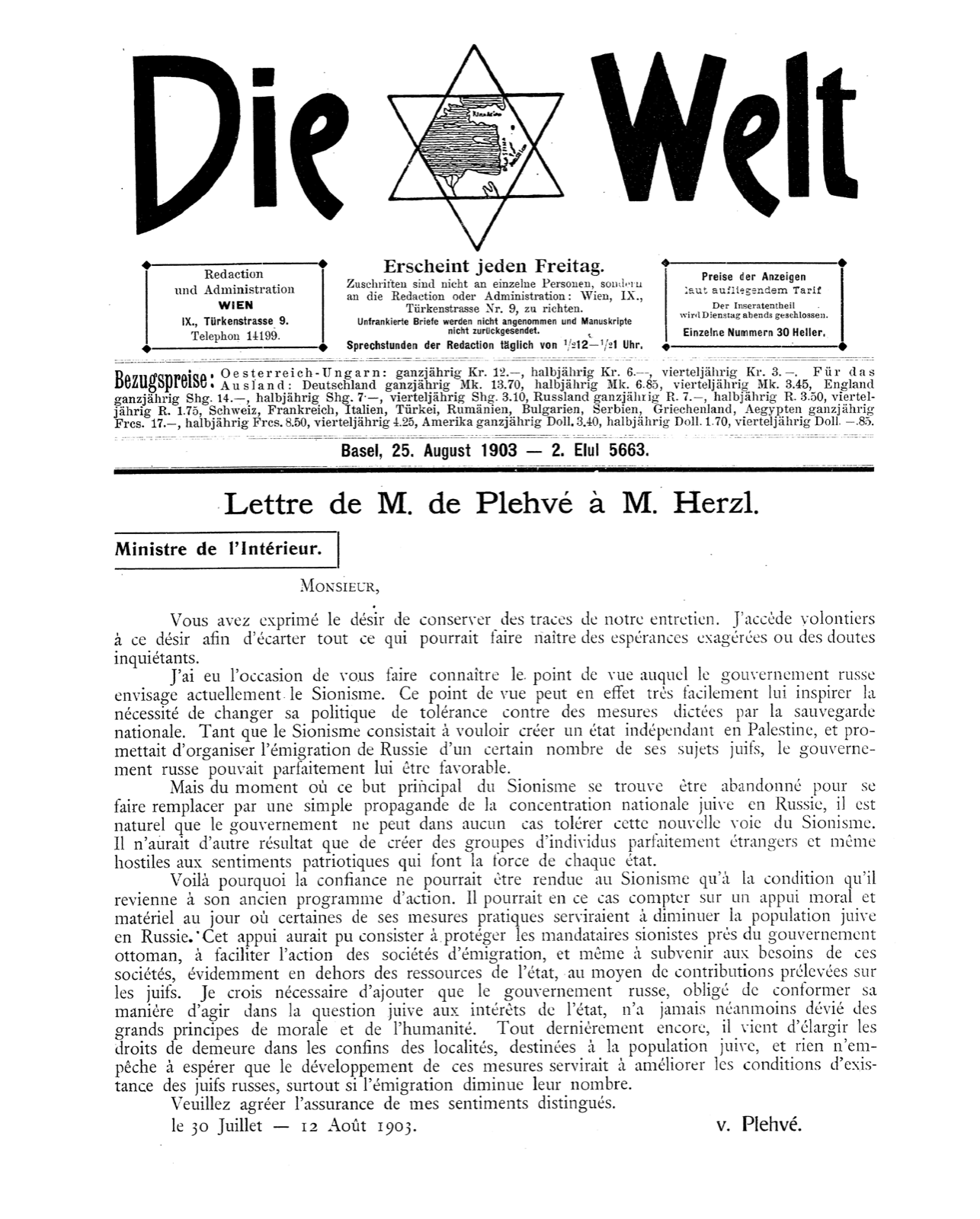
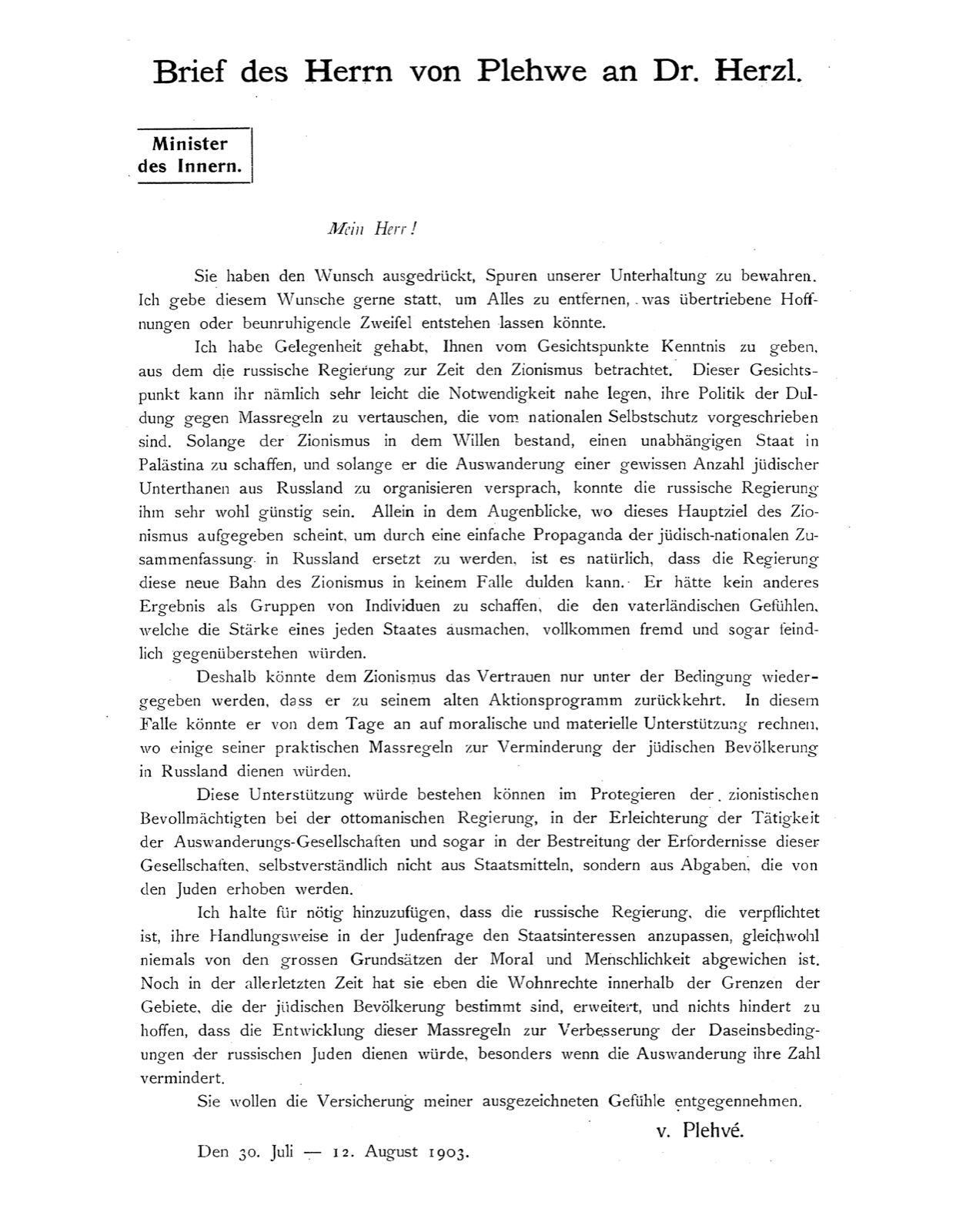
Letter from M. de Plehve to M. Herzl.
Minister of the Interior.
Sir,
You have expressed the wish to preserve some record of our conversation. I willingly accede to this wish, in order to remove everything that might give rise to exaggerated hopes or disquieting doubts.
I have had occasion to acquaint you with the point of view from which the Russian Government at present regards Zionism. This point of view may indeed very easily impress upon it the necessity of exchanging its policy of toleration for measures dictated by national self-preservation. So long as Zionism consisted in the wish to create an independent state in Palestine, and promised to organise the emigration from Russia of a certain number of her Jewish subjects, the Russian Government could perfectly well be favourable to it.
But from the moment when this principal aim of Zionism is found to be abandoned, to be replaced by a mere propaganda for Jewish national concentration in Russia, it is natural that the Government can in no case tolerate this new course of Zionism. It could have no other result than to create groups of individuals entirely alien, and even hostile, to the patriotic sentiments which constitute the strength of every state.
That is why confidence could be restored to Zionism only on condition that it return to its former programme of action. In that case it could count upon moral and material support from the day when certain of its practical measures should serve to diminish the Jewish population in Russia. This support might have consisted in protecting the Zionist representatives before the Ottoman Government, in facilitating the work of the emigration societies, and even in meeting the needs of those societies — not, of course, out of the resources of the State, but by means of contributions levied upon the Jews. I think it necessary to add that the Russian Government, obliged as it is to conform its conduct in the Jewish question to the interests of the State, has nevertheless never departed from the great principles of morality and humanity. Only very lately it has extended the rights of residence within the confines of the localities set apart for the Jewish population, and nothing prevents the hope that the development of these measures would serve to improve the conditions of existence of the Russian Jews, especially if emigration diminishes their number.
Accept, Sir, the assurance of my distinguished sentiments.
30 July — 12 August 1903.
v. Plehve.