The World
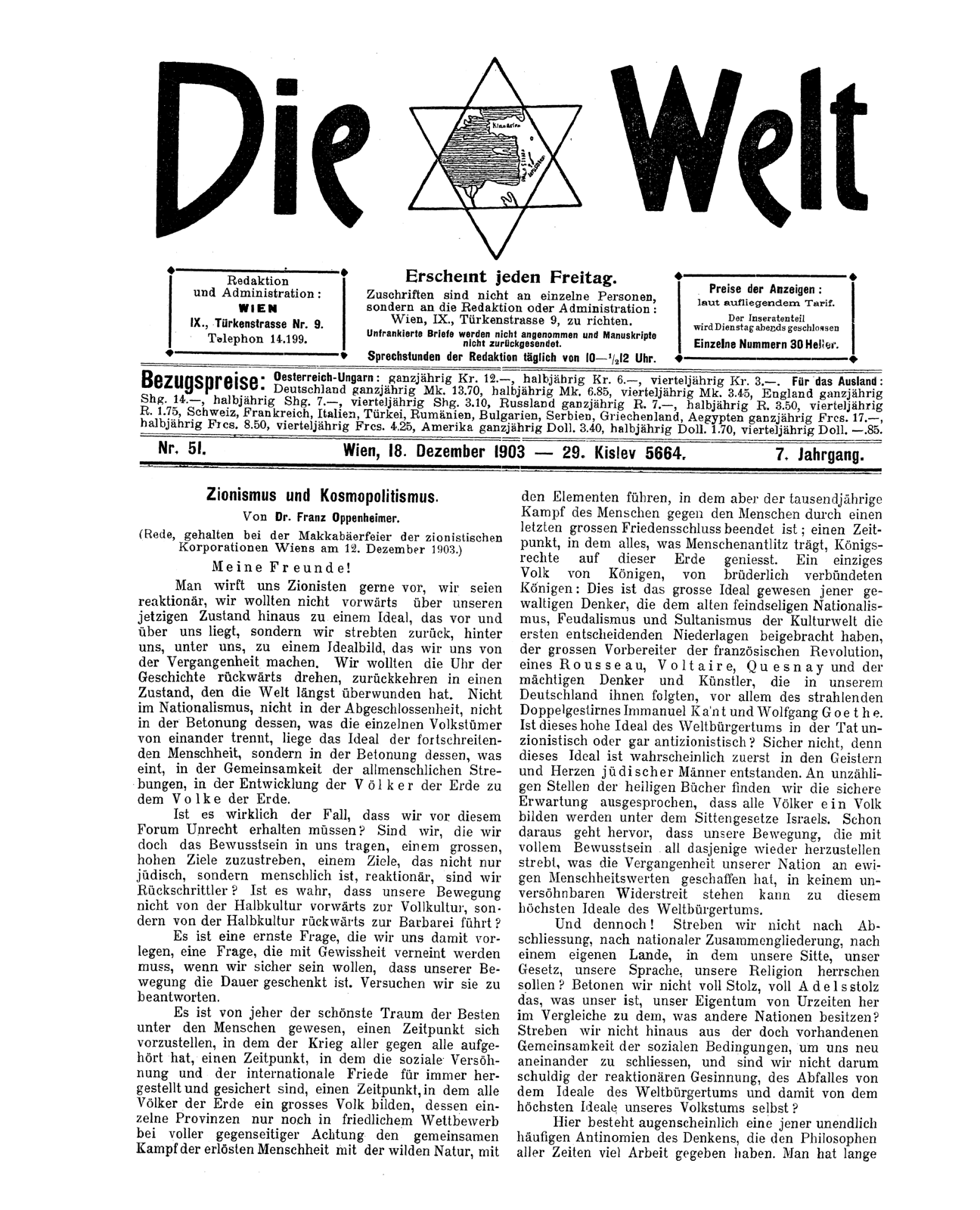
Die Welt
Editorial and Business Offices: Vienna, IX., Türkenstrasse No. 9. Telephone 14.199. Appears every Friday. Correspondence is to be addressed not to individuals but to the Editorial Office or the Administration: Vienna, IX., Türkenstrasse 9. Unstamped letters are not accepted and manuscripts are not returned. Editorial office hours daily from 10—1/212 o'clock. Advertising rates: according to the published tariff. The advertisement section closes on Tuesday evening. Single numbers 30 Heller.
Subscription rates: Austria-Hungary: yearly Kr. 12.—, half-yearly Kr. 6.—, quarterly Kr. 3.—. Abroad: Germany yearly Mk. 13.70, half-yearly Mk. 6.85, quarterly Mk. 3.45; England yearly Shg. 14.—, half-yearly Shg. 7.—, quarterly Shg. 3.10; Russia yearly R. 7.—, half-yearly R. 3.50, quarterly R. 1.75; Switzerland, France, Italy, Turkey, Roumania, Bulgaria, Servia, Greece, Egypt yearly Frcs. 17.—, half-yearly Frcs. 8.50, quarterly Frcs. 4.25; America yearly Doll. 3.40, half-yearly Doll. 1.70, quarterly Doll. —.85.
No. 51. | Vienna, 18 December 1903 — 29 Kislev 5664. | 7th Year.
Zionism and Cosmopolitanism.
By Dr. Franz Oppenheimer.
(Address delivered at the Maccabean Festival of the Zionist student corporations of Vienna on 12 December 1903.)
My friends!
It is a favourite reproach against us Zionists that we are reactionary: we do not wish, it is said, to go forward beyond our present condition towards an ideal that lies before and above us, but strive backward, behind us, beneath us, towards an ideal image that we have made for ourselves of the past. We would turn back the clock of history, return to a condition which the world has long since outgrown. Not in nationalism, not in seclusion, not in insisting upon what separates the several peoples from one another, lies the ideal of progressing mankind, but in insisting upon what unites, in the common striving of all humanity, in the development of the peoples of the earth into the one people of the earth.
Is it really the case that before this tribunal we must be found in the wrong? Are we, who yet carry within us the consciousness of striving towards a great and lofty goal, a goal that is not merely Jewish but human — are we reactionary, are we retrogressives? Is it true that our movement leads, not forward from half-culture to full culture, but backward from half-culture to barbarism?
It is a grave question that we thereby put to ourselves, a question that must be answered with certainty in the negative if we are to be sure that our movement is granted endurance. Let us try to answer it.
It has ever been the fairest dream of the best among men to picture to themselves a time in which the war of all against all has ceased, a time in which social reconciliation and international peace are established and secured for ever, a time in which all the peoples of the earth form one great people, whose several provinces, in peaceful emulation and full mutual respect, carry on only the common struggle of redeemed mankind against savage nature, against the elements, but in which the thousand-year struggle of man against man has been ended by a last great conclusion of peace; a time in which all that bears a human countenance enjoys the rights of kings upon this earth. One single people of kings, of kings allied as brothers: this was the great ideal of those mighty thinkers who dealt the first decisive defeats to the old hostile nationalism, feudalism and sultanism of the civilised world, the great forerunners of the French Revolution, a Rousseau, a Voltaire, a Quesnay, and of the mighty thinkers and artists who followed them in our Germany, above all the radiant twin stars Immanuel Kant and Wolfgang Goethe. Is this lofty ideal of world citizenship in fact un-Zionist, or even anti-Zionist? Surely not, for this ideal very probably arose first in the minds and hearts of Jewish men. In countless places of the Holy Scriptures we find expressed the confident expectation that all peoples shall form one people under the moral law of Israel. From this alone it follows that our movement, which strives in full consciousness to restore all that the past of our nation created in the way of eternal human values, can stand in no irreconcilable conflict with this highest ideal of world citizenship.
And yet! Do we not strive for seclusion, for national consolidation, for a land of our own in which our custom, our law, our language, our religion shall prevail? Do we not insist, full of pride, full of the pride of nobility, upon what is ours, our possession from the earliest times, in comparison with what other nations possess? Do we not strive to go out from the community of social conditions that does after all exist, in order to join ourselves anew to one another, and are we not therefore guilty of a reactionary disposition, of apostasy from the ideal of world citizenship and thereby from the highest ideal of our own nationhood?
Here there evidently exists one of those infinitely frequent antinomies of thought which have given the philosophers of every age much labour. It was long