The World
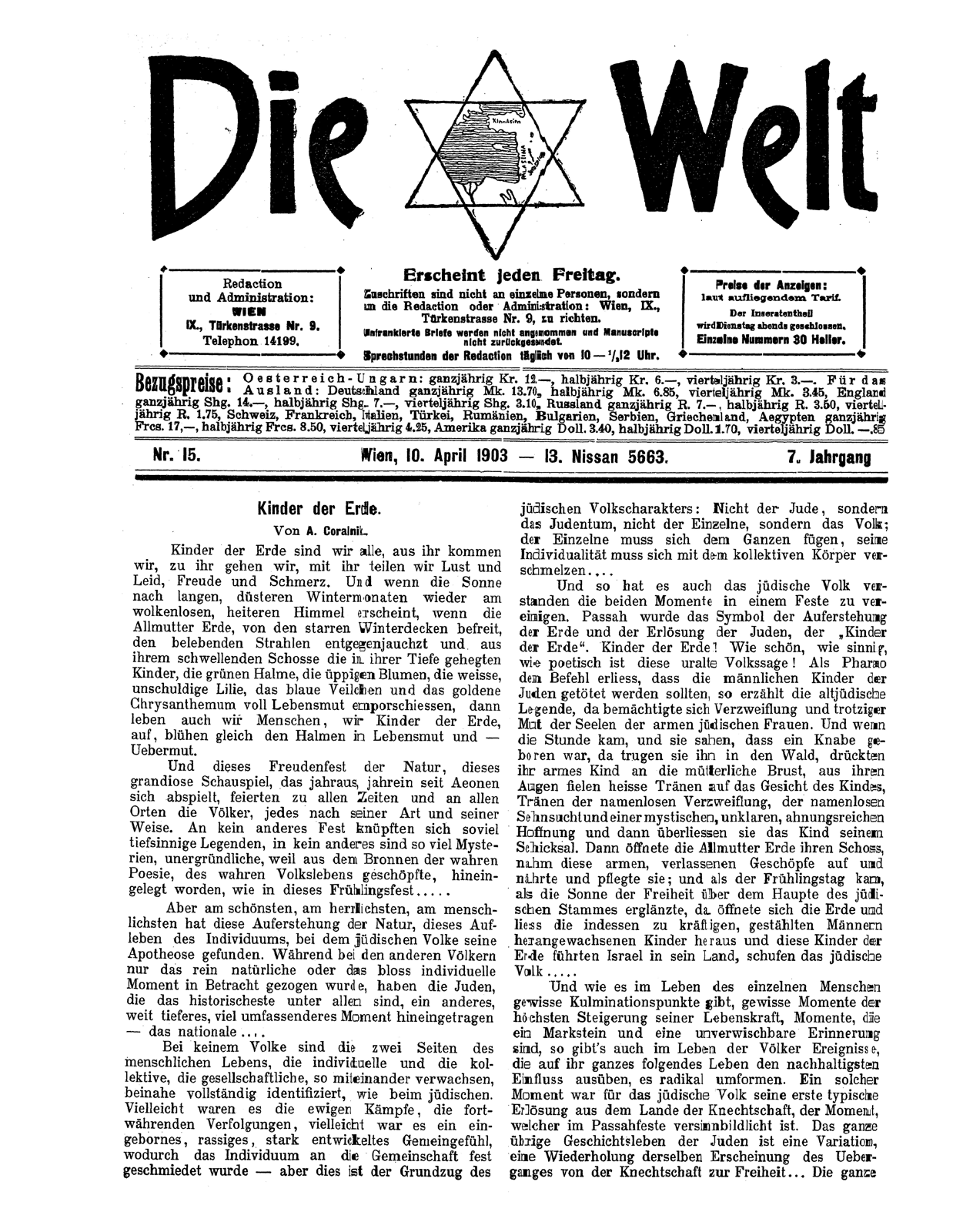
Die Welt
Editorial Office and Administration: VIENNA IX., Türkenstrasse No. 9. Telephone 14199.
Appears every Friday. Communications are to be addressed not to individual persons but to the Editorial Office or the Administration: Vienna, IX., Türkenstrasse No. 9. Unstamped letters are not accepted and manuscripts are not returned. Editorial office hours daily from 10 to half-past 11 o'clock.
Advertisement rates: according to the published tariff. The advertisement section closes on Tuesday evening. Single numbers 30 Heller.
Subscription rates: Austria-Hungary: yearly Kr. 12.—, half-yearly Kr. 6.—, quarterly Kr. 3.—. Abroad: Germany yearly Mk. 13.70, half-yearly Mk. 6.85, quarterly Mk. 3.45; England yearly Shg. 14.—, half-yearly Shg. 7.—, quarterly Shg. 3.10; Russia yearly R. 7.—, half-yearly R. 3.50, quarterly R. 1.75; Switzerland, France, Italy, Turkey, Roumania, Bulgaria, Servia, Greece, Egypt yearly Frcs. 17.—, half-yearly Frcs. 8.50, quarterly 4.25; America yearly Doll. 3.40, half-yearly Doll. 1.70, quarterly Doll. —.85
No. 15. | Vienna, 10 April 1903 — 13 Nissan 5663. | 7th Year
Children of the Earth.
By A. Coralnik.
Children of the earth are we all; from her we come, to her we go, with her we share pleasure and sorrow, joy and pain. And when the sun, after long and gloomy months of winter, appears once more in the cloudless, serene sky, when the All-Mother Earth, freed from her rigid coverings of winter, greets the quickening rays with jubilation, and from her swelling womb the children she has cherished in her depths — the green blades, the luxuriant flowers, the white and innocent lily, the blue violet and the golden chrysanthemum — shoot upward full of the courage of life, then we men too, we children of the earth, revive, and blossom like the blades of grass in courage of life and — in wantonness.
And this festival of nature's joy, this grandiose spectacle which has been enacted year in, year out, for aeons, the peoples of all times and all places have celebrated, each after its own kind and its own fashion. To no other festival have so many profound legends attached themselves; into no other have so many mysteries been laid — unfathomable, because drawn from the well-spring of true poetry, of the true life of the people — as into this festival of spring.....
But most beautifully, most gloriously, most humanly has this resurrection of nature, this reawakening of the individual, found its apotheosis among the Jewish people. While among the other peoples only the purely natural or the merely individual element was taken into account, the Jews, who are the most historical of them all, have brought into it another, far deeper, far more comprehensive element — the national....
With no people are the two sides of human life, the individual and the collective, the social, so grown together, so almost wholly identified, as with the Jewish. Perhaps it was the eternal struggles, the unceasing persecutions; perhaps it was an inborn, racial, strongly developed sense of community, by which the individual was forged fast to the community — but this is the fundamental trait of the Jewish national character: not the Jew, but Judaism; not the individual, but the people; the individual must submit himself to the whole, his individuality must fuse with the collective body....
And so the Jewish people, too, understood how to unite these two elements in one festival. Passover became the symbol of the resurrection of the earth and of the redemption of the Jews, the "children of the earth." Children of the earth! How beautiful, how full of meaning, how poetic is this ancient folk-legend! When Pharaoh issued the command that the male children of the Jews should be put to death — so the old Jewish legend relates — despair and defiant courage seized upon the souls of the poor Jewish women. And when the hour came and they saw that a boy was born, they carried him into the forest, pressed their poor child to the maternal breast; from their eyes hot tears fell upon the face of the child, tears of nameless despair, of nameless longing, and of a mystical, obscure, presentient hope; and then they left the child to its fate. Then the All-Mother Earth opened her womb, took up these poor forsaken creatures, and nourished and tended them; and when the day of spring came, when the sun of freedom shone out over the head of the Jewish race, the earth opened and let forth the children, who had meanwhile grown into strong and hardened men; and these children of the earth led Israel into its land and created the Jewish people.....
And as in the life of the individual man there are certain points of culmination, certain moments of the highest intensification of his vital force, moments which are a landmark and an indelible memory, so there are in the life of peoples also events which exercise the most lasting influence upon the whole of their subsequent life and transform it radically. Such a moment for the Jewish people was its first typical redemption out of the land of bondage — the moment which is symbolised in the Passover festival. The whole remaining historical life of the Jews is a variation, a repetition of the same phenomenon of the passage from bondage to freedom... The whole