The World
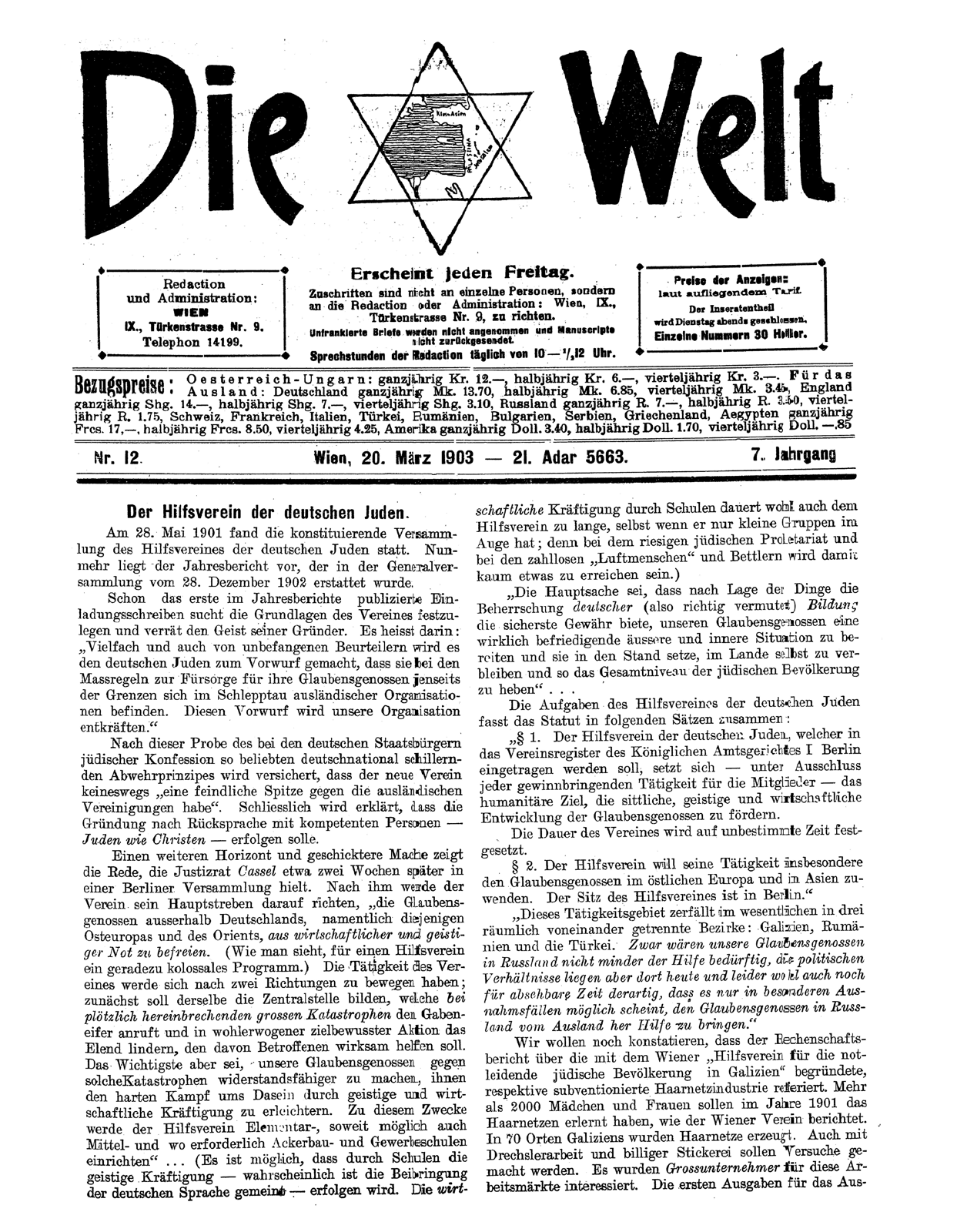
Die Welt
Editorial and business offices: VIENNA IX., Türkenstrasse No. 9. Telephone 14199.
Appears every Friday. Correspondence is to be addressed not to individual persons but to the Editorial or Business Office: Vienna, IX., Türkenstrasse No. 9. Unstamped letters are not accepted, and manuscripts are not returned. Editorial office hours daily from $10-1/212$ o'clock.
Advertising rates: according to the tariff on file. The advertisement section closes on Tuesday evening. Single numbers 30 Heller.
Subscription rates: Austria-Hungary: yearly Kr. 12.—, half-yearly Kr. 6.—, quarterly Kr. 3.—. Abroad: Germany yearly Mk. 13.70, half-yearly Mk. 6.85, quarterly Mk. 3.45; England yearly Shg. 14.—, half-yearly Shg. 7.—, quarterly Shg. 3.10; Russia yearly R. 7.—, half-yearly R. 3.50, quarterly R. 1.75; Switzerland, France, Italy, Turkey, Roumania, Bulgaria, Servia, Greece, Egypt yearly Frcs. 17.—, half-yearly Frcs. 8.50, quarterly 4.25; America yearly Doll. 3.40, half-yearly Doll. 1.70, quarterly Doll. —.85
No. 12. | Vienna, 20 March 1903 — 21 Adar 5663. | 7th Year
The Hilfsverein der deutschen Juden.
On 28 May 1901 the constituent meeting of the Hilfsverein der deutschen Juden (Relief Association of German Jews) took place. Its annual report, presented at the general meeting of 28 December 1902, now lies before us.
The very first letter of invitation published in the annual report seeks to lay down the foundations of the association, and betrays the spirit of its founders. It says: "It is frequently made a reproach against the German Jews, and by impartial judges as well, that in their measures for the care of their co-religionists beyond the frontiers they are in the wake of foreign organisations. Our organisation will refute this reproach."
After this specimen of the defensive principle, with its German-national shimmer, so beloved of German citizens of the Jewish confession, we are assured that the new association by no means "has a hostile point against the foreign bodies." Finally it is declared that the foundation is to take place after consultation with competent persons — Jews as well as Christians.
A wider horizon and more skilful workmanship are shown in the speech which Justizrat Cassel delivered some two weeks later at a meeting in Berlin. According to him, the association would direct its chief endeavour towards "freeing the co-religionists outside Germany, especially those of Eastern Europe and of the Orient, from economic and intellectual distress. (As one sees, a positively colossal programme for a relief association.) The activity of the association would have to move in two directions: first, it is to form the central office which, when great catastrophes suddenly break forth, calls upon the zeal of the charitable, and by well-considered, purposeful action is to alleviate the misery and give effective help to those affected. The most important thing, however, is to make our co-religionists more able to withstand such catastrophes, and to lighten for them the hard struggle for existence by intellectual and economic strengthening. To this end the Hilfsverein will establish elementary schools, so far as possible secondary schools also, and where necessary agricultural and trade schools" ... (It is possible that intellectual strengthening — presumably the teaching of the German language is meant — will be achieved through schools. Economic strengthening through schools probably takes too long even for the Hilfsverein, even if it has only small groups in view; for with the enormous Jewish proletariat and the countless "Luftmenschen" and beggars, hardly anything will be achieved by it.)
"The main thing is that, as matters stand, the mastery of German (so we guessed rightly) culture offers the surest guarantee of preparing for our co-religionists a truly satisfactory outward and inward situation, and of enabling them to remain in the country itself and so to raise the general level of the Jewish population" ...
The statutes sum up the tasks of the Hilfsverein der deutschen Juden in the following sentences:
"§ 1. The Hilfsverein der deutschen Juden, which is to be entered in the register of associations of the Royal District Court I, Berlin, sets itself — to the exclusion of any profit-making activity for its members — the humanitarian aim of furthering the moral, intellectual and economic development of its co-religionists.
The duration of the association is fixed for an indefinite period.
§ 2. The Hilfsverein intends to devote its activity in particular to the co-religionists in Eastern Europe and in Asia. The seat of the Hilfsverein is in Berlin."
"This field of activity falls essentially into three districts separated from one another in space: Galicia, Roumania and Turkey. Our co-religionists in Russia, it is true, would be no less in need of help; but the political conditions there are today, and unfortunately will probably remain for the foreseeable future, such that it seems possible only in special exceptional cases to bring help from abroad to the co-religionists in Russia."
We would further note that the statement of accounts reports on the hair-net industry founded, or rather subsidised, together with the Viennese "Hilfsverein für die notleidende jüdische Bevölkerung in Galizien" (Relief Association for the Distressed Jewish Population in Galicia). More than 2000 girls and women are said to have learned hair-netting in the year 1901, as the Viennese association reports. Hair-nets were produced in 70 localities in Galicia. Experiments are also to be made with turnery and cheap embroidery. Large employers have been interested in these labour markets. The first expenses for the Aus-